


After spending more than six decades adding color to temples all over Taiwan, artisan Tsai Lung-chin (蔡龍進) has set his brush on restoring worn door gods and other bastions of traditional architecture back to their original splendor.
At 75 years old, Tsai is no newcomer to traditional temple painting.
He began 62 years ago growing up as a child of farmers in Yunlin County’s Shueilin Township (水林).
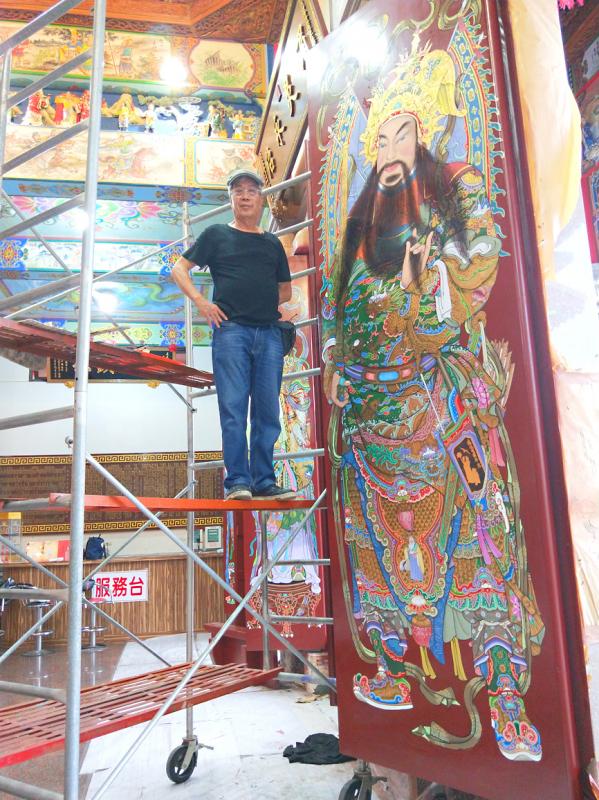
Photo courtesy of Tsai Lung-chin
Tsai recalled that when he was not toiling in the sweltering fields, he loved visiting temples to watch glass painters at work. Drawing from their inspiration, he bought some paper to try his hand at sketching the Buddha in his household shrine.
His father, noticing his enthusiasm, encouraged him to pursue the skill, Tsai said, adding that when he was 13, he became an apprentice to a renowned traditional painter, Pan Li-shui (潘麗水).
Since his family owned a significant amount of farmland at the time, Tsai said Pan believed he came from a wealthy family.
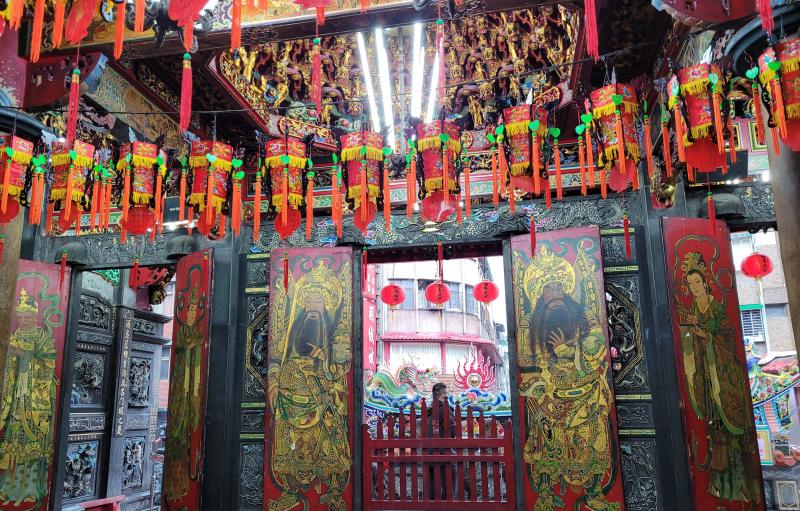
Photo: Lai Hsiao-tung, Taipei Times
Fearing that he would not take the role seriously, Pan charged his family NT$2,000 per month in tuition fees, Tsai said.
Tsai said he started with painting bonsai and life sketches, spending his days accompanying Pan to temples, and his evenings grinding ink and observing Pan as he worked.
After witnessing his dedication, staying up late into the night to practice, any reservations Pan had about teaching the young apprentice evaporated and he no longer asked for any tuition fees, Tsai said.
Three years into his apprenticeship, Pan was confident that Tsai had mastered the work and graduated him from his tutelage.
In Tsai’s view, since every temple is dedicated to a different deity, it is the job of the artisan to portray the separate gods to each temple’s specifications.
This involves a significant amount of research into their history, which informs the artist’s creative vision and ultimate portrayal of their subject, he said.
“Viewing a painting is like listening to a story,” Tsai said. “The artisan is responsible for telling an interesting tale.”
Over time Tsai made a name for himself through word of mouth, his artwork gracing houses of worship across Taiwan — especially in northern Taiwan, where nearly 70 percent of all temples have seen his brush — and abroad.
His work can be found in some of the nation’s most famous temples, including Xia Hai City God Temple (霞海城隍廟), Longshan Temple (龍山寺) and Zhinan Temple (指南宮) in Taipei; Lecheng Temple (樂成宮) in Taichung; Nankunshen Daitianfu (南鯤鯓代天府) in Tainan; and a temple in Saitama, Japan.
Yet none is more special to Tsai than Cihui Temple (慈惠宮) in New Taipei City’s Banciao District (板橋), which he helped rebuild from scratch, from the door gods to murals and even sculptures.
Although afraid that his craft is slowly dying off along with experienced artisans, Tsai is happy that his son is prepared to carry on the tradition, along with other apprentices under his instruction.
Over the past few years, Tsai has gotten more invitations to renovate historic buildings by staying as true as possible to the original artists’ methods and artistic vision.
He has also been designated a preserver of traditional painting by the New Taipei City Government, which in 2020 also granted him its annual Cultural Award.

Considering that most countries issue more than five denominations of banknotes, the central bank has decided to redesign all five denominations, the bank said as it prepares for the first major overhaul of the banknotes in more than 24 years. Central bank Governor Yang Chin-lung (楊金龍) is expected to report to the Legislative Yuan today on the bank’s operations and the redesign’s progress. The bank in a report sent to the legislature ahead of today’s meeting said it had commissioned a survey on the public’s preferences. Survey results showed that NT$100 and NT$1,000 banknotes are the most commonly used, while NT$200 and NT$2,000

The Centers for Disease Control (CDC) yesterday reported the first case of a new COVID-19 subvariant — BA.3.2 — in a 10-year-old Singaporean girl who had a fever upon arrival in Taiwan and tested positive for the disease. The girl left Taiwan on March 20 and the case did not have a direct impact on the local community, it said. The WHO added the BA.3.2 strain to its list of Variants Under Monitoring in December last year, but this was the first imported case of the COVID-19 variant in Taiwan, CDC Deputy Director-General Lin Ming-cheng (林明誠) said. The girl arrived in Taiwan on

South Korea is planning to revise its controversial electronic arrival card, a step Taiwanese officials said prompted them to hold off on planned retaliatory measures, a South Korean media report said yesterday. A Yonhap News Agency report said that the South Korean Ministry of Foreign Affairs is planning to remove the “previous departure place” and “next destination” fields from its e-arrival card system. The plan, reached after interagency consultations, is under review and aims to simplify entry procedures and align the electronic form with the paper version, a South Korean ministry official said. The fields — which appeared only on the electronic form

The Ministry of Foreign Affairs (MOFA) is suspending retaliation measures against South Korea that were set to take effect tomorrow, after Seoul said it is updating its e-arrival system, MOFA said today. The measures were to be a new round of retaliation after Taiwan on March 1 changed South Korea's designation on government-issued alien resident certificates held by South Korean nationals to "South Korea” from the "Republic of Korea," the country’s official name. The move came after months of protests to Seoul over its listing of Taiwan as "China (Taiwan)" in dropdown menus on its new online immigration entry system. MOFA last week


 RSS
RSS