


Veteran prosecutor Hsing Tai-chao (邢泰釗) was nominated by President Tsai Ing-wen (蔡英文) on Thursday to head Taiwan’s highest body of prosecution.
The president named the chief of the High Prosecutors’ Office to replace the incumbent prosecutor-general of the Supreme Prosecutors’ Office, Chiang Hui-ming (江惠民), whose tenure ends on May 7, Presidential Office spokesperson Xavier Chang (張惇涵) said in a statement.
Hsing’s nomination requires confirmation by the Legislative Yuan.
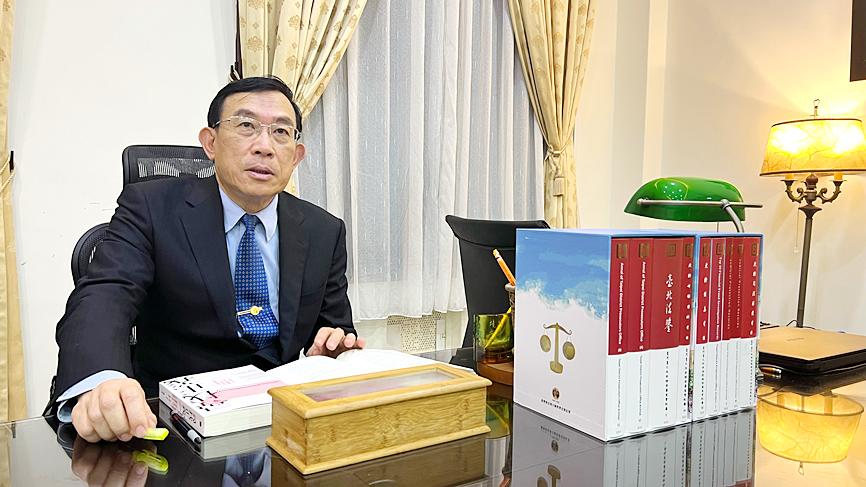
Photo: CNA
Hsing was one of five prosecutors recommended by the Prosecutors Association after an internal vote within the department to solicit names of top candidates.
Hsing, 63, has been a prosecutor for more than three decades, and his leadership has been highly praised, the statement said, referring to his previous roles as head of the district prosecutors’ offices in Taipei, Kaohsiung and Pingtung, as well as deputy minister of justice.
As chief prosecutor at the High Prosecutors’ Office, Hsing has overseen investigations into major cases involving drug dealing, financial crimes and national security offenses, the statement said.
The president hopes the legislature supports the nomination and that Hsing advances judicial reforms if he receives the position, it added.
Tsai convened the National Conference on Judicial Reform in 2017 to commence efforts to promote the enhancement of civil participation and transparency in Taiwan’s legal system, among other tasks, the Ministry of Justice said.
Hsing expressed gratitude for the nomination and said that he would strive to do his best should his nomination be confirmed.
Hsing said he would insist on judicial independence and uphold professional standards while pushing for judicial reforms.
Under the Organic Act of Court Organization (法院組織法), the prosecutor-general is tasked with supervising and directing prosecutors and prosecution affairs nationwide.
Hsing graduated from National Chung Hsing University with a Bachelor of Arts in law and obtained a master’s degree in jurisprudence from Chinese Culture University in 1988, the Presidential Office said.
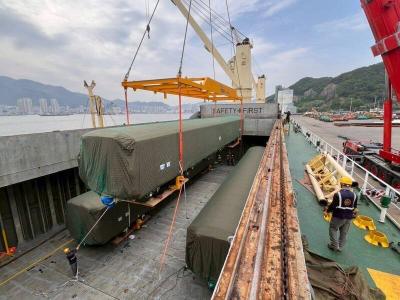
The first of 10 new high-capacity trains purchased from South Korea’s Hyundai Rotem arrived at the Port of Taipei yesterday to meet the demands of an expanding metro network, Taipei Rapid Transit Corp (TRTC) said yesterday. The train completed a three-day, 1,200km voyage from the Port of Masan in South Korea, the company said. Costing NT$590 million (US$18.79 million) each, the new six-carriage trains feature a redesigned interior based on "human-centric" transportation concepts, TRTC said. The design utilizes continuous longitudinal seating to widen the aisles and optimize passenger flow, while also upgrading passenger information displays and driving control systems for a more comfortable
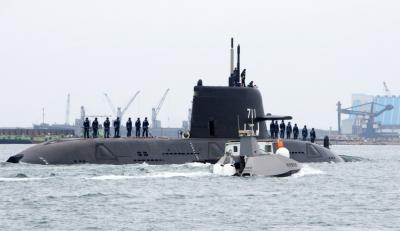
Taiwan's first indigenous defense submarine, the SS-711 Hai Kun (海鯤, or Narwhal), departed for its 13th sea trial at 7am today, marking its seventh submerged test, with delivery to the navy scheduled for July. The outing also marked its first sea deployment since President William Lai (賴清德) boarded the submarine for an inspection on March 19, drawing a crowd of military enthusiasts who gathered to show support. The submarine this morning departed port accompanied by CSBC Corp’s Endeavor Manta (奮進魔鬼魚號) uncrewed surface vessel and a navy M109 assault boat. Amid public interest in key milestones such as torpedo-launching operations and overnight submerged trials,
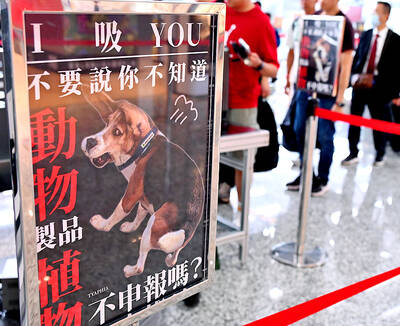
Quarantine awareness posters at Taiwan Taoyuan International Airport have gone viral for their use of wordplay. Issued by the airport branch of the Animal and Plant Health Inspection Agency, the posters feature sniffer dogs making a range of facial expressions, paired with advisory messages built around homophones. “We update the messages for holidays and campaign needs, periodically refreshing materials to attract people’s attention,” quarantine officials said. “The aim is to use the dogs’ appeal to draw focus to quarantine regulations.” A Japanese traveler visiting Taiwan has posted a photo on X of a poster showing a quarantine dog with a
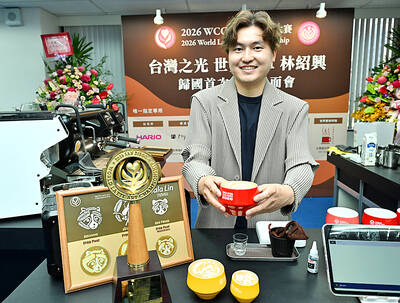
Taiwan’s coffee community has launched a “one-person-one-e-mail” campaign, calling for people to send a protest-e-mail to the World Coffee Championships (WCC) urging it to redesignate Taiwanese competitors as from “Taiwan,” rather than “Chinese Taipei.” The call followed sudden action last week after the WCC changed all references to Taiwanese competitors from “Taiwan” to “Chinese Taipei,” including recent World Latte Art champion Bala (林紹興), who won the World Latte Art Championship in San Diego earlier this month. When Bala received the trophy, he was referred to as representing Taiwan, as well as in the announcement on the WCC’s Web site, until it


 RSS
RSS