


Hikers should beware of venomous snakes, as March and April typically mark the end of hibernation season, a doctor said ahead of the long holiday this weekend.
As Children’s Day and Tomb Sweeping Day approach, many people are expected to visit cemeteries in mountainous areas or engage in outdoor activities.
However, spring also heralds the end of hibernation and beginning of the mating season for many types of snakes, Taipei Tzu Chi Hospital emergency physician Lin Po-chen (林柏蓁) said yesterday.
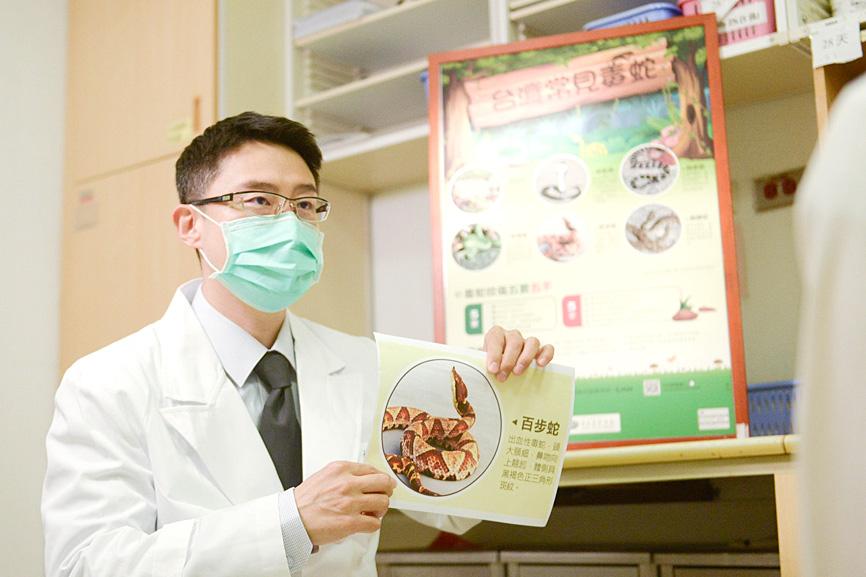
Photo courtesy of Taipei Tzu Chi Hospital
The six most common types of snake venom in Taiwan can be classified into three categories: hemotoxic, neurotoxic or mixed, he said.
Severity depends on the placement of the bite, and type and amount of venom that reaches the circulatory system, he said.
Common snakes with hemotoxic venom in Taiwan include the green tree viper (Viridovipera stejnegeri), Taiwanese habu (Protobothrops mucrosquamatus) and hundred-pace pit viper (Deinagkistrodon acutus), Lin said.
Minor bites could result in bruising, swelling or blistering, while more severe cases could cause muscle damage, kidney failure, irregular blood coagulation or other potentially fatal complications, he added.
Snakes with neurotoxic venom include the many-banded krait (Bungarus multicinctus) and Taiwan cobra (Naja atra), Lin said.
After a minor bite, nausea, vomiting, diarrhea and numbness in the limbs is possible, as well as signs of muscle paralysis such as drooping eyelids, blurred vision, slurred speech and salivation, he said.
Severe cases might lead to unconsciousness, coma and potentially fatal respiratory failure, he added.
Some snakes, such as the Formosan Russell’s viper (Daboia siamensis), have a mix of the two types of venom, Lin said.
Each type has its own antivenom, which has greatly reduced the incidence of serious injury or death from accidental snakebites, he said.
If bitten, Lin advised remaining as calm as possible and remembering the snake’s appearance, including color and pattern.
If possible, taking a photograph of the snake would help doctors select the correct antivenom, Lin added.
It is also important to immediately remove any watches, rings or other things that might impede swelling, and to rinse the wound with water or saline, he added.
Lin advised against excessive movement, as this increases blood flow and can accelerate the spread of the venom.
The area near the bite should also be kept below the chest to impede the flow of venom to the heart, he added.
Snakebites should be treated differently from regular wounds, as some common treatments such as icing, tourniquets or holding the injured area higher than the heart could exacerbate rather than stop the spread of the venom, Lin said.
He also advised against other treatments associated with snakebites, such as widening the wound, sucking the venom out, urinating on the wound or drinking alcohol.

AGING: While Japan has 22 submarines, Taiwan only operates four, two of which were commissioned by the US in 1945 and 1946, and transferred to Taiwan in 1973 Taiwan would need at least 12 submarines to reach modern fleet capabilities, CSBC Corp, Taiwan chairman Chen Cheng-hung (陳政宏) said in an interview broadcast on Friday, citing a US assessment. CSBC is testing the nation’s first indigenous defense submarine, the Hai Kun (海鯤, Narwhal), which is scheduled to be delivered to the navy next month or in July. The Hai Kun has completed torpedo-firing tests and is scheduled to undergo overnight sea trials, Chen said on an SET TV military affairs program. Taiwan would require at least 12 submarines to establish a modern submarine force after assessing the nation’s operational environment and defense

A white king snake that frightened passengers and caused a stir on a Taipei MRT train on Friday evening has been claimed by its owner, who would be fined, Taipei Rapid Transit Corp (TRTC) said yesterday. A person on Threads posted that he thought he was lucky to find an empty row of seats on Friday after boarding a train on the Bannan (Blue) Line, only to spot a white snake with black stripes after sitting down. Startled, he jumped up, he wrote, describing the encounter as “terrifying.” “Taipei’s rat control plan: Release snakes on the metro,” one person wrote in reply, referring
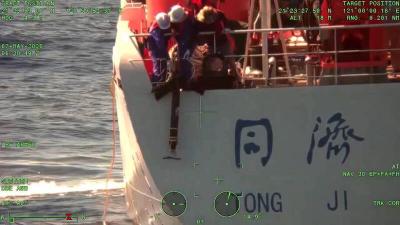
The coast guard today said that it had disrupted "illegal" operations by a Chinese research ship in waters close to the nation and driven it away, part of what Taipei sees a provocative pattern of China's stepped up maritime activities. The coast guard said that it on Thursday last week detected the Chinese ship Tongji (同濟號), which was commissioned only last year, 29 nautical miles (54km) southeast of the southern tip of Taiwan, although just outside restricted waters. The ship was observed lowering ropes into the water, suspected to be the deployment of scientific instruments for "illegal" survey operations, and the coast

Taiwan’s two cases of hantavirus so far this year are on par with previous years’ case numbers, and the government is coordinating rat extermination work, so there should not be any outbreaks, Centers for Disease Control (CDC) Director-General Philip Lo (羅一鈞) said today in an interview with the Liberty Times (the Taipei Times’ sister newspaper). An increase in rat sightings in Taipei and New Taipei City has raised concerns about the spread of hantavirus, as rats can carry the disease. In January, a man in his 70s who lived in Taipei’s Daan District (大安) tested positive posthumously for hantavirus, Taiwan’s


 RSS
RSS