


The New Power Party (NPP) caucus yesterday urged the Taiwan Railways Administration (TRA) to speed up its train safety reforms, as the agency has shown only minor improvements.
The Executive Yuan and the Ministry of Transportation and Communications should examine whether the railway agency has fulfilled the pledges it made to ensure a safe railway service, the NPP caucus said.
The caucus said it hosted a media conference on the urgency of railway safety reform at the TRA, as it would soon be one year since Taroko Express No. 408 derailed in Hualien County on April 2 last year, killing 49 people and injuring 213.
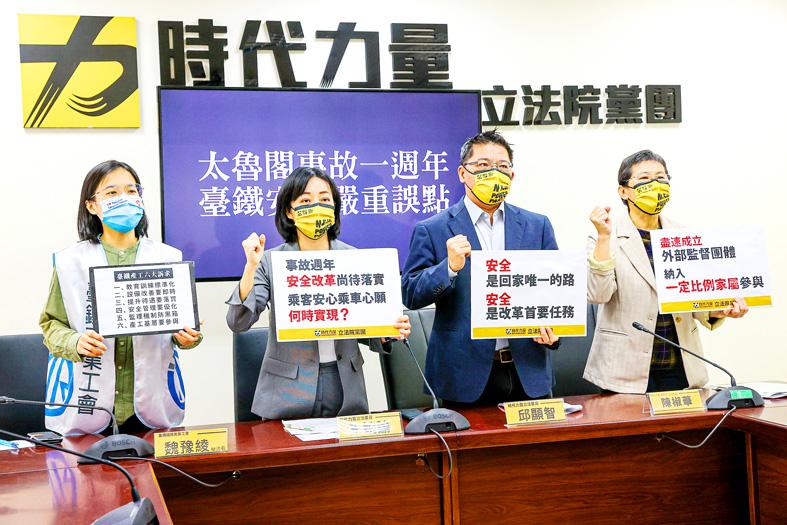
Photo: CNA
The train crashed inside Cingshuei Tunnel (清水隧道) after colliding with a crane truck that had rolled from a construction site onto the tracks near the tunnel’s entrance.
The TRA told the caucus that it is still, after almost a year, considering proposals to raise penalties for contractors if their work disrupts train operations, NPP Legislator Claire Wang (王婉諭) said.
The ministry and TRA are too slow in addressing safety issues, she said.
Since April last year, at least two safety incidents occurred involving foreign objects on railway lines, Wang said.
In December last year, a steel beam fell from a nearby construction site and hit another Taroko Express train operating along the northeast coast, while a commuter train hit a construction barrier in Hsinchu County in January, she said.
NPP caucus whip Chiu Hsien-chih (邱顯智) said that the ministry appears to think that all of the TRA’s problems will be solved if it transforms the railway agency into a state-run corporation.
Regardless of whether the TRA is a government agency, or a state-run or private corporation, safety is the most important issue when operating a railway service, he said.
“Some measures can be implemented without first having to corporatize the TRA. The ticket pricing scheme, which has not been adjusted for 25 years, is one of the main reasons that the agency has been sustaining financial losses. This can be [changed] now,” he said.
No major railway accidents occurred between June last year and last month, TRA data showed. However, the agency still recorded 34 minor incidents and 419 abnormalities over the past six months.
Nine of the TRA’s 33 urgent safety issues have been addressed so far this year, including building an emergency report system, improving the management of construction sites along railway lines, telemonitoring the automatic train protection system on trains and using a smart system to identify fissures on steel railway tracks.
The National Train Drivers’ Union and Taiwan Railway Union held a media conference saying they questioned the agency’s resolve in enhancing the safety of railway operations.
“Passing … [the] marker on the North Link Railway Line where the Taroko Express derailed last year, always reminds train drivers that our colleague, Chiang Pei-fung (江沛峰), died in the incident,” National Train Driver Union chairman Huang Lung-hua (黃隆華) said.
Corporatizing the TRA was proposed after the Taroko Express derailment last year, but safety should be the focus of the railway service, Huang said.
“Unfortunately, we heard nothing about safety issues at the hearing at [a meeting of] the legislature’s Transportation Committee on Thursday last week. Instead, we heard how the assets of the TRA should be handled to resolve the agency’s financial difficulties,” he said.
Members of the train drivers’ union remain determined to go on strike on International Workers’ Day on May 1, Huang said.

Considering that most countries issue more than five denominations of banknotes, the central bank has decided to redesign all five denominations, the bank said as it prepares for the first major overhaul of the banknotes in more than 24 years. Central bank Governor Yang Chin-lung (楊金龍) is expected to report to the Legislative Yuan today on the bank’s operations and the redesign’s progress. The bank in a report sent to the legislature ahead of today’s meeting said it had commissioned a survey on the public’s preferences. Survey results showed that NT$100 and NT$1,000 banknotes are the most commonly used, while NT$200 and NT$2,000

The Centers for Disease Control (CDC) yesterday reported the first case of a new COVID-19 subvariant — BA.3.2 — in a 10-year-old Singaporean girl who had a fever upon arrival in Taiwan and tested positive for the disease. The girl left Taiwan on March 20 and the case did not have a direct impact on the local community, it said. The WHO added the BA.3.2 strain to its list of Variants Under Monitoring in December last year, but this was the first imported case of the COVID-19 variant in Taiwan, CDC Deputy Director-General Lin Ming-cheng (林明誠) said. The girl arrived in Taiwan on

South Korea is planning to revise its controversial electronic arrival card, a step Taiwanese officials said prompted them to hold off on planned retaliatory measures, a South Korean media report said yesterday. A Yonhap News Agency report said that the South Korean Ministry of Foreign Affairs is planning to remove the “previous departure place” and “next destination” fields from its e-arrival card system. The plan, reached after interagency consultations, is under review and aims to simplify entry procedures and align the electronic form with the paper version, a South Korean ministry official said. The fields — which appeared only on the electronic form

The Ministry of Foreign Affairs (MOFA) is suspending retaliation measures against South Korea that were set to take effect tomorrow, after Seoul said it is updating its e-arrival system, MOFA said today. The measures were to be a new round of retaliation after Taiwan on March 1 changed South Korea's designation on government-issued alien resident certificates held by South Korean nationals to "South Korea” from the "Republic of Korea," the country’s official name. The move came after months of protests to Seoul over its listing of Taiwan as "China (Taiwan)" in dropdown menus on its new online immigration entry system. MOFA last week


 RSS
RSS