


Parents of young children should ensure that small objects are kept out of their reach, a doctor said, citing data showing that about 90 percent of incidents of children choking occur at home.
Coin cell batteries are one of the most dangerous items typically swallowed by children, and parents should seek medical assistance for their child if they have swallowed such a high-risk object, Chang Gung Memorial Hospital pediatrician Wu Chang-teng (吳昌騰) said.
It is especially urgent if the child vomits or drools after swallowing the object, he said.
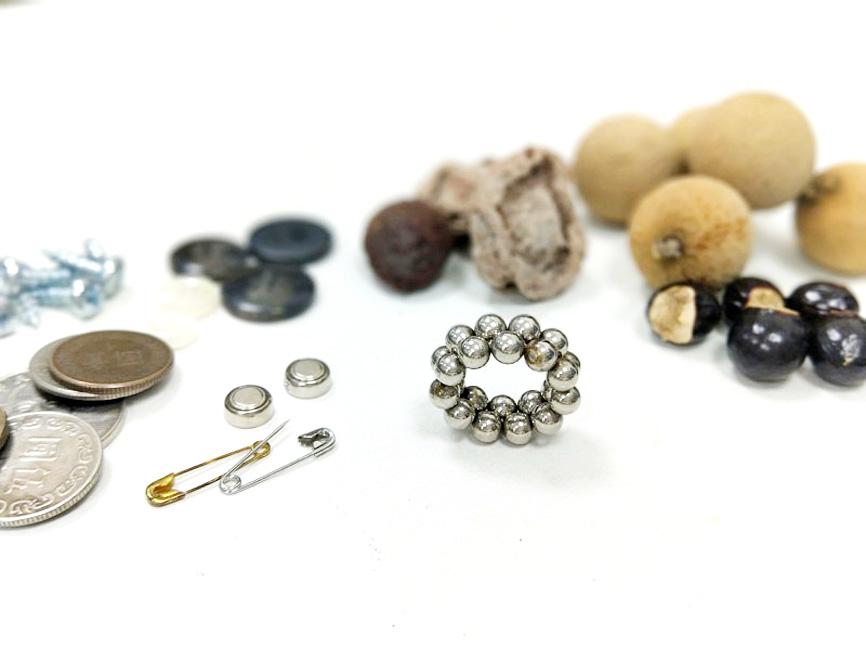
Photo copied by Tsai Shu-yuan, Taipei Times
From 2011 to 2015, 590 underage people received hospital treatment after ingesting foreign objects, he said, adding that 52.3 percent of them were boys and 47.7 percent were girls.
The average age was five, and a majority of the incidents occurred around noon, he said.
“We see children end up in the emergency room for swallowing all kinds of small objects: pills, coin cell batteries, coins, small toys and magnets — these are commonly swallowed,” he said.
Wu said his hospital had treated a two-year-old girl who had choked on a battery and whose neck had become stiff after the battery caused corrosion in her esophagus.
The girl’s parents rushed her to the emergency room after she began vomiting and drooling, he said.
“In the human body, batteries can short-circuit due to the humidity, and then discharge and generate heat,” he said. “Not only might the mucous membrane and cartilage be scalded, but the battery fluid might also corrode the esophageal mucosa.”
Such corrosion could cause complications such as esophageal stenosis — a tightening or narrowing of the esophagus — an esophageal perforation or vocal cord paralysis, he said.
Magnetic “buckyballs,” which are widely used in toys, also pose a significant danger, he said, citing the case of a three-year-old boy who had stomach punctures due to swallowing 23 of the magnets.
Numerous children in the US and Japan have died from swallowing “buckyballs,” he said.
Chang Gung Memorial Hospital Child Protection Center director Yeh Kuo-wei (葉國偉) said that parents should learn cardiopulmonary resuscitation and the Heimlich maneuver.
Learning these basic techniques can help parents save their child from choking after swallowing a foreign object, he said.
However, if a child swallows a poisonous substance, parents should immediately take them to a doctor, rather than inducing vomiting, he said, adding that vomiting could cause burns to the esophagus and the gastrointestinal tract.

Considering that most countries issue more than five denominations of banknotes, the central bank has decided to redesign all five denominations, the bank said as it prepares for the first major overhaul of the banknotes in more than 24 years. Central bank Governor Yang Chin-lung (楊金龍) is expected to report to the Legislative Yuan today on the bank’s operations and the redesign’s progress. The bank in a report sent to the legislature ahead of today’s meeting said it had commissioned a survey on the public’s preferences. Survey results showed that NT$100 and NT$1,000 banknotes are the most commonly used, while NT$200 and NT$2,000

The Centers for Disease Control (CDC) yesterday reported the first case of a new COVID-19 subvariant — BA.3.2 — in a 10-year-old Singaporean girl who had a fever upon arrival in Taiwan and tested positive for the disease. The girl left Taiwan on March 20 and the case did not have a direct impact on the local community, it said. The WHO added the BA.3.2 strain to its list of Variants Under Monitoring in December last year, but this was the first imported case of the COVID-19 variant in Taiwan, CDC Deputy Director-General Lin Ming-cheng (林明誠) said. The girl arrived in Taiwan on

South Korea is planning to revise its controversial electronic arrival card, a step Taiwanese officials said prompted them to hold off on planned retaliatory measures, a South Korean media report said yesterday. A Yonhap News Agency report said that the South Korean Ministry of Foreign Affairs is planning to remove the “previous departure place” and “next destination” fields from its e-arrival card system. The plan, reached after interagency consultations, is under review and aims to simplify entry procedures and align the electronic form with the paper version, a South Korean ministry official said. The fields — which appeared only on the electronic form

The Ministry of Foreign Affairs (MOFA) is suspending retaliation measures against South Korea that were set to take effect tomorrow, after Seoul said it is updating its e-arrival system, MOFA said today. The measures were to be a new round of retaliation after Taiwan on March 1 changed South Korea's designation on government-issued alien resident certificates held by South Korean nationals to "South Korea” from the "Republic of Korea," the country’s official name. The move came after months of protests to Seoul over its listing of Taiwan as "China (Taiwan)" in dropdown menus on its new online immigration entry system. MOFA last week


 RSS
RSS