


Supermassive “bubbles” in space might have been created by a single event originating at the black hole near the center of our galaxy, a Taiwanese researcher said on Thursday.
The successful simulation of a theoretical model lent credence to the hypothesis that Fermi “bubbles,” as well as the microwave haze, were the result of a single jet event from the central black hole, said Karen Yang (揚湘怡), an associate professor in National Tsing Hua University’s Institute of Astronomy.
The theoretical model would extend understanding of activity at the center of the Milky Way and the correlation of supermassive black hole and galaxy co-evolution in the context of galaxy formation, said the abstract of a paper titled “Fermi and eROSITA bubbles as relics of the past activity of the Galaxy’s central black hole,” which was published in the journal Nature Astronomy this month.

Photo courtesy of National Tsing Hua University
University of Michigan Department of Astronomy associate professor Mateusz Ruszkowski and University of Wisconsin-Madison professor Ellen Zweibel were the coauthors.
The origin of the bubbles and the microwave haze has been intensely debated since their discovery, Yang said.
As the bubbles and the haze have “symmetry about the galactic center,” the team hypothesized that they originated from energetic outbursts, she said.
The central black hole has absorbed 10,000 to 100,000 times the mass of our sun, but only some of that mass has passed the event horizon — the “point of no return” — with most of it spat out at nearly the speed of light, Yang said.
Using a numerical simulation, the team demonstrated how the model can reproduce a process to create the bubbles and haze, the study said.
“It allows us to derive critical constraints on the energetics and timescales of the outburst,” the paper said.
The study demonstrates how supermassive black holes evolve and the co-evolution of such features in other galaxies, Ruszkowski said, adding that perhaps researchers might one day answer how such “bubbles” affect galactic evolution.
The eROSITA X-ray instrument, which was built by the Max Planck Institute for Extraterrestrial Physics in Germany, is part of the Russian-German Spektr-RG space observatory.
The Fermi bubbles were previously discovered by the Fermi Gamma-ray Space Telescope.

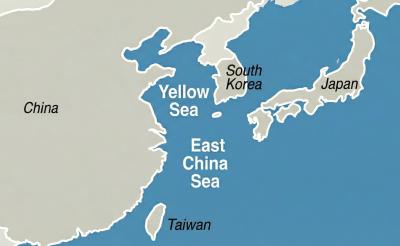
China has reserved offshore airspace in the Yellow Sea and East China Sea from March 27 to May 6, issuing alerts usually used to warn of military exercises, although no such exercises have been announced, the Wall Street Journal (WSJ) reported yesterday. Reserving such a large area for 40 days without explanation is an “unusual step,” as military exercises normally only last a few days, the paper said. These alerts, known as Notice to Air Missions (Notams), “are intended to inform pilots and aviation authorities of temporary airspace hazards or restrictions,” the article said. The airspace reserved in the alert is
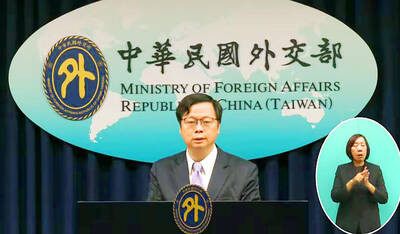
NAMING SPAT: The foreign ministry called on Denmark to propose an acceptable solution to the erroneous nationality used for Taiwanese on residence permits Taiwan has revoked some privileges for Danish diplomatic staff over a Danish permit that lists “Taiwan” as “China,” Eric Huang (黃鈞耀), head of the Ministry of Foreign Affairs’ Department of European Affairs, told a news conference in Taipei yesterday. Reporters asked Huang whether the Danish government had responded to the ministry’s request that it correct the nationality on Danish residence permits of Taiwanese, which has been listed as “China” since 2024. Taiwan’s representative office in Denmark continues to communicate with the Danish government, and the ministry has revoked some privileges previously granted to Danish representatives in Taiwan and would continue to review
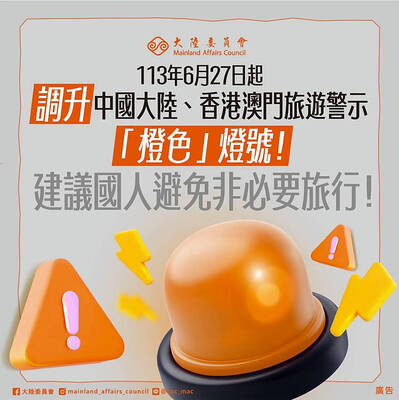
More than 6,000 Taiwanese students have participated in exchange programs in China over the past two years, despite the Mainland Affairs Council’s (MAC) “orange light” travel advisory, government records showed. The MAC’s publicly available registry showed that Taiwanese college and university students who went on exchange programs across the Strait numbered 3,592 and 2,966 people respectively. The National Immigration Agency data revealed that 2,296 and 2,551 Chinese students visited Taiwan for study in the same two years. A review of the Web sites of publicly-run universities and colleges showed that Taiwanese higher education institutions continued to recruit students for Chinese educational programs without
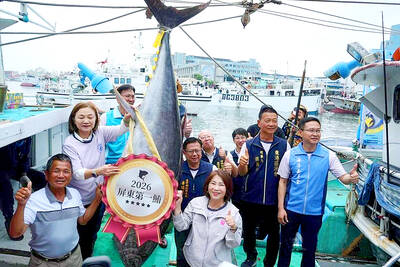
The first bluefin tuna of the season, brought to shore in Pingtung County and weighing 190kg, was yesterday auctioned for NT$10,600 (US$333.5) per kilogram, setting a record high for the local market. The auction was held at the fish market in Donggang Fishing Harbor, where the Siaoliouciou Island-registered fishing vessel Fu Yu Ching No. 2 delivered the “Pingtung First Tuna” it had caught for bidding. Bidding was intense, and the tuna was ultimately jointly purchased by a local restaurant and a local company for NT$10,600 per kilogram — NT$300 ,more than last year — for a total of NT$2.014 million. The 67-year-old skipper


 RSS
RSS