


The US Senate Foreign Relations Committee on Wednesday passed a bipartisan resolution in support of Lithuania’s relationship with Taiwan.
Lithuania faced retaliation from Beijing for allowing Taiwan to open the Taiwanese Representative Office in Vilnius in November last year, despite the lack of formal diplomatic ties between the two. China reacted by recalling its ambassador from Vilnius and expelling Lithuania’s ambassador from Beijing. It also imposed economic sanctions against Lithuania, including the suspension of direct freight train services to the Baltic state.
The resolution, introduced by US senators Jim Risch and Jeanne Shaheen on Nov. 5 last year, commended the Lithuanian government “for its resolve in increasing ties with Taiwan and supporting its firm stance against coercion by the Chinese Communist Party [CCP].”
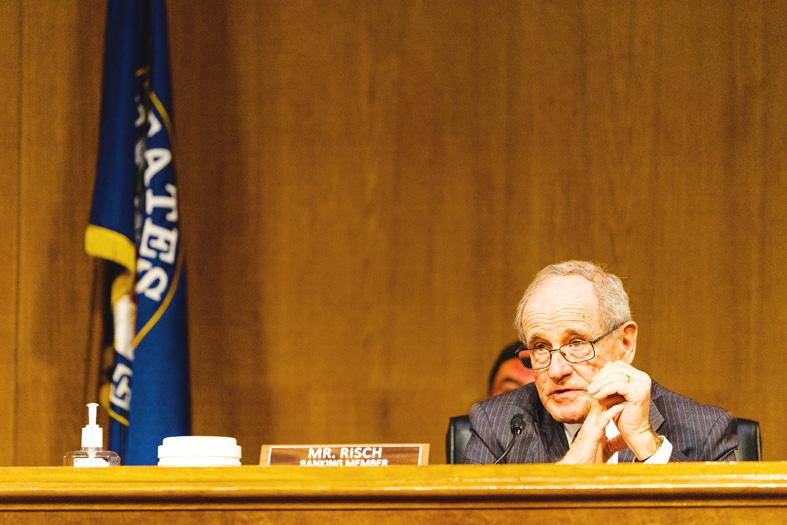
Photo: Bloomberg
The Senate “commits to supporting Lithuania and Taiwan in the face of these challenges, including by exploring ways to increase economic cooperation with both counties,” it says, adding that the Senate “encourages European allies to continue to stand in solidarity with Lithuania against aggression from the government of the People’s Republic of China.”
The Senate “supports Taiwan in its struggle against CPP malign influence, coercion and aggression, which threatens not only the Taiwanese people and countries in the Indo-Pacific [region], but also any nation around the world that enacts policies or positions that are inconsistent with those of the CPP,” it added.
In a joint news release, Risch, a Republican, said that “Lithuania deserves recognition for its decision to stand with Taiwan, despite the backlash it receives from Beijing.”
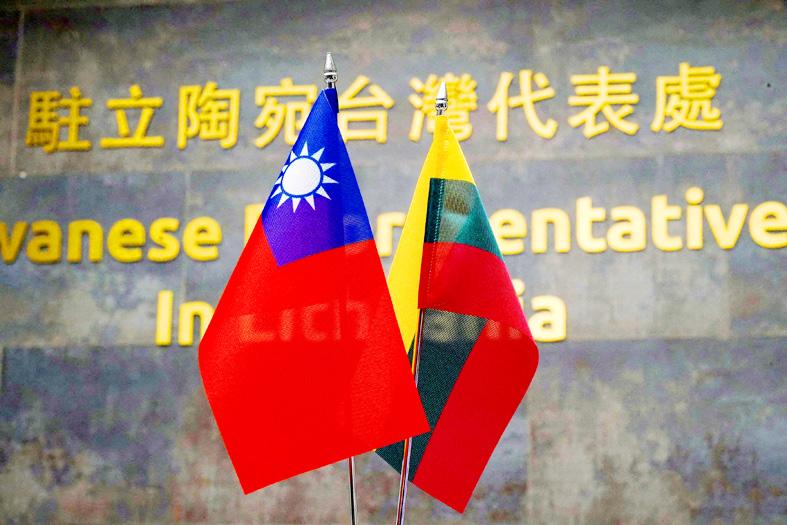
Photo: Reuters
“Our resolution sends a signal to all our allies that when you make the moral choice to stand with a fellow democracy and stand up to coercive authoritarian pressure, you can trust your allies will be united with you,” Risch said.
Shaheen, a Democrat, added that the “committee’s bipartisan approval of our resolution sends a powerful message to China that the US will not sit idly by as it seeks to impose its views and use economic manipulation against Lithuania and other democracies throughout eastern Europe.”
“Now more than ever, the US must take every opportunity to make clear to authoritarian regimes and strongmen around the world that we will not tolerate malign behavior that threatens our world order or the stability of liberal democracies,” Shaheen said.
The nonbinding resolution next goes to the Senate floor for a vote.

FUKUOKA SITUATION: Japanese media reported that the pathogen is expected to be identified by the summer, while the CDC downplayed the idea that it was hMPV A “mysterious cold-like illness” reported in Japan’s Fukuoka Prefecture does not seem to be a new disease, but Japanese authorities have been asked about the situation, the Centers for Disease Control (CDC) said yesterday. The Fukuoka Prefectural Medical Association on Wednesday told a news conference that a “mystery cold” that has become a hot topic on social media is “highly likely to be caused by some kind of viral infection,” Japan’s KBC News reported. “Many people are experiencing symptoms starting with a sore throat, followed by a runny nose, phlegm and a severe cough,” KBC News reported, citing association officials. Health authorities are

Nvidia Corp CEO Jensen Huang (黃仁勳) arrived in Taiwan yesterday ahead of upcoming AI and technology events, saying he plans to meet with clients and Taiwan Semiconductor Manufacturing Co Chairman C.C. Wei (魏哲家) during his visit. After landing at Taipei Songshan Airport, Huang posed for photos with fans and handed out Yakult drinks to reporters and supporters waiting at the scene, saying he has “a lot to do” during the trip. Asked about reports that Nvidia’s planned headquarters site in Taipei’s Beitou Shilin Technology Park could break ground on May 27, Huang said that if the company holds an event, he would

Carrefour Taiwan is to begin using a new name from the start of July, but it cannot divulge the name until then, the chairman of the supermarket chain's parent company said today. President Chain Store Co chairman Lo Chih-hsien (羅智先) was asked by reporters after a shareholders' meeting to confirm whether the company has settled on a new name for the supermarket brand. In March, the government-registered name of two Carrefour Taiwan branches was quietly changed to "Le Chia Kang" (樂家康) in Chinese, raising speculation that has been selected as the name. Lo said that because of local regulations and contractual obligations, the
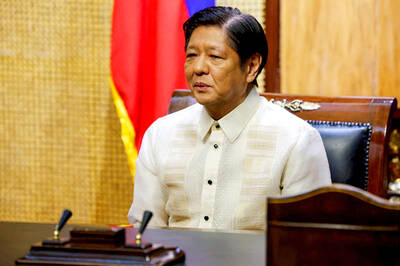
The Philippines would likely be involved in any conflict over Taiwan due to its proximity to the democracy claimed by China, President Ferdinand Marcos Jr said, reiterating a stance that risks angering Beijing. “In the Philippines, we do not have a choice because Taiwan is so close to the Philippines and we have almost 200,000 Filipino nationals living and working in Taiwan,” Marcos said in an interview with Japanese media in Manila on Monday. The Philippine leader’s comments come ahead of a state visit to Japan next week, where he is to meet with Japanese Prime Minister Sanae Takaichi to discuss security


 RSS
RSS