


The pictures and names of drunk-driving repeat offenders are to be publicized after the Directorate-General of Highways (DGH) implements an update to the enforcement rules by the end of this month.
The faces of repeat offenders would not be pixelated and their names would be revealed in full, the highway authority said, following a discussion with experts on Friday last week.
The list of offenders would be posted on the Web sites of the agency’s motor vehicle offices, it added.
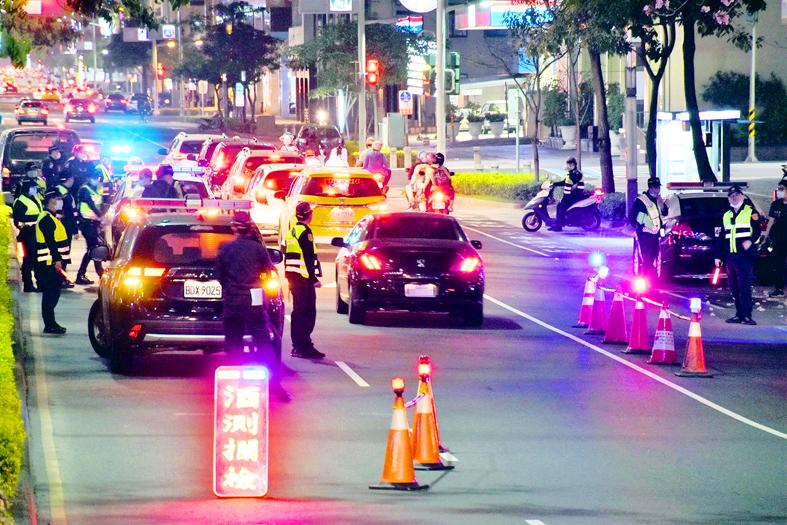
Photo: Huang Liang-chieh, Taipei Times
The measure is part of tougher drunk-driving penalties targeting repeat offenders in an amendment to Article 35 of the Road Traffic Management and Penalty Act (道路交通管理處罰條例) passed by the Legislative Yuan in January, which is to be enforced on March 31, the agency said.
Participants in last week’s meeting generally agreed that the government needs not blur the faces of repeat offenders and can release their full names, but the experts have yet to reach a consensus on whether the pictures should be obtained from motor vehicle offices or household registration offices, the agency said.
Some participants suggested that the government use mug shots taken when the repeat offenders were stopped by the police, it added.
Although Tainan earlier this month became the first city in Taiwan to disclose the names and pictures of three drunk drivers, some criticized the city for pixelating their faces and not disclosing their full names.
Others accused it of breaching personal data protection rules.
Whether Tainan’s disclosure of their pictures constituted a data privacy breach would be determined by the National Development Council, the agency said.
DGH Director-General Chen Wen-ruey (陳文瑞) said his agency would only disclose the information of repeat offenders until courts have decided their cases, estimating that this would take about one month from their offense.
In addition to the publication of their information, the amendment also stipulates that people who are caught driving drunk twice or more within 10 years or refuse to undergo breath alcohol tests are to be considered repeat offenders.
Passengers aged 18 or older who are caught riding in a vehicle driven by a drunk person would be fined NT$6,000 to NT$15,000.
Vehicles of first-time drunk drivers would be confiscated if they cause serious personal injuries or death.

Considering that most countries issue more than five denominations of banknotes, the central bank has decided to redesign all five denominations, the bank said as it prepares for the first major overhaul of the banknotes in more than 24 years. Central bank Governor Yang Chin-lung (楊金龍) is expected to report to the Legislative Yuan today on the bank’s operations and the redesign’s progress. The bank in a report sent to the legislature ahead of today’s meeting said it had commissioned a survey on the public’s preferences. Survey results showed that NT$100 and NT$1,000 banknotes are the most commonly used, while NT$200 and NT$2,000

The Centers for Disease Control (CDC) yesterday reported the first case of a new COVID-19 subvariant — BA.3.2 — in a 10-year-old Singaporean girl who had a fever upon arrival in Taiwan and tested positive for the disease. The girl left Taiwan on March 20 and the case did not have a direct impact on the local community, it said. The WHO added the BA.3.2 strain to its list of Variants Under Monitoring in December last year, but this was the first imported case of the COVID-19 variant in Taiwan, CDC Deputy Director-General Lin Ming-cheng (林明誠) said. The girl arrived in Taiwan on

South Korea is planning to revise its controversial electronic arrival card, a step Taiwanese officials said prompted them to hold off on planned retaliatory measures, a South Korean media report said yesterday. A Yonhap News Agency report said that the South Korean Ministry of Foreign Affairs is planning to remove the “previous departure place” and “next destination” fields from its e-arrival card system. The plan, reached after interagency consultations, is under review and aims to simplify entry procedures and align the electronic form with the paper version, a South Korean ministry official said. The fields — which appeared only on the electronic form

The Ministry of Foreign Affairs (MOFA) is suspending retaliation measures against South Korea that were set to take effect tomorrow, after Seoul said it is updating its e-arrival system, MOFA said today. The measures were to be a new round of retaliation after Taiwan on March 1 changed South Korea's designation on government-issued alien resident certificates held by South Korean nationals to "South Korea” from the "Republic of Korea," the country’s official name. The move came after months of protests to Seoul over its listing of Taiwan as "China (Taiwan)" in dropdown menus on its new online immigration entry system. MOFA last week


 RSS
RSS