


The National Communications Commission (NCC) should propose a draft bill on digital communication to ensure that social media platforms have transparent mechanisms to review online content, legislators and media experts said on Tuesday last week.
The call came after the official YouTube channel of the Golden Horse Award-winning Hong Kong documentary Revolution of Our Times (時代革命), which tells the stories of the Hong Kong protests in 2019 and 2020, was shut down for six hours the day before the film’s premiere on Feb. 25, due to an alleged influx of complaints over its content.
The documentary’s official fan page on Facebook was reportedly suppressed and not appearing in searches of the film’s title.
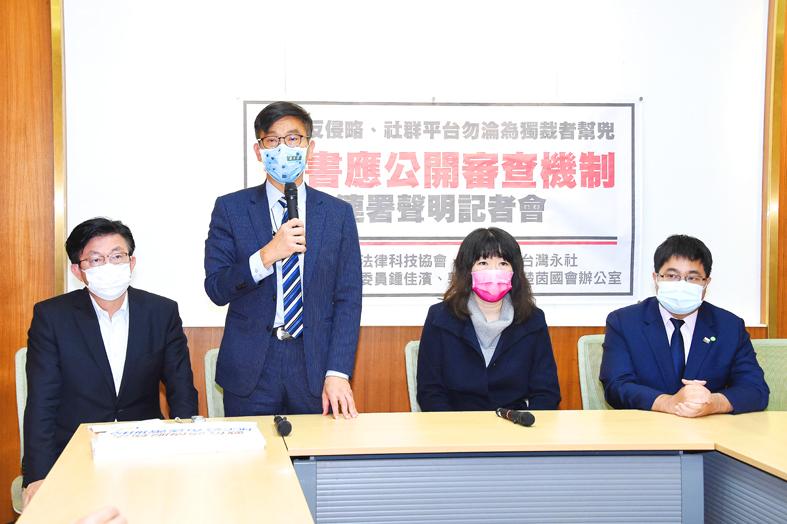
Photo: Tu Chien-jung, Taipei Times
Democratic Progressive Party (DPP) Legislator Chung Chia-pin (鍾佳濱) said that social media companies often claim they have no way of verifying the authenticity of the content on their platforms whenever they are asked to remove disinformation, allowing it to spread on the Internet.
However, they also often block content without disclosing the standards they use, he said.
“We ask social media companies to disclose the standards they use to review content on their platforms,” he said.
The NCC last year unveiled the legal framework of a draft act, which would require Internet service providers to disclose their review procedures, but it did not set a timeline for its completion, he said.
Platform operators have the power to control speech freedom, raising questions of whether politicians or political parties can take advantage of the situation to manipulate public opinion, said National Taipei University of Technology associate professor Christy Chiang (江雅綺), representing the Taiwan Law and Technology Association.
Professional Technology Temple (PTT) founder Ethan Tu’s (杜奕瑾) Facebook page was banned for using a profile cover picture of the Ukrainian national flag, said attorney Huang Di-ying (黃帝穎), representing the Taiwan Forever Association legal reform group.
A US court ruling required Facebook to make public its content review standards and offer users a series of remedial procedures, he said, adding that Taiwan does not yet have such regulations.
“Companies have corporate responsibilities, and the government is obligated to oversee them and ensure that speech freedom is protected,” he said.
Facebook censors speech, as witnessed in the case with the documentary, DPP Legislator Kuo Kuo-wen (郭國文) said, adding that this fuels social division.
“The soon-to-be-established Department of Digital Development should help rectify these problems, whether preventing the spread of disinformation or making Facebook’s algorithm open and transparent,” he said.
Free speech is important to democracy, and Facebook’s censorship must not exceed domestic laws, DPP Legislator Lin Chu-yin (林楚茵) cited Premier Su Tseng-chang (蘇貞昌) as saying, adding that Su has instructed government agencies to make legal revisions soon.
The Fair Trade Commission should support consumers by requiring platforms to disclose their suppression algorithms and not apply them arbitrarily, Lin said.
Facebook has such great power in Taiwan because the country has long allowed overseas digital platforms to benefit from regulations without taking responsibility for their actions, said Shen Jung-chin (沈榮欽), an assistant professor at the School of Administrative Studies of Atkinson Faculty at York University in Canada.

Considering that most countries issue more than five denominations of banknotes, the central bank has decided to redesign all five denominations, the bank said as it prepares for the first major overhaul of the banknotes in more than 24 years. Central bank Governor Yang Chin-lung (楊金龍) is expected to report to the Legislative Yuan today on the bank’s operations and the redesign’s progress. The bank in a report sent to the legislature ahead of today’s meeting said it had commissioned a survey on the public’s preferences. Survey results showed that NT$100 and NT$1,000 banknotes are the most commonly used, while NT$200 and NT$2,000

The Centers for Disease Control (CDC) yesterday reported the first case of a new COVID-19 subvariant — BA.3.2 — in a 10-year-old Singaporean girl who had a fever upon arrival in Taiwan and tested positive for the disease. The girl left Taiwan on March 20 and the case did not have a direct impact on the local community, it said. The WHO added the BA.3.2 strain to its list of Variants Under Monitoring in December last year, but this was the first imported case of the COVID-19 variant in Taiwan, CDC Deputy Director-General Lin Ming-cheng (林明誠) said. The girl arrived in Taiwan on

South Korea is planning to revise its controversial electronic arrival card, a step Taiwanese officials said prompted them to hold off on planned retaliatory measures, a South Korean media report said yesterday. A Yonhap News Agency report said that the South Korean Ministry of Foreign Affairs is planning to remove the “previous departure place” and “next destination” fields from its e-arrival card system. The plan, reached after interagency consultations, is under review and aims to simplify entry procedures and align the electronic form with the paper version, a South Korean ministry official said. The fields — which appeared only on the electronic form

The Ministry of Foreign Affairs (MOFA) is suspending retaliation measures against South Korea that were set to take effect tomorrow, after Seoul said it is updating its e-arrival system, MOFA said today. The measures were to be a new round of retaliation after Taiwan on March 1 changed South Korea's designation on government-issued alien resident certificates held by South Korean nationals to "South Korea” from the "Republic of Korea," the country’s official name. The move came after months of protests to Seoul over its listing of Taiwan as "China (Taiwan)" in dropdown menus on its new online immigration entry system. MOFA last week


 RSS
RSS