


Taiwan believes that Chinese President Xi Jinping (習近平) is likely to be too focused on a key party meeting regarding his tenure as China’s leader to take invasive military action this year, regardless of what happens between Russia and Ukraine, two senior security officials in Taipei said.
The government has assessed the risk of a Chinese attack to be low, even if the US were to be distracted by a war in eastern Europe, the officials said on the condition of anonymity.
Leadership of the Chinese Communist Party is prioritizing domestic stability ahead of a twice-a-decade congress and would not take any action that jeopardizes Xi’s efforts to secure a third term, they said.
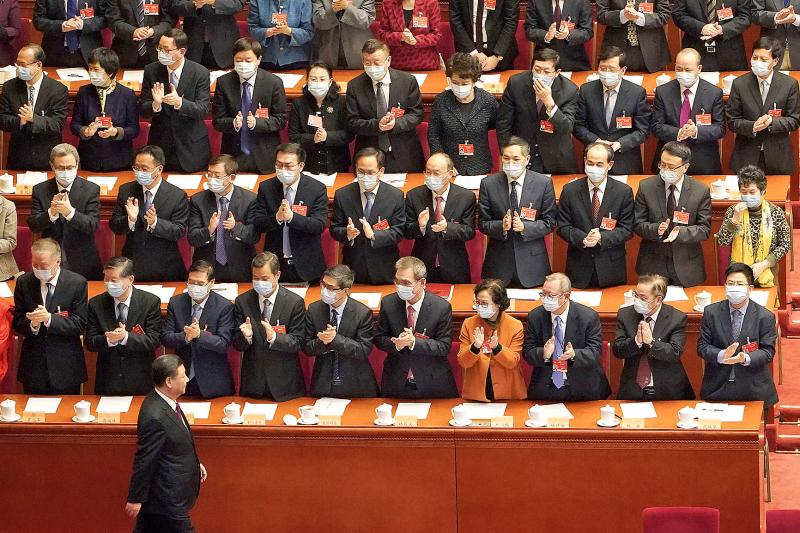
Photo: AP
Moreover, the Chinese People’s Liberation Army still lacks the capabilities needed to guarantee the success of any attack on Taiwan, the officials said.
Regardless, China could exploit a shift in global attention toward Ukraine to ramp up military exercises or other efforts to influence political opinion in Taiwan.
Taiwan and Ukraine share similar security concerns, with larger, nuclear-armed neighbors seeking greater influence over their territory and no formal US alliance. The administration of US President Joe Biden believes that China has been gauging the US response to the buildup of Russian troops on the Ukrainian border as a proxy for how the US would deal with more aggressive action by Beijing against Taiwan, reports said last week.
President Tsai Ing-wen (蔡英文) has appointed a task force to monitor the Ukraine situation and evaluate its security repercussions on Taiwan.
“We will be on high alert and watch for anyone using this opportunity to make trouble,” Executive Yuan spokesman Lo Ping-cheng (羅秉成) said on Tuesday in response to a question about the significance of the Ukraine crisis to Taipei. “Taiwan has always been on high alert, but will be especially so when the situation in other nations is severe.”
The Ukraine crisis comes at a sensitive time for Xi, who is expected to secure a precedent-breaking third term as party leader in the second half of the year. In a sign of the event’s supreme political importance, several Chinese government agencies have declared maintaining a stable environment for the party congress to be a top priority for this year.
One of the officials cautioned that it was difficult to predict decisionmaking in a political system dominated by one man.
Such leaders could make sudden and seemingly irrational decisions to consolidate power or influence, the official said.
US Pacific Air Forces commander General Kenneth Wilsbach in Singapore said that he was concerned about China trying “to take advantage” of tensions over Ukraine.
“It wouldn’t be surprising if they tried something that would maybe be provocative and see how the international community reacts,” Wilsbach said.
Chinese warplanes made about 960 forays into Taiwan’s air defense identification zone last year, compared with about 380 sorties the year prior, Ministry of National Defense data showed.
Speculation that the Ukraine crisis shows the US’ reluctance to send troops overseas could feed Chinese “cognitive warfare” efforts against Taiwan, the other senior Taiwanese official said.
Taiwan believes that its strategic importance to the US is greater than Ukraine’s, due to its location and vital chip industry, the official said.
The relationship between Taiwan and China “has its own dynamics,” Presidential Office spokeswoman Kolas Yotaka said.
It “is not going to be fundamentally changed by what is happening between Russia and Ukraine today,” she said.

FUKUOKA SITUATION: Japanese media reported that the pathogen is expected to be identified by the summer, while the CDC downplayed the idea that it was hMPV A “mysterious cold-like illness” reported in Japan’s Fukuoka Prefecture does not seem to be a new disease, but Japanese authorities have been asked about the situation, the Centers for Disease Control (CDC) said yesterday. The Fukuoka Prefectural Medical Association on Wednesday told a news conference that a “mystery cold” that has become a hot topic on social media is “highly likely to be caused by some kind of viral infection,” Japan’s KBC News reported. “Many people are experiencing symptoms starting with a sore throat, followed by a runny nose, phlegm and a severe cough,” KBC News reported, citing association officials. Health authorities are

Nvidia Corp CEO Jensen Huang (黃仁勳) arrived in Taiwan yesterday ahead of upcoming AI and technology events, saying he plans to meet with clients and Taiwan Semiconductor Manufacturing Co Chairman C.C. Wei (魏哲家) during his visit. After landing at Taipei Songshan Airport, Huang posed for photos with fans and handed out Yakult drinks to reporters and supporters waiting at the scene, saying he has “a lot to do” during the trip. Asked about reports that Nvidia’s planned headquarters site in Taipei’s Beitou Shilin Technology Park could break ground on May 27, Huang said that if the company holds an event, he would

Carrefour Taiwan is to begin using a new name from the start of July, but it cannot divulge the name until then, the chairman of the supermarket chain's parent company said today. President Chain Store Co chairman Lo Chih-hsien (羅智先) was asked by reporters after a shareholders' meeting to confirm whether the company has settled on a new name for the supermarket brand. In March, the government-registered name of two Carrefour Taiwan branches was quietly changed to "Le Chia Kang" (樂家康) in Chinese, raising speculation that has been selected as the name. Lo said that because of local regulations and contractual obligations, the
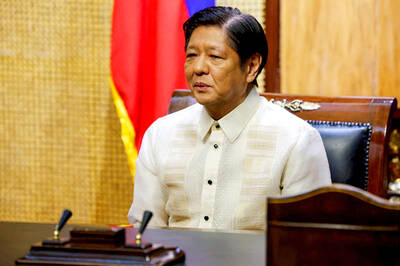
The Philippines would likely be involved in any conflict over Taiwan due to its proximity to the democracy claimed by China, President Ferdinand Marcos Jr said, reiterating a stance that risks angering Beijing. “In the Philippines, we do not have a choice because Taiwan is so close to the Philippines and we have almost 200,000 Filipino nationals living and working in Taiwan,” Marcos said in an interview with Japanese media in Manila on Monday. The Philippine leader’s comments come ahead of a state visit to Japan next week, where he is to meet with Japanese Prime Minister Sanae Takaichi to discuss security


 RSS
RSS