


Most of Taiwan’s 672 local COVID-19 cases this year involved the Omicron variant of SARS-CoV-2, and patients aged 12 or younger mostly had different symptoms from older people, the Central Epidemic Command Center (CECC) said yesterday.
While 590 of the local cases where adolescents or adults, 82 of those infected were children aged 12 or younger, said Centers for Disease Control Deputy Director-General Philip Lo (羅一鈞), deputy head of the CECC’s medical response division.
About 63 percent of the infected children had fevers and coughs, while only about 20 percent of adolescents and adults had a fever, he said.
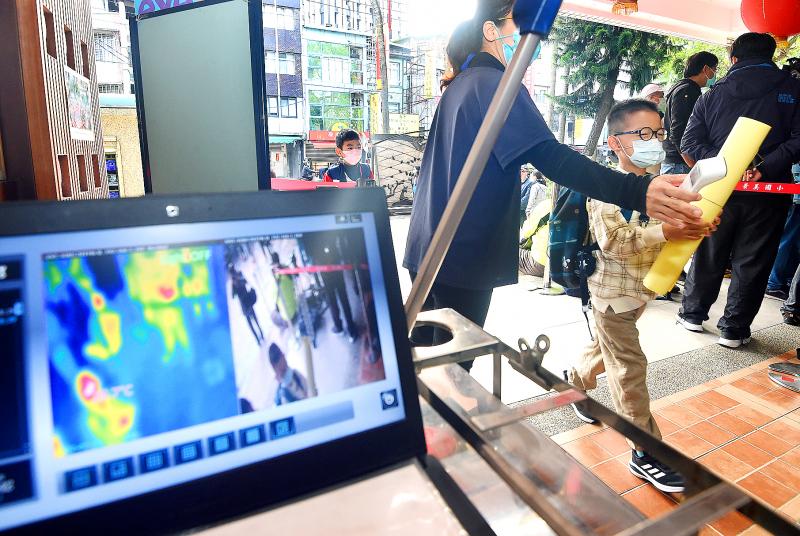
Photo: Liao Chen-huei, Taipei Times
However, gathering data is difficult, as younger children often cannot describe their symptoms, he said.
Infected children rarely described muscle aches, shivers or loss of smell, likely due to their inability to describe the symptoms, he said.
The CECC yesterday reported 18 domestically transmitted cases, included a high-school student in Tainan, Lo said, adding that the city’s health authorities ordered the school to temporarily close for disinfection.
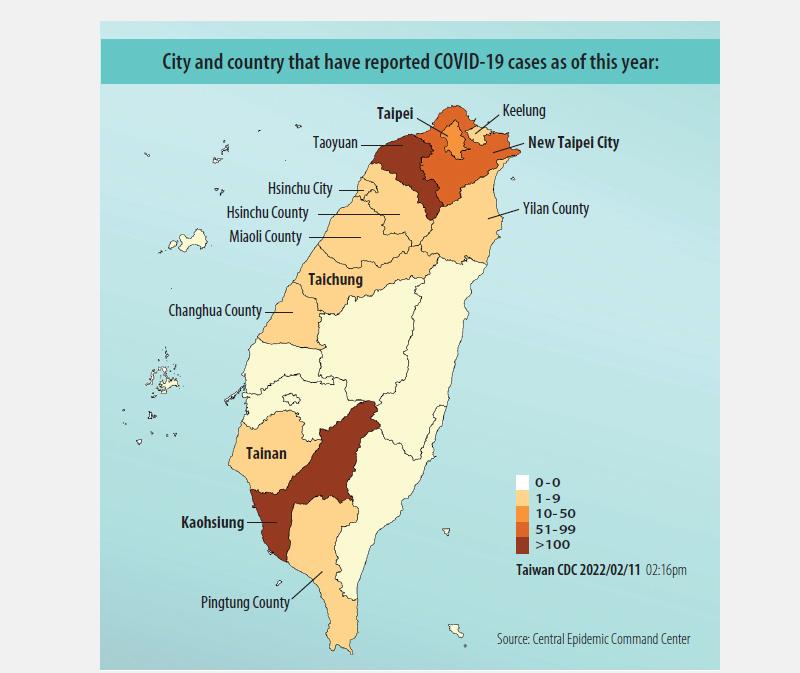
Tainan Mayor Huang Wei-che (黃偉哲) said that 145 people had been identified as contacts of the girl, adding that 134 of them have been ordered to quarantine and 11 have been ordered to observe self-health management protocols.
The protocols require listed contacts of COVID-19 cases to wear masks at all times outside and avoid situations where they might come into close contact with others.
Huang said that 210 secondary contacts of the student had undergone COVID-19 tests, but so far none of them tested positive.
The student, who lives in Kaohsiung, was tested along with her parents on Thursday, after a friend of hers tested positive the day before, he said.
From Monday to Wednesday, the student attended a winter camp, potentially coming in contact with many children under the age of 12, Huang said.
Separately, the New Taipei City Government yesterday highlighted another case reported yesterday with a potentially large number of contacts, a worker at a Kebuke tea shop.
It was the second case at the branch, after another worker was confirmed to have COVID-19 on Thursday, and it remains unknown where the two contracted the virus, the city government said.
New Taipei City Mayor Hou You-yi (侯友宜) said health authorities discovered the second case when testing close contacts of the first case at the outlet.
However, only one of the first case’s 19 close contacts identified so far tested positive, Hou said, adding that contact tracing would continue, including in southern Taiwan, where the case traveled during the Lunar New Year holiday.
The CECC yesterday also reported 61 imported cases, arrivals from Australia, Bangladesh, Brazil, Canada, France, Germany, India, Mexico, Myanmar, the Philippines, Singapore, South Korea, the UK, the United Arab Emirates, the US and Vietnam.

Actor Darren Wang (王大陸) was sentenced to six months in prison, commutable to a fine, by the New Taipei District Court today for contravening the Personal Data Protection Act (個人資料保護法) in a case linked to an alleged draft-dodging scheme. Wang allegedly paid NT$3.6 million (US$114,380) to an illegal group to help him evade mandatory military service through falsified medical documents, prosecutors said. He transferred the funds to Chen Chih-ming (陳志明), the alleged mastermind of a draft-evasion ring, although he lost contact with him as he was already in detention on fraud charges, they said. Chen is accused of helping a

SECURITY: Starlink owner Elon Musk has taken pro-Beijing positions, and allowing pro-China companies to control Taiwan’s critical infrastructure is risky, a legislator said Starlink was reluctant to offer services in Taiwan because of the nation’s extremely high penetration rates in 4G and 5G services, the Ministry of Digital Affairs said yesterday. The ministry made the comments at a meeting of the legislature’s Transportation Committee, which reviewed amendments to Article 36 of the Telecommunications Management Act (電信管理法). Article 36 bans foreigners from holding more than 49 percent of shares in public telecommunications networks, while shares foreigners directly and indirectly hold are also capped at 60 percent of the total, unless specified otherwise by law. The amendments, sponsored by Chinese Nationalist Party (KMT) Legislator Ko

UNREASONABLE SURVEILLANCE: A camera targeted on an road by a neighbor captured a man’s habitual unsignaled turn into home, netting him dozens of tickets The Taichung High Administrative Court has canceled all 45 tickets given to a man for failing to use a turn signal while driving, as it considered long-term surveillance of his privacy more problematic than the traffic violations. The man, surnamed Tseng (曾), lives in Changhua County and was reported 45 times within a month for failing to signal while driving when he turned into the alley where his residence is. The reports were filed by his neighbor, who set up security cameras that constantly monitored not only the alley but also the door and yard of Tseng’s house. The surveillance occurred from July

‘SAME OLD TRICK’: Even if Beijing resumes individual travel to Taiwan, it would only benefit Chinese tourism companies, the Economic Democracy Union convener said China’s 10 new “incentives” are “sugar-coated poison,” an official said yesterday, adding that Taiwanese businesses see them clearly for what they are, but that Beijing would inevitably find some local collaborators to try to drums up support. The official, speaking on condition of anonymity, made the remark ahead of a news conference the General Chamber of Commerce is to hold today. The event, titled “Industry Perspectives on China’s Recent Pro-Taiwan Policies,” is expected to include representatives from industry associations — such as those in travel, hotels, food and agriculture — to request the government cooperate with China’s new measures, people familiar with


 RSS
RSS