

The Chinese Nationalist Party (KMT) illegally obtained land in Taipei that was formerly the site of the Institute of Revolutionary Practice, the Ill-gotten Party Assets Settlement Committee said yesterday, ordering the party to pay NT$3.2 billion (US$114.95 million) in compensation.
From 1954 to 1974, the KMT-affiliated institute administered the land and building in Wenshan District (文山), which was known as the Chunghsing Estate (中興山莊), the committee said.
The KMT’s income from membership fees from 1953 to June 1980 comprised only 1.83 percent of the institute’s income, while government subsidies made up 85.38 percent, the committee said.
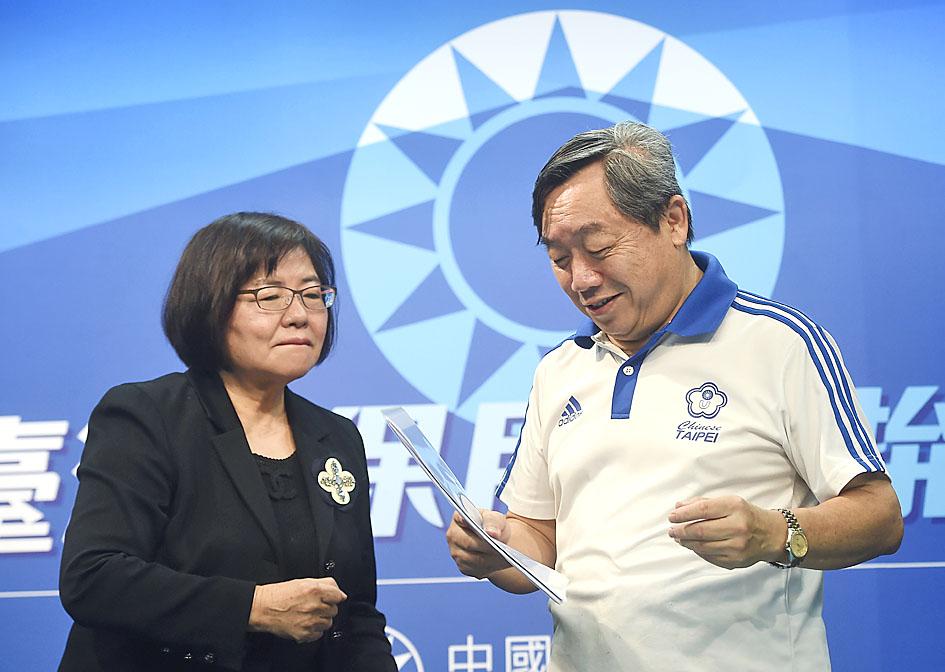
Photo: Chien Jung-fong, Taipei Times
The KMT’s solution to “balance its budget” was to ask members who were in office to increase government subsidies or transfer party work to the government, the committee said, adding that the KMT had even taken out interest-free loans from the central bank to pay institute expenses.
These are not normal actions for political parties and there is reason to believe that all legitimate income the party procured was depleted between 1953 and 1980, so the funds it used to procure the estate were illegitimate, the committee said.
As the asset has been transferred to the Taipei City Government and Yuanlih Group, the Act Governing the Handling of Ill-gotten Properties by Political Parties and Their Affiliate Organizations (政黨及其附隨組織不當取得財產處理條例), stipulates that the KMT should pay NT$3.2 billion — the price it sold the asset for minus taxes, the committee said.
Yuanlih Group said it would donate NT$801.34 million to the state and yesterday signed a settlement with the committee.
Yuanlih bought some of the land with plans to construct residential buildings.
KMT Administration and Management Committee director Chiu Da-chan (邱大展) said that the party has the sale contract to prove that it purchased the land for much more than it had sold it for.
The committee should provide proof if it is accusing the party of having appropriated state funds for illegitimate use, Chiu said.
KMT Disciplinary Committee director Lee Guei-min (李貴敏) said that the party would take appropriate legal action.

A Straits Exchange Foundation official today warned that yielding to political pressure in exchange for access to China’s entertainment industry rarely ends well, amid rumors that China is seeking to lure Taiwanese K-pop star Chou Tzu-yu (周子瑜). Chou, more commonly known as Tzuyu, is the only Taiwanese member of the girl group Twice. Her contract with JYP Entertainment is set to expire at the end of this year, and there have been widespread reports that she would not renew it. She is reportedly planning to pursue solo activities under her parents’ agency, Yu Hai Entertainment (瑜海娛樂), although China has also reportedly offered
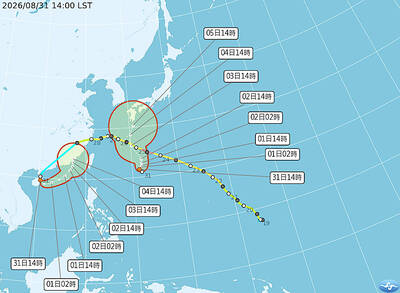
A tropical depression near Hainan that was once Typhoon Saudel may once again strengthen into a tropical storm, the Central Weather Administration (CWA) said yesterday, but a sea warning for waters around Taiwan is unlikely. CWA forecaster Huang En-hung (黃恩鴻) said that Saudel would return to being a weak tropical storm by late yesterday or early this morning. However, as the storm is to gradually weaken again and would head toward China’s Guangdong Province away from Taiwan, the chances that it would affect Taiwan enough for the CWA to issue a sea warning are relatively low,
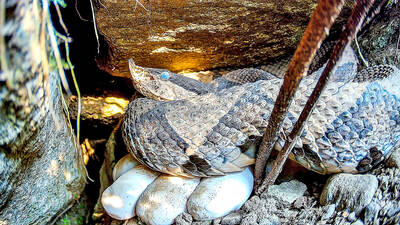
NATURE TAKES ITS COURSE: The agency’s head said he felt a sense of loss watching red-banded snakes eat the babies, as they had decided on non-intervention The Forestry and Nature Conservation Agency yesterday released a documentary on a hundred-pace viper that had incubated 16 eggs, all of which hatched, but only a baby viper escaped after they were attacked by red-banded snakes. The agency’s Taichung branch last year launched the viper reproduction monitoring project soon after forest rangers Lin Chun-yu (林俊佑) and Chou Chia-cheng (周家成) spotted a pregnant hundred-pace viper in a grass-covered burrow near a parking lot in Tbulan Village (松鶴部落). The Atayal village, in Taichung’s Heping District (和平), is headed by Ecyang Yapu, who was positive about the project and assisted in access control and power
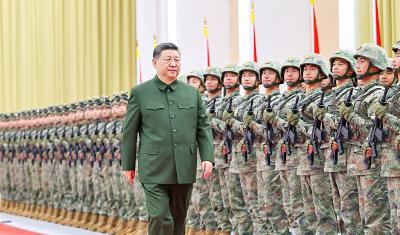
China has revised its National Defense Mobilization Law to prepare for a rapid transition to wartime, with an official today saying the measures are aimed at helping Chinese President Xi Jinping (習近平) fulfill his “historic mission of national unification.” The revised version of the mobilization law is to take effect on Oct. 1, marking the first major revision since the law was enacted in 2010. The amendments define national defense mobilization as measures taken in response to threats to national sovereignty, unification, territorial integrity, security and development interests, including efforts to ensure rapid transition between peacetime and wartime and convert economic and


 RSS
RSS