


The New Taipei City Government has recognized an artisan who has been restoring statues of deities for more than three decades for his contributions to cultural preservation.
Chin Ming-wei (金明偉), 52, has restored more than 10,000 statues of deities over the past 30 years, including those at Taipei’s Xiahai City God Temple and New Taipei City’s Baohe Temple in Lujhou District (蘆洲).
Last year, he received a plaque from a temple that named him the “god of healing” and received an award from the New Taipei City Government for his contributions to the preservation of intangible culture.
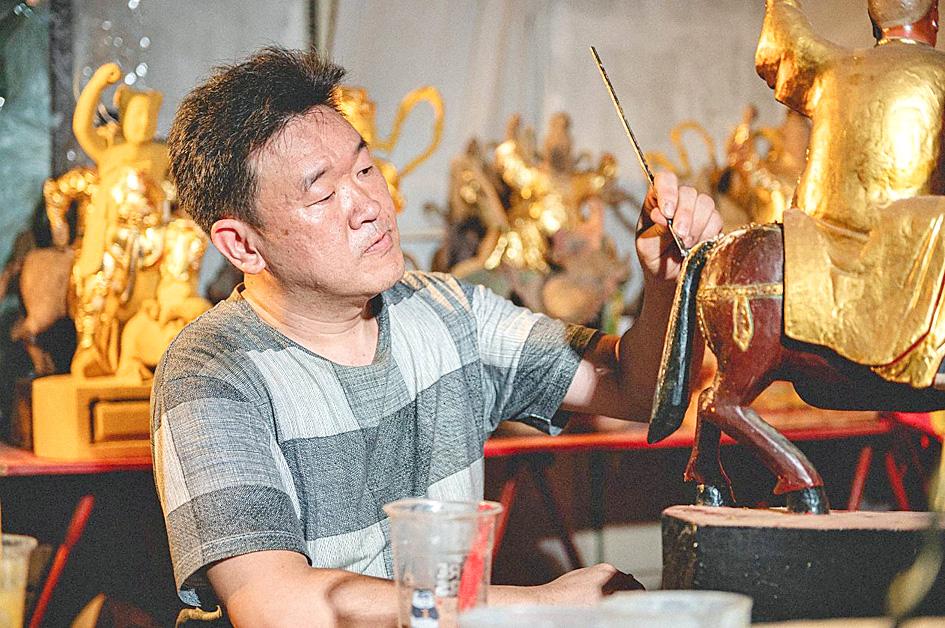
Photo courtesy of Chin Ming-wei
“When I entered junior-high school I had no interest in studies,” Chin said on Jan. 30. “I was at a store for Buddhist implements in Taipei’s Wanhua District (萬華) when my mother suggested that I learn statue restoration from the artist working at the store.”
Chin studied as an apprentice with the store’s artist for three years, he said, adding that the first statue he restored on his own was one of the Taoist deity Guanze Zunwang (廣澤尊王) that he bought in Changhua County’s Lugang Township (鹿港).
“The face of the statue was eaten by moths. I worked on it for two months, and I was moved by the results. Since then, I have been immersed in the art,” he said. “Thirty years have gone by in the blink of an eye.”
Chin has worked with temples in Taipei and New Taipei City, and between 1995 and 1997 he worked for the Lin Family Mansion and Garden (林本源園邸) in New Taipei City’s Banciao District (板橋), restoring relics on the property.
Chin became associated with Xiahai City God Temple after he helped it restore an ancient plaque that was badly damaged by termites.
“The most important thing when it comes to the restoration of religious statues is that you must retain the original appearance. You cannot have it look new after restoration,” he said. “The statue must show traces of the years it has been through. Do not innovate, follow the footsteps of the artists who came before you.”
Restoring a statue is like curing it of a disease, he said, adding that he hangs an incense bag on the statue before beginning restoration.
Chin said he was once cured of back pain after restoring a statue from a doctor’s collection.
The art of statue restoration has been in decline since the 1990s, when China began mass producing statues and restoring them at low cost.
“In the time it would take a Taiwanese artist to restore one statue, China could make 10 to 20 replacement statues,” he said. “Lots of Taiwanese artists moved on to other fields.”

Considering that most countries issue more than five denominations of banknotes, the central bank has decided to redesign all five denominations, the bank said as it prepares for the first major overhaul of the banknotes in more than 24 years. Central bank Governor Yang Chin-lung (楊金龍) is expected to report to the Legislative Yuan today on the bank’s operations and the redesign’s progress. The bank in a report sent to the legislature ahead of today’s meeting said it had commissioned a survey on the public’s preferences. Survey results showed that NT$100 and NT$1,000 banknotes are the most commonly used, while NT$200 and NT$2,000

The Centers for Disease Control (CDC) yesterday reported the first case of a new COVID-19 subvariant — BA.3.2 — in a 10-year-old Singaporean girl who had a fever upon arrival in Taiwan and tested positive for the disease. The girl left Taiwan on March 20 and the case did not have a direct impact on the local community, it said. The WHO added the BA.3.2 strain to its list of Variants Under Monitoring in December last year, but this was the first imported case of the COVID-19 variant in Taiwan, CDC Deputy Director-General Lin Ming-cheng (林明誠) said. The girl arrived in Taiwan on

South Korea is planning to revise its controversial electronic arrival card, a step Taiwanese officials said prompted them to hold off on planned retaliatory measures, a South Korean media report said yesterday. A Yonhap News Agency report said that the South Korean Ministry of Foreign Affairs is planning to remove the “previous departure place” and “next destination” fields from its e-arrival card system. The plan, reached after interagency consultations, is under review and aims to simplify entry procedures and align the electronic form with the paper version, a South Korean ministry official said. The fields — which appeared only on the electronic form

The Ministry of Foreign Affairs (MOFA) is suspending retaliation measures against South Korea that were set to take effect tomorrow, after Seoul said it is updating its e-arrival system, MOFA said today. The measures were to be a new round of retaliation after Taiwan on March 1 changed South Korea's designation on government-issued alien resident certificates held by South Korean nationals to "South Korea” from the "Republic of Korea," the country’s official name. The move came after months of protests to Seoul over its listing of Taiwan as "China (Taiwan)" in dropdown menus on its new online immigration entry system. MOFA last week


 RSS
RSS