


The death of air force pilot Chen Yi (陳奕) in the crash of an F-16V jet on Tuesday last week was from blunt-force trauma caused by a high-speed impact, the prosecutor responsible for investigating the case said on Monday.
The finding was based on an autopsy conducted on bones and skin tissue found at the crash site near the Aogu Wetlands (鰲鼓溼地) in Chiayi County’s Dongshih Township (東石) over the past few days, Chiayi County Chief Prosecutor Tsai Ying-chun (蔡英俊) said.
Tests conducted on a DNA sample taken from Chen’s mother confirmed that the human remains retrieved from the site belonged to Chen, Tsai said.
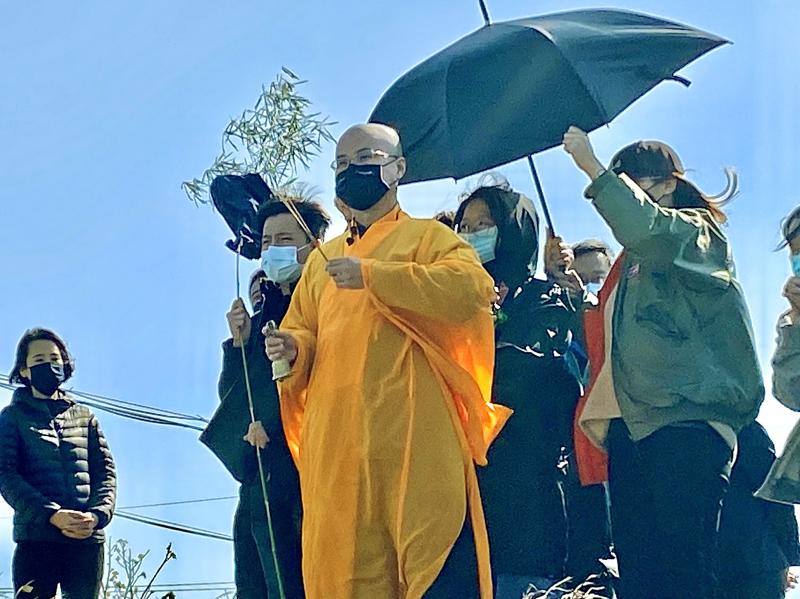
Photo: Tsai Tsung-hsun, Taipei Times
An autopsy was conducted on the remains, which concluded that the cause of death was a severe high-speed impact, resulting in deadly, full-body, multiple blunt-force traumas, Tsai said.
Searchers on Monday also found human tissue that might be part of Chen’s scalp, and tests would be conducted to see if it belongs to him, Tsai said.
Earlier on Monday, the prosecutors’ office issued an autopsy certificate to Chen’s family that serves in place of a death certificate, enabling the family to claim state compensation and handle funeral matters.
The F-16V piloted by Chen with the serial number 6650 disappeared from radar screens at 3:23pm on Tuesday last week, about 30 minutes after it took off from Chiayi Air Base on a routine training mission with another aircraft.
The aircraft had just completed a series of simulated missile launches, when it abruptly nosedived into the sea near the wetlands, the pilot of the other jet, a ground controller and a witness said.
The flight recorder of the crashed jet has been found and sent to aviation experts, raising hopes of finding clues to the cause of the crash, which has confounded experts so far.
Searchers found the device on Monday evening, an air force press release said.
The device was handed to professionals to retrieve its flight history data, the air force said.
An ad hoc investigation committee has been formed to determine the cause of the crash.

Considering that most countries issue more than five denominations of banknotes, the central bank has decided to redesign all five denominations, the bank said as it prepares for the first major overhaul of the banknotes in more than 24 years. Central bank Governor Yang Chin-lung (楊金龍) is expected to report to the Legislative Yuan today on the bank’s operations and the redesign’s progress. The bank in a report sent to the legislature ahead of today’s meeting said it had commissioned a survey on the public’s preferences. Survey results showed that NT$100 and NT$1,000 banknotes are the most commonly used, while NT$200 and NT$2,000

The Centers for Disease Control (CDC) yesterday reported the first case of a new COVID-19 subvariant — BA.3.2 — in a 10-year-old Singaporean girl who had a fever upon arrival in Taiwan and tested positive for the disease. The girl left Taiwan on March 20 and the case did not have a direct impact on the local community, it said. The WHO added the BA.3.2 strain to its list of Variants Under Monitoring in December last year, but this was the first imported case of the COVID-19 variant in Taiwan, CDC Deputy Director-General Lin Ming-cheng (林明誠) said. The girl arrived in Taiwan on

South Korea is planning to revise its controversial electronic arrival card, a step Taiwanese officials said prompted them to hold off on planned retaliatory measures, a South Korean media report said yesterday. A Yonhap News Agency report said that the South Korean Ministry of Foreign Affairs is planning to remove the “previous departure place” and “next destination” fields from its e-arrival card system. The plan, reached after interagency consultations, is under review and aims to simplify entry procedures and align the electronic form with the paper version, a South Korean ministry official said. The fields — which appeared only on the electronic form

The Ministry of Foreign Affairs (MOFA) is suspending retaliation measures against South Korea that were set to take effect tomorrow, after Seoul said it is updating its e-arrival system, MOFA said today. The measures were to be a new round of retaliation after Taiwan on March 1 changed South Korea's designation on government-issued alien resident certificates held by South Korean nationals to "South Korea” from the "Republic of Korea," the country’s official name. The move came after months of protests to Seoul over its listing of Taiwan as "China (Taiwan)" in dropdown menus on its new online immigration entry system. MOFA last week


 RSS
RSS