


The Taipei Performing Arts Center is soon to open its doors for a trial run from March to May to test all three of its auditoriums, Taipei Deputy Mayor Tsai Ping-kun (蔡炳坤) said on Tuesday.
The 59,000m2 cultural landmark, which cost NT$6.75 billion (US$244.4 million) and took 10 years to complete, would host 15 performance groups and 58 shows during the trial phase from March 11 to May 15, Tsai told a news conference.
“Finally, the Taipei Performing Arts Center will welcome the people of Taipei, and I’m sure a lot of people will be deeply moved and filled with anticipation,” he said.
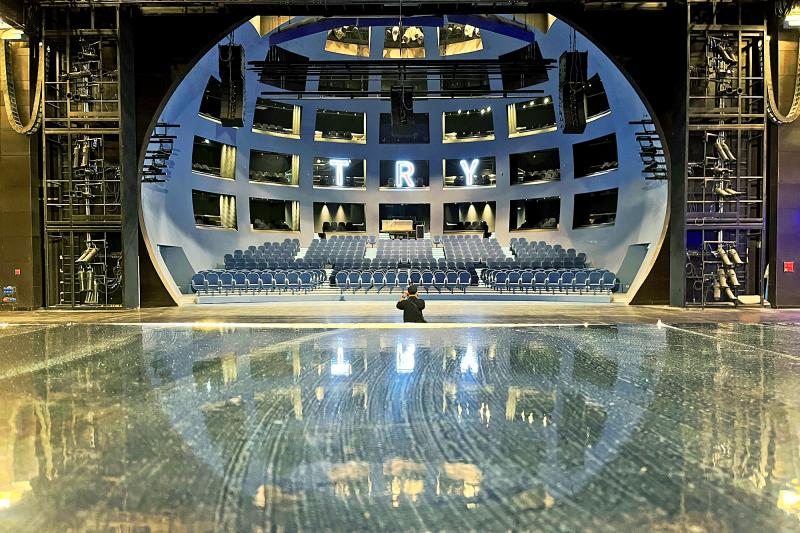
Photo: CNA
One of the auditoriums that complement the complex’s futuristic design is the Globe Playhouse, a spherical 800-seat theater that resembles a planet. The center also features the Grand Theater, a 1,500-seat venue, and the Blue Box, an 800-seat multiform theater for experimental performances, Tsai said.
The complex has made international headlines, and the center’s opening is considered one of Asia’s most important cultural developments of the year, he added.
The complex is expected to boost Taiwan’s performing arts as it would provide a venue not just for accomplished performers, but also for up-and-coming talent to help them grow, Taipei Performing Arts Center chairwoman Liu Ruo-yu (劉若瑀) said.
“It’s like opening a door for performers at all levels to be able to come in,” Liu said. “We wish to make the Taipei Performing Arts Center an international landmark, where people will come from around the world to watch artists perform.”
The new center soars above the bustle of the Shilin Night Market (士林夜市), famous for its night life and one of the city’s must-visit tourist destinations.
People coming to watch shows would also complement the vibrant commercial activity in the area, center CEO Austin Wang (王孟超) said.
“We hope we can attract more theaters, coffee shops, restaurants and art galleries to pop up in the area,” Wang said.
Construction for the Taipei Performing Arts Center started in 2012, and the building topped out in August 2014. The facility was commissioned by the Taipei City Government to support performing arts groups.
The complex is expected to fully open in July with the official opening in August, the center said in a statement.
More information on tickets for performances during the center’s trial phase can be found at www.tpac-taipei.org.
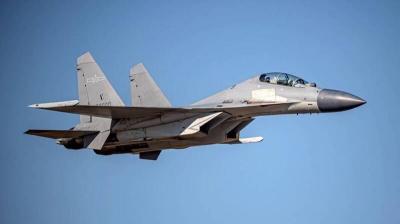
Eight Chinese naval vessels and 24 military aircraft were detected crossing the median line of the Taiwan Strait between 6am yesterday and 6am today, the Ministry of National Defense said this morning. The aircraft entered Taiwan’s northern, central, southwestern and eastern air defense identification zones, the ministry said. The armed forces responded with mission aircraft, naval vessels and shore-based missile systems to closely monitor the situation, it added. Eight naval vessels, one official ship and 36 aircraft sorties were spotted in total, the ministry said.
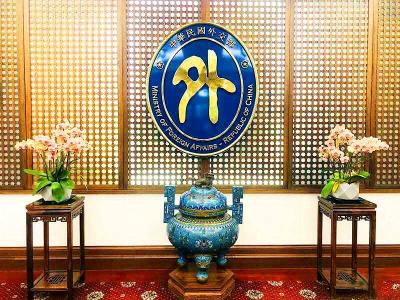
The Ministry of Foreign Affairs (MOFA) today said that if South Korea does not reply appropriately to its request to correct Taiwan’s name on its e-Arrival card system before March 31, it would take corresponding measures to alter how South Korea is labeled on the online Taiwan Arrival Card system. South Korea’s e-Arrival card system lists Taiwan as “China (Taiwan)” in the “point of departure” and “next destination” fields. The ministry said that it changed the nationality for South Koreans on Taiwan’s Alien Resident Certificates from “Korea” to “South Korea” on March 1, in a gesture of goodwill and based on the
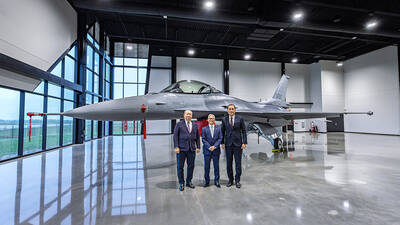
Taiwanese officials were shown the first of 66 F-16V fighter jets purchased by Taiwan from the United States, the Ministry of National Defense said yesterday, adding the aircraft has completed an initial flight test and is expected to be delivered later this year. A delegation led by Deputy Minister of National Defense Hsu Szu-chien (徐斯儉) visited Lockheed Martin’s F-16 C/D Block 70 (also known as F-16V) assembly line in South Carolina on March 16 to view the aircraft. The jet will undergo a final acceptance flight in the US before being delivered to Taiwan, the
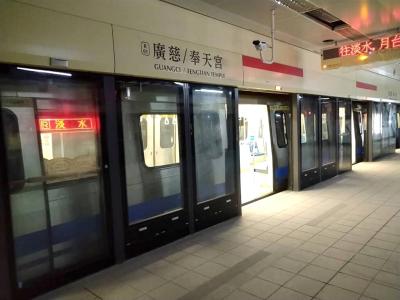
The New Taipei Metro's Sanyin Line and the eastern extension of the Taipei Metro's Tamsui-Xinyi Line (Red Line) are scheduled to begin operations in June, the National Development Council said today. The Red Line, which terminates at Xiangshan Station, would be connected by the 1.4km extension to a new eastern terminal, Guangci/Fengtian Temple Station, while the Sanyin Line would link New Taipei City's Tucheng and Yingge stations via Sanxia District (三峽). The council gave the updates at a council meeting reviewing progress on public construction projects for this year. Taiwan's annual public infrastructure budget would remain at NT$800 billion (US$25.08 billion), with NT$97.3


 RSS
RSS