


The government has chosen 72 elite athletes to participate in a “Golden Plan” for the 2024 Summer Olympics in Paris and 78 for the 2028 Summer Olympics in Los Angeles, the Sports Administration said on Wednesday.
The “Golden Plan,” which was first developed to train athletes for the 2020 Tokyo Olympic Games, identifies elite athletes who have the best chances of winning gold, silver or bronze medals at the Olympics, and provides them with customized training and optimal resources.
Acting Sports Administration Director-General Lin Terng-chiao (林騰蛟) said in a statement that Taiwanese athletes scored two golds, four silvers and six bronzes in Tokyo last year, the nation’s best performance.
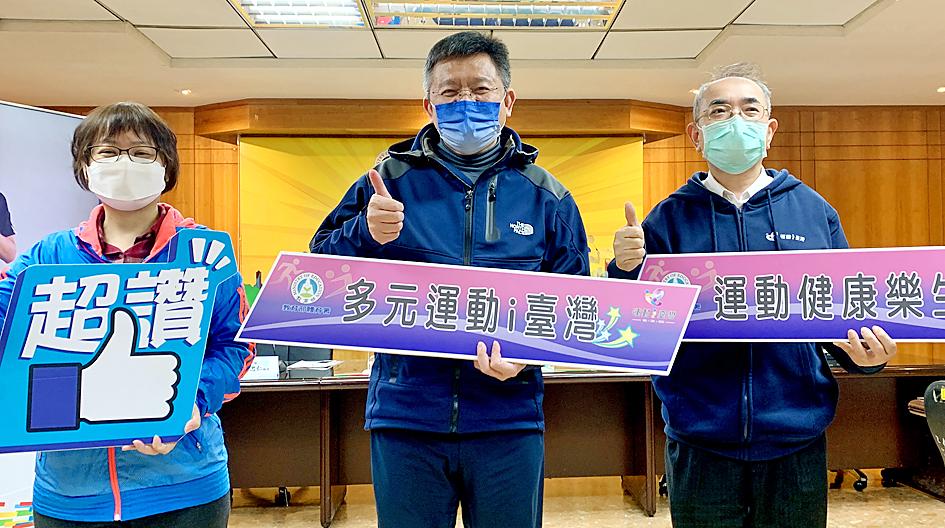
Photo: CNA
To prepare for the Summer Games in 2024 and 2028, Lin said that the plan has been upgraded to “Golden Plan 2.0.”
Lin said that the new version divides the elite athletes into five levels.
Athletes in Level 1 won gold in Tokyo or have accumulated enough points to be in the world’s top three.
Athletes in Level 2 were in the world’s top three at the latest world championships, won gold at the latest Asian Games or have accumulated enough points to be in the world’s top five.
Athletes in Level 3 won silver at the latest Asian Games or have accumulated enough points to be in the world’s top eight.
Athletes in Levels 4 and 5 were in the top three at the latest Universiade, Youth Olympic Games, Asian championships or world junior championships; were in the top two at the Asian youth championships or the Asian Youth Games; or had outstanding performances in domestic sports events and were recommended by experts for their potential.
Elite athletes who competed in the Tokyo Olympics have been placed in the first three levels, depending on their performance, the agency said, adding that they are to receive personalized training to prepare them to compete in Paris.
“For the 2024 and 2028 Olympic Games, we have also selected other athletes based on their results on athletic tests and on their performance in the last year,” the agency said.
The Golden Plan 2.0 list of elite athletes was finalized at the end of last year through deliberations by the Competition Enhancement Committee at the National Sport Training Center, it said.
National sports associations have been requested to endorse the athletes’ training plans from this month, it added.
The agency said that it has amended the regulations so that athletes training for competitions have more flexibility to stay current on schoolwork.
The government has budgeted NT$8.69 billion (US$314.31 million) toward the construction of new tennis courts and swimming pool facilities near the National Sports Training Center, it said.
The construction would be completed in 2026, it added.

Considering that most countries issue more than five denominations of banknotes, the central bank has decided to redesign all five denominations, the bank said as it prepares for the first major overhaul of the banknotes in more than 24 years. Central bank Governor Yang Chin-lung (楊金龍) is expected to report to the Legislative Yuan today on the bank’s operations and the redesign’s progress. The bank in a report sent to the legislature ahead of today’s meeting said it had commissioned a survey on the public’s preferences. Survey results showed that NT$100 and NT$1,000 banknotes are the most commonly used, while NT$200 and NT$2,000

The Centers for Disease Control (CDC) yesterday reported the first case of a new COVID-19 subvariant — BA.3.2 — in a 10-year-old Singaporean girl who had a fever upon arrival in Taiwan and tested positive for the disease. The girl left Taiwan on March 20 and the case did not have a direct impact on the local community, it said. The WHO added the BA.3.2 strain to its list of Variants Under Monitoring in December last year, but this was the first imported case of the COVID-19 variant in Taiwan, CDC Deputy Director-General Lin Ming-cheng (林明誠) said. The girl arrived in Taiwan on

South Korea is planning to revise its controversial electronic arrival card, a step Taiwanese officials said prompted them to hold off on planned retaliatory measures, a South Korean media report said yesterday. A Yonhap News Agency report said that the South Korean Ministry of Foreign Affairs is planning to remove the “previous departure place” and “next destination” fields from its e-arrival card system. The plan, reached after interagency consultations, is under review and aims to simplify entry procedures and align the electronic form with the paper version, a South Korean ministry official said. The fields — which appeared only on the electronic form

The Ministry of Foreign Affairs (MOFA) is suspending retaliation measures against South Korea that were set to take effect tomorrow, after Seoul said it is updating its e-arrival system, MOFA said today. The measures were to be a new round of retaliation after Taiwan on March 1 changed South Korea's designation on government-issued alien resident certificates held by South Korean nationals to "South Korea” from the "Republic of Korea," the country’s official name. The move came after months of protests to Seoul over its listing of Taiwan as "China (Taiwan)" in dropdown menus on its new online immigration entry system. MOFA last week


 RSS
RSS