


A man who killed one person and injured three others from the same family while driving under the influence (DUI) of alcohol last month in Kaohsiung has been officially charged with homicide.
The 38-year-old man, Huang Tzu-yang (黃子洋), was aware that he was unable to operate a vehicle safely and might get into a crash that could result in death or injury, but still drove his vehicle at about 7pm on Dec. 26 after drinking some alcohol, the Kaohsiung District Prosecutors’ Office said in a statement yesterday.
Because Huang should have known not to drive drunk and his drunk driving resulted in someone’s death, he was indicted for indirectly intended criminal homicide, it said, adding that prosecutors recommended giving Huang a harsh penalty.
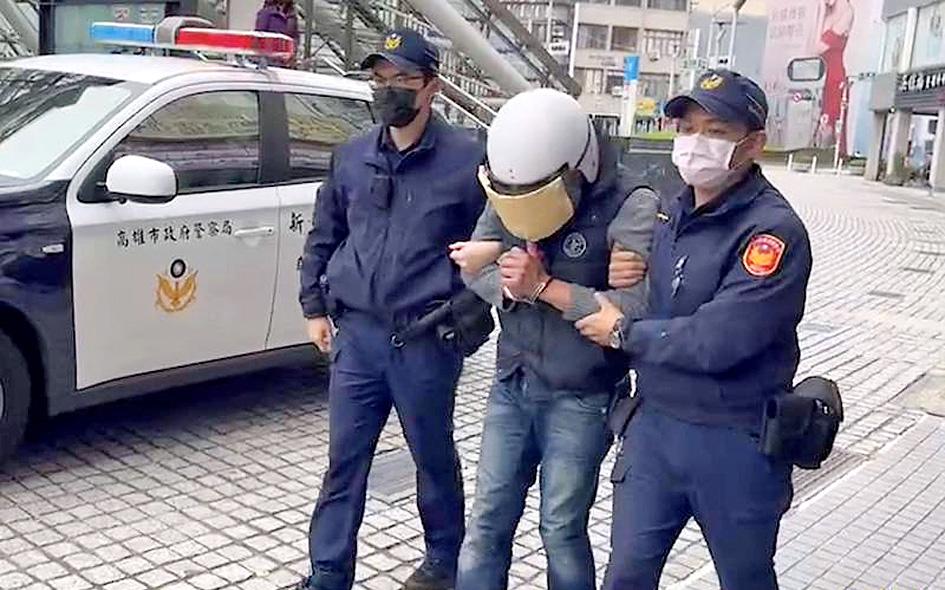
Photo: Huang Liang-chieh, Taipei Times
Driving without a license, Huang hit the family of four with his BMW sedan as they were on a pedestrian crossing in the city’s Cianjin District (前金).
Huang was arrested at the scene by police, and a test showed that his blood alcohol level was 1.24 milligrams per liter (mg/l), about five times the legal limit of 0.25mg/l.
On Dec. 28, the Kaohsiung District Court ruled that Huang be detained for driving under the influence resulting in death and offenses against public safety.
Huang is a repeat offender, with a DUI in 2006 and another in 2009, although neither injured anyone, police said.
On the evening of last month’s incident, Huang had a few drinks, including whiskey, at a cafe, before heading to an eatery for dinner with friends.
However, on the way, he struck the family of four at the intersection of Hedong Road and Guomin Street in Cianjin, police said.
The mother, 37, surnamed Fan (范), showed no vital signs at the scene and was declared dead upon arriving at a hospital, while her husband, 45, and two daughters, aged 15 and 13, are still in intensive care.

Considering that most countries issue more than five denominations of banknotes, the central bank has decided to redesign all five denominations, the bank said as it prepares for the first major overhaul of the banknotes in more than 24 years. Central bank Governor Yang Chin-lung (楊金龍) is expected to report to the Legislative Yuan today on the bank’s operations and the redesign’s progress. The bank in a report sent to the legislature ahead of today’s meeting said it had commissioned a survey on the public’s preferences. Survey results showed that NT$100 and NT$1,000 banknotes are the most commonly used, while NT$200 and NT$2,000

The Centers for Disease Control (CDC) yesterday reported the first case of a new COVID-19 subvariant — BA.3.2 — in a 10-year-old Singaporean girl who had a fever upon arrival in Taiwan and tested positive for the disease. The girl left Taiwan on March 20 and the case did not have a direct impact on the local community, it said. The WHO added the BA.3.2 strain to its list of Variants Under Monitoring in December last year, but this was the first imported case of the COVID-19 variant in Taiwan, CDC Deputy Director-General Lin Ming-cheng (林明誠) said. The girl arrived in Taiwan on

South Korea is planning to revise its controversial electronic arrival card, a step Taiwanese officials said prompted them to hold off on planned retaliatory measures, a South Korean media report said yesterday. A Yonhap News Agency report said that the South Korean Ministry of Foreign Affairs is planning to remove the “previous departure place” and “next destination” fields from its e-arrival card system. The plan, reached after interagency consultations, is under review and aims to simplify entry procedures and align the electronic form with the paper version, a South Korean ministry official said. The fields — which appeared only on the electronic form

The Ministry of Foreign Affairs (MOFA) is suspending retaliation measures against South Korea that were set to take effect tomorrow, after Seoul said it is updating its e-arrival system, MOFA said today. The measures were to be a new round of retaliation after Taiwan on March 1 changed South Korea's designation on government-issued alien resident certificates held by South Korean nationals to "South Korea” from the "Republic of Korea," the country’s official name. The move came after months of protests to Seoul over its listing of Taiwan as "China (Taiwan)" in dropdown menus on its new online immigration entry system. MOFA last week


 RSS
RSS