


Democratic Progressive Party (DPP) legislators on Friday called for a Cabinet task force to tackle urea shortages, as prices soar for the additive used in diesel vehicles to reduce emissions.
Demand for urea has risen since the Environmental Protection Administration in September last year announced new emissions standards for diesel vehicles, DPP Legislator Chung Chia-pin (鍾佳濱) told a news conference in Taipei.
More than half of domestic diesel vehicles need the additive, he said.
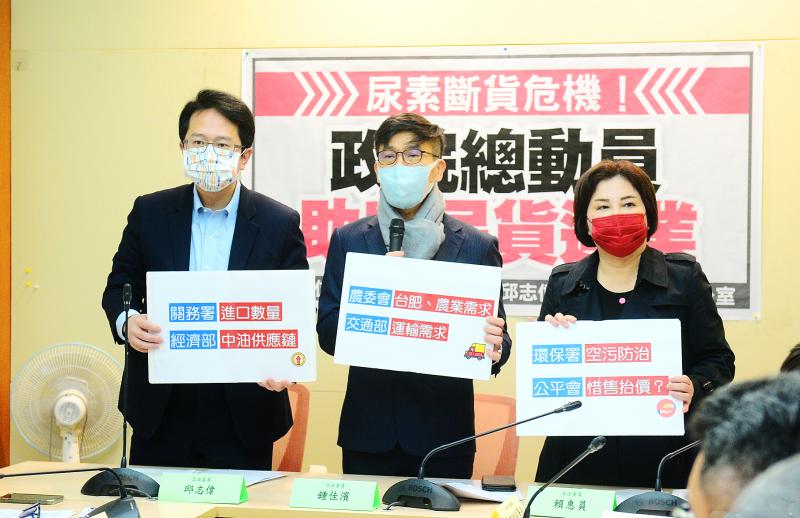
Photo: Wang Yi-sung, Taipei Times
The global supply of urea has been destabilized since China in October tightened control over the chemical’s export, while many industries in South Korea are also affected due to urea shortages, he said.
Taiwan Fertilizer no longer produces urea and imports it from overseas, he added.
Taiwan imports about 15,000 tonnes of urea every year, and a shortage would affect many sectors related to automotive and agricultural industries, among others, Chung said.
Imported urea prices soared from US$281.2 per tonne in January 2020 to US$834 per tonne in November, DPP Legislator Lai Hui-yuan (賴惠員) said, citing Customs Administration data.
As urea is also used in fertilizers, the government should ensure that farmers have a sufficient supply, she said.
The government should investigate potential hoarding to inflate the price, Lai said, adding that heavier penalties are needed to prevent such behavior.
Urea should be listed as a strategic material, DPP Legislator Chiu Chih-wei (邱志偉) said, calling on the Ministry of Economic Affairs to protect urea supply.
The ministry should establish an emergency response group to tackle the crisis by closely monitoring supply and demand of urea, while setting up an interagency group to secure the chemical from other countries, he said.
It should also ask local suppliers to meet domestic demand before exporting urea, he added.
The ministry should evaluate all strategic materials that are primarily imported, while seeking alternate sources for them, he said.
It should also convene a meeting with Taiwan Fertilizer and other firms to deliberate whether the nation could resume urea production, Chiu said.
Suppliers project that urea stocks would be sufficient until March and April, while CPC Corp, Taiwan fuel stations are selling urea in limited amounts, Industrial Development Bureau Secretary-General Chou Chung-pin (周崇斌) said.
The Bureau of Foreign Trade is seeking other suppliers in Indonesia and Japan, he added.
The bureau has tightened control over the export of urea, while establishing a platform with the Ministry of Transportation and Communications to allow freight operators to seek other sources of urea, Chou said.
With more than 20,000 tonnes of urea in stock, Taiwan Fertilizer can supply the substance until the end of June, Agriculture and Food Agency Secretary-General Chen Chi-lung said.
The agency is looking to stabilize the prices of urea fertilizers, and farmers are required to register their names when purchasing the fertilizers to promote efficient use, he said.

Considering that most countries issue more than five denominations of banknotes, the central bank has decided to redesign all five denominations, the bank said as it prepares for the first major overhaul of the banknotes in more than 24 years. Central bank Governor Yang Chin-lung (楊金龍) is expected to report to the Legislative Yuan today on the bank’s operations and the redesign’s progress. The bank in a report sent to the legislature ahead of today’s meeting said it had commissioned a survey on the public’s preferences. Survey results showed that NT$100 and NT$1,000 banknotes are the most commonly used, while NT$200 and NT$2,000

The Centers for Disease Control (CDC) yesterday reported the first case of a new COVID-19 subvariant — BA.3.2 — in a 10-year-old Singaporean girl who had a fever upon arrival in Taiwan and tested positive for the disease. The girl left Taiwan on March 20 and the case did not have a direct impact on the local community, it said. The WHO added the BA.3.2 strain to its list of Variants Under Monitoring in December last year, but this was the first imported case of the COVID-19 variant in Taiwan, CDC Deputy Director-General Lin Ming-cheng (林明誠) said. The girl arrived in Taiwan on

South Korea is planning to revise its controversial electronic arrival card, a step Taiwanese officials said prompted them to hold off on planned retaliatory measures, a South Korean media report said yesterday. A Yonhap News Agency report said that the South Korean Ministry of Foreign Affairs is planning to remove the “previous departure place” and “next destination” fields from its e-arrival card system. The plan, reached after interagency consultations, is under review and aims to simplify entry procedures and align the electronic form with the paper version, a South Korean ministry official said. The fields — which appeared only on the electronic form

The Ministry of Foreign Affairs (MOFA) is suspending retaliation measures against South Korea that were set to take effect tomorrow, after Seoul said it is updating its e-arrival system, MOFA said today. The measures were to be a new round of retaliation after Taiwan on March 1 changed South Korea's designation on government-issued alien resident certificates held by South Korean nationals to "South Korea” from the "Republic of Korea," the country’s official name. The move came after months of protests to Seoul over its listing of Taiwan as "China (Taiwan)" in dropdown menus on its new online immigration entry system. MOFA last week


 RSS
RSS