


Taiwan’s military showcased its urban terrain operational capabilities yesterday in exercises at a mock town inside an infantry training center in Kaohsiung.
In the drill, platoons from the 586th Armored Brigade and the 333rd Mechanized Infantry Brigade conducted “red-blue” exercises, with red playing the role of an invading force and blue on defense.
The exercise took place in a 6,599m2 compound inside the Army Infantry Training Command in Fengshan District (鳳山).
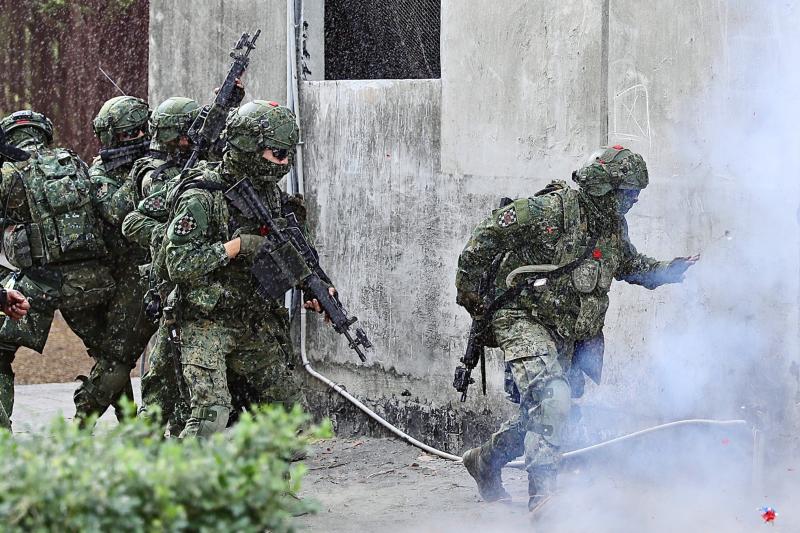
Photo: RITCHIE B. TONGO, EPA-EFE
The soldiers wore multiple integrated laser engagement systems (MILES) from the US.
The system uses lasers and blank cartridges for training purposes.
Aside from the troops, each side also mobilized one CM32 and one CM33 armored vehicle, and two other eight-wheeled vehicles.
The mock town — built to allow simulations of military operations in urban terrain — has 26 buildings.
The area has neighborhoods and alleys similar to those in Taiwan.
Urban terrain operations are known for their fast-tempo, short-range and high-pressure environments, and the mock town features rows of gray buildings designed to help soldiers develop skills for real-world situations, the army said.
The mock town, which was built decades ago, is regularly upgraded to mimic up-to-date urban environments.
It allows infantry soldiers to hone the skills needed for house-to-house and street-by-street fighting in towns and cities, the army said.
The MILES system was developed to facilitate battle simulation, it said.
Soldiers have laser sensors on their uniforms and weapons, which detect when they have been illuminated by a laser from a mock weapon in the system.
The data from an exercise allows commanders to conduct reviews and make adjustments immediately after each drill, the army said.
Since November 2019, 36 infantry platoons have conducted urban terrain operations at the mock town, with each session lasting two weeks, it said.
Yesterday’s drill was part of a three-day public demonstration that began on Wednesday.
Members of the media were allowed to observe the demonstration, which aims to showcase Taiwan’s combat readiness.
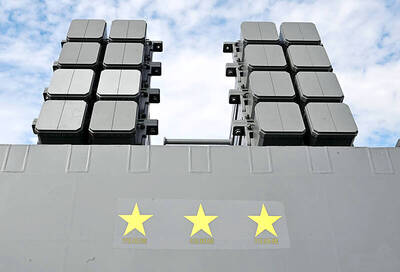
UPGRADE: The Kang Ding-class frigate is replacing its Chaparall missiles with Tien Chien II and Hua Yang VLS, which would provide it with long-range, 360° air defense Taiwan plans to produce 1,200 to 1,376 Hai Chien II missiles (海劍二, Sea Sword II) — also known as TC-2N — to serve as the standard air defense system of the navy’s surface combatant fleet, a source said yesterday. Last week, the Hai Chien II, the naval version of the Tien Kung II missile (天劍二, Sky Sword II), completed a live-fire test in waters off the National Chungshan Institute of Science and Technology’s Jiupeng facility (九鵬) in Pingtung County’s Manjhou Township (滿州). The MIM72 Chaparral and other dated air defense missiles that currently arm Taiwanese ships have inadequate range to combat Chinese

REASONS FOR TRAVEL: An assistant professor said that proposed amendments to penalize drivers if they used drugs overseas would not deter people from traveling People who operate a motor vehicle under the influence of marijuana would have their driver’s license revoked, even if they used the substance while overseas, the Ministry of Transportation and Communications said yesterday, citing proposed amendments to the Road Traffic Management and Penalty Act (道路交通管理處罰條例). The amendments would also authorize the government to revoke the licenses of people determined to have used Category 1 or Category 2 narcotics, even if they were not operating a vehicle while under the influence of drugs, as well as ban them from taking the license test for three years, the ministry said. People aged 18 or

HEAVY WEATHER: Typhoon Jangmi is due to crash straight into the Ryukyus as airlines look to shift flights to larger aircraft or cancel flights to Okinawa entirely Taiwan’s international air carriers announced flight adjustments over the weekend as Typhoon Jangmi is forecast to hit the Ryukyu Islands today and tomorrow. The Central Weather Administration (CWA) upgraded Jangmi from a tropical storm to a typhoon at 8am yesterday, with the eye located 580km south of Naha city. It was moving north at 19kph. Today, China Airlines’ CI-120, CI-121, CI-122 and CI-123 flights between Taoyuan and Naha, Okinawa, have been canceled as well as CI-132 and CI-133 between Kaohsiung and Naha. EVA Air’s BR-112, BR-113, BR-186 and BR-185 flights between Taoyuan and Naha are also canceled. Low-cost carrier Tigerair Taiwan canceled IT-230,
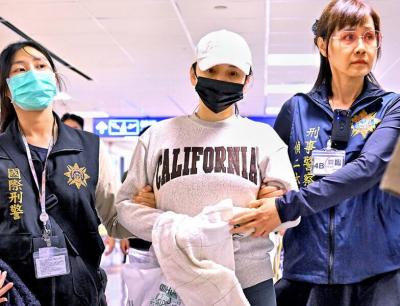
Johanne Liou (劉喬安), a Taiwanese woman who shot to unwanted fame during the Sunflower movement protests in 2014, returned to Taiwan last night after being deported from the US. She is to stand trial in Taiwan for charges involving embezzlement, fraud and drug crimes. The Criminal Investigation Bureau (CIB) said it took her into custody at Taiwan Taoyuan International Airport and would first question her before transferring her to the New Taipei District Prosecutors’ Office. She was arrested upon disembarking a flight from San Francisco that landed shortly before 7pm. Liou absconded to the US in 2019 after jumping bail


 RSS
RSS