


Taiwan is to work with Medical Excellence Japan to explore market opportunities in Southeast Asia, as a part of its effort to fortify ties with New Southbound Policy countries, the Cabinet’s Office of Trade Negotiations said yesterday.
The government in October last year established Medical Excellence Taiwan, which is this year to work with its Japanese counterpart to explore the medical care market in Southeast Asia, the office said.
The government’s New Southbound Policy covers the 10 ASEAN members, as well as Australia, Bangladesh, Bhutan, India, Nepal, Pakistan, Sri Lanka and New Zealand.
Since the start of the COVID-19 pandemic, Taiwan has faced many barriers in promoting international exchanges, such as training events related to natural disaster relief and agriculture, the office said, adding that the government still holds exchanges online and helps countries fight COVID-19 with medical equipment.
Over the past year, the government has retained more than 2,700 professionals from New Southbound Policy countries, including the first graduates of two industry-academia cooperation programs for foreign and overseas Taiwanese students, which show that Taiwan is a place for learning Mandarin as well as acquiring knowledge and vocational skills, the office said.
More than 110,000 visitors from the countries sought medical help in Taiwan during the first 10 months of last year, which accounted for nearly half of the nation’s total international medical services, it said.
NRICM101, a Chinese medicine-based herbal formula developed by Taiwanese researchers to treat symptoms of COVID-19, has been sold in the Philippines, Singapore, Thailand and other countries, it added.
Taiwan also donated oxygen concentrators, medical masks and personal protective equipment to India, Indonesia and Vietnam, it said.
The government and Taiwanese insurers in Vietnam convinced Hanoi to launch an international medical insurance program, which eases the burden of Vietnamese seeking treatment in Taiwan, the office said.
Taiwan also improved trade ties with New Southbound Policy countries through industrial forums and financial support, aiming to help Taiwanese businesses diversify investment risks by switching to Southeast and South Asian markets, it said.
From January last year to November, the total trade volume between Taiwan and New Southbound Policy countries reached US$135.6 billion, rising 38 percent year-on-year, the office said.
Export revenues to the countries have also steadily grown since October 2020, it added.
Taiwanese investment in the countries grew 116 percent year-on-year, while GlobalWafers invested in GWafers Singapore and Cathay Life Insurance increased capital to its branch in Vietnam, it said.
Taiwanese investment in India also rose 41 percent year-on-year; if counting Taiwanese investment through third countries, the nation has become one of India’s top-20 source countries of foreign investment, it said.
Under the government’s border control measures, visitors from New Southbound Policy countries still cannot visit Taiwan, but the government is striving to improve the nation’s tourism environment, the office said.
Taiwan was ranked No. 2 in the Global Muslim Travel Index among non-Organization of Islamic Cooperation tourist destinations, behind Singapore, it said.
Hopefully, more young people from New Southbound Policy countries would want to stay in Taiwan, while more Taiwanese goods — ranging from food products, smart technology systems and medical care services — would be available in those nations, the office said.


UPGRADE: The Kang Ding-class frigate is replacing its Chaparall missiles with Tien Chien II and Hua Yang VLS, which would provide it with long-range, 360° air defense Taiwan plans to produce 1,200 to 1,376 Hai Chien II missiles (海劍二, Sea Sword II) — also known as TC-2N — to serve as the standard air defense system of the navy’s surface combatant fleet, a source said yesterday. Last week, the Hai Chien II, the naval version of the Tien Kung II missile (天劍二, Sky Sword II), completed a live-fire test in waters off the National Chungshan Institute of Science and Technology’s Jiupeng facility (九鵬) in Pingtung County’s Manjhou Township (滿州). The MIM72 Chaparral and other dated air defense missiles that currently arm Taiwanese ships have inadequate range to combat Chinese

REASONS FOR TRAVEL: An assistant professor said that proposed amendments to penalize drivers if they used drugs overseas would not deter people from traveling People who operate a motor vehicle under the influence of marijuana would have their driver’s license revoked, even if they used the substance while overseas, the Ministry of Transportation and Communications said yesterday, citing proposed amendments to the Road Traffic Management and Penalty Act (道路交通管理處罰條例). The amendments would also authorize the government to revoke the licenses of people determined to have used Category 1 or Category 2 narcotics, even if they were not operating a vehicle while under the influence of drugs, as well as ban them from taking the license test for three years, the ministry said. People aged 18 or
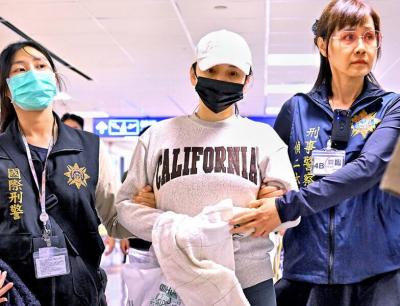
Johanne Liou (劉喬安), a Taiwanese woman who shot to unwanted fame during the Sunflower movement protests in 2014, returned to Taiwan last night after being deported from the US. She is to stand trial in Taiwan for charges involving embezzlement, fraud and drug crimes. The Criminal Investigation Bureau (CIB) said it took her into custody at Taiwan Taoyuan International Airport and would first question her before transferring her to the New Taipei District Prosecutors’ Office. She was arrested upon disembarking a flight from San Francisco that landed shortly before 7pm. Liou absconded to the US in 2019 after jumping bail
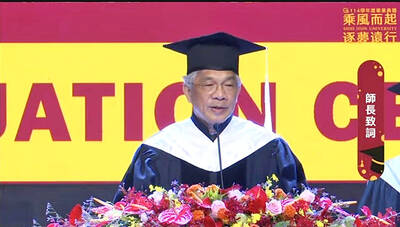
Shih Hsin University President Chen Ching-he (陳清河) yesterday issued a public apology for comments made in his commencement speech last week, stating that he has asked the school to suspend his duties and halt his wages for two months as a show of contrition. At the commencement ceremony on May 30, Chen said, “If you don’t manage your time well, or your own emotions, or your health, then I am telling every one of you — put a quick end to ‘you,’ because the world has no need for ‘you.’” The comments have sparked significant controversy online, and Chen through an open


 RSS
RSS