


A long-lost nude sculpture by late Taiwanese sculptor Huang Tu-shui (黃土水) is to be the central exhibit at a show at the Museum of National Taipei University of Education from today through April.
The exhibition, titled “Lumiere: The Enlightenment and Self-Awakening of Taiwanese Culture,” is to feature the newly rediscovered sculpture — Water of Immortality (甘露水), which was formerly known as Sweet Dew — along with paintings and writing by more than 20 Taiwanese artists and literary figures of the Japanese colonial period.
Curator Lin Mun-lee (林曼麗), who discovered the sculpture early this year, on Thursday expressed her happiness and excitement about the event, calling it “long overdue” and “highly anticipated” by art lovers and the general public.
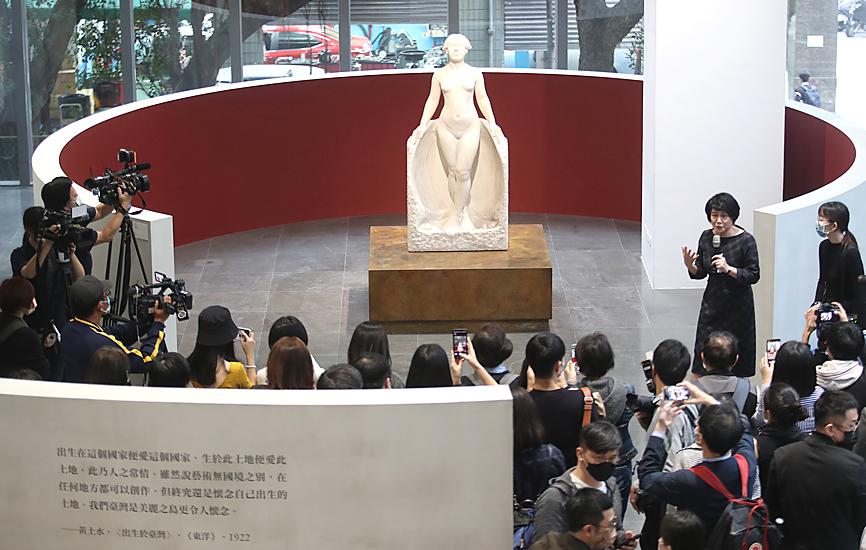
Photo: CNA
This year marks the centenary of the sculpture’s completion, as well as the founding of the Taiwan Cultural Association, which launched the New Cultural Movement and ushered in a golden age for Taiwanese art, she said.
“We are fortunate to be able to include Water of Immortality, which is the last piece of lost art history, in the exhibition,” she said.
The sculpture portrays a young woman in a calm yet confident upright posture with her head tilted slightly backward and both hands holding either side of a large shell behind her back.
“I have been watching her since the day she was placed in the gallery, and I find her more beautiful as the days go by,” Lin said.
“She’s finally reborn after more than 50 years in the dark,” Lin said, referring to the sculpture being kept in a wooden case for the past half century.
Chou Wan-yao (周婉窈), head of the exhibition’s research team, said that the exhibitions title tries to capture the spirit of Huang’s era, with “lumiere” (French for “light”) highlighting that artists were searching for the light of a better, more progressive future.
“Water of Immortality is the central symbol of light, representing Huang’s anticipation for Taiwan’s society at that time,” Chou said.
The exhibition also features works that were recently found or displayed for the first time ever, including late Taiwanese painter Ran In-ting’s (藍蔭鼎) A Noodle Stand at Night and Chen Chin’s (陳靜) Embroidering the Skirt.
Works from iconic Taiwanese painters, including Chen Cheng-po (陳澄波), Kuo Po-chuan (郭柏川), Liao Chi-chun (廖繼春), Li Mei-shu (李梅樹), Chen Chih-chi (陳植棋) and Kuo Hsueh-hu (郭雪湖), are also part of the exhibition, which runs through April 24.

NATIONAL SECURITY: Authorities are working to confirm the identities of the military personnel involved and investigating possible illegal conduct and regulatory violations Authorities are probing possible national security implications after Kinmen police and immigration officers on Sunday found a Chinese woman allegedly posing as a tourist while engaging in prostitution involving more than 10 military personnel. The woman, surnamed Chen (陳), has since been deported, authorities said, adding that investigators are still working to confirm the identities of those implicated, as the records only listed code names and aliases. The case stemmed from a report received by the Kinmen District Prosecutors’ Office on Friday last week from the Jinhu Precinct of the Kinmen County Police Bureau. On Sunday, police, along with the National Immigration

GLOBALGIVING: ‘ Caving to external pressure is not acceptable for an organization that has cultivated justice reform and human rights for 30 years,’ one NGO said A slew of non-government organizations (NGOs) have withdrawn from the GlobalGiving fundraising platform after it announced it would use “Chinese Taipei” instead of “Taiwan” from next month. The Taiwan Good Rice Association wrote on Facebook on Friday that it was informed on April 28 via a teleconference call of the change, which was made because the platform wanted to operate in China. Taiwan Good Rice is to terminate all cooperative relationships with GlobalGiving in response to the platform’s “unilateral and non-negotiable” decision to remove references to Taiwan, the NGO said. “Taiwan is in the official name of Taiwan Good Rice Association and the

HEAVY WEATHER: Typhoon Jangmi is due to crash straight into the Ryukyus as airlines look to shift flights to larger aircraft or cancel flights to Okinawa entirely Taiwan’s international air carriers announced flight adjustments over the weekend as Typhoon Jangmi is forecast to hit the Ryukyu Islands today and tomorrow. The Central Weather Administration (CWA) upgraded Jangmi from a tropical storm to a typhoon at 8am yesterday, with the eye located 580km south of Naha city. It was moving north at 19kph. Today, China Airlines’ CI-120, CI-121, CI-122 and CI-123 flights between Taoyuan and Naha, Okinawa, have been canceled as well as CI-132 and CI-133 between Kaohsiung and Naha. EVA Air’s BR-112, BR-113, BR-186 and BR-185 flights between Taoyuan and Naha are also canceled. Low-cost carrier Tigerair Taiwan canceled IT-230,
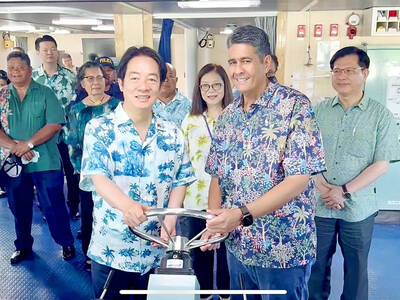
MULTIPRONGED APPROACH: China has sought to pressure Palau across a number of fronts, but the island nation has staunchly resisted overtures to ditch Taiwan Palau has been firm in backing Taiwan despite Chinese pressure that uses tourism economics, cyberattacks and criminal infiltration as tools to threaten the Pacific ally into renouncing its recognition of Taiwan as a sovereign state. The Presidential Office yesterday announced that Vice President Hsiao Bi-khim (蕭美琴) would visit Palau from Saturday to Wednesday next week at the invitation of Palauan President Surangel Whipps Jr. Whipps in April said in an interview that China had outspokenly asked Palau to “denounce Taiwan.” “And we have said: ‘We have no enemies, but nobody tells us who our friends are,’” he said. Whipps has told reporters multiple times


 RSS
RSS