

The Taiwan Railways Administration (TRA) should record all incidents, as well as the causes of the incidents, on its Web site so that the public can review them, the New Power Party (NPP) caucus said yesterday, calling for a comprehensive reform of the TRA after 222 abnormal operational incidents were reported between June and September.
While the TRA disclosed the incidents to the public when they occurred, it did not record the information for future reference, NPP deputy caucus whip Chen Jiau-hua (陳椒華) said, adding that the TRA’s monthly report of railway incidents is not made public until two months later.
“Statistics show that two to three incidents happen on the TRA system every day. This is not an illusion,” Chen said, adding that the number only included major incidents that must be reported.
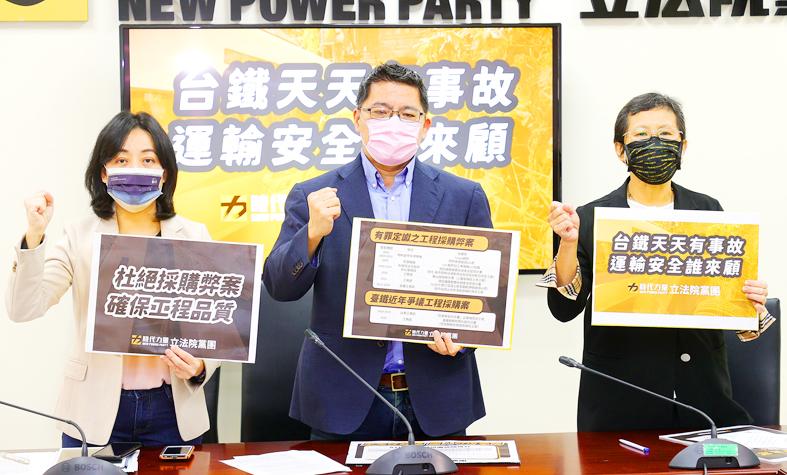
Photo: CNA
From 2006 to 2010, the TRA spent NT$21.2 billion (US$762.15 million) purchasing Taroko and Puyuma Express tilting trains to replace old trains and improve operational safety, but its incomplete train maintenance mechanism and inappropriate management of construction near railway lines led to the deadly derailments of Puyuma Express No. 6432 in 2018 and Taroko Express No. 408 this year, NPP Legislator Claire Wang (王婉諭) said.
The TRA also budgeted nearly NT$100 billion to procure EMU900 and EMU3000 trains from Japanese and South Korean manufacturers, with train carriages arriving in different batches from this year to 2026, Wang said.
“Buying new trains does not necessarily prevent incidents from happening. The TRA can only reduce the occurrence of incidents by thoroughly maintaining trains, examining the system and minimizing personnel errors,” Wang said.
The Taipei District Court on Thursday last week ruled that Japan’s Sumitomo Corp — the manufacturer of the Puyuma Express — was not liable for damage caused by the derailment in 2018 and does not need to pay compensation to the TRA.
The court and a Taiwan Transportation Safety Board investigation concluded that the Puyuma Express derailment in 2018 occurred because the TRA failed to properly maintain the train and identify a deactivated link in the telemonitoring and automatic train protection systems, Wang said, adding that the TRA was also found to have failed to implement standard operating procedures for train dispatchers.
As of October, the TRA had reported 341 incidents in which on-board facilities had failed this year, NPP caucus whip Chiu Hsien-chih (邱顯智) said.
In 2019 and last year, the number of incidents reported totaled 472 and 436 respectively, he said.
A Puyuma Express train on Dec. 3 activated its emergency braking system at Ruisui (瑞穗) Station in Hualien County due to a malfunctioning automatic train protection system, Chiu said.
The TRA said that the system has been in use since 1995 and its warranty has expired.
“The TRA’s explanation shows that it lacks a plan to replace devices before the warranty expires,” he said.
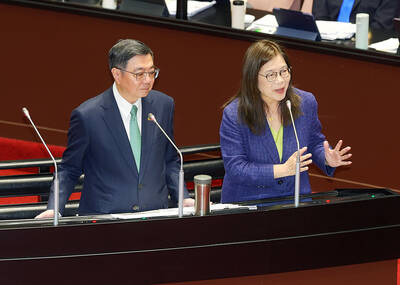
The donation of offshore patrol vessel Kinmen to the Philippines includes provisions that protect Taiwanese fishers and facilitate security cooperation across the First Island Chain, officials said yesterday. The comment was made during the Cabinet’s comprehensive administrative report at the legislature after Chinese Nationalist Party (KMT) Legislator Hsu Yu-chen (許宇甄) expressed concerns about the decision to give a ship to a country whose coast guard had in 2013 fired on a Taiwanese trawler and killed its captain without provocation. The Cabinet should lay out the safeguards that have been established to prevent the Philippine government from using the Kinmen to harass, expel
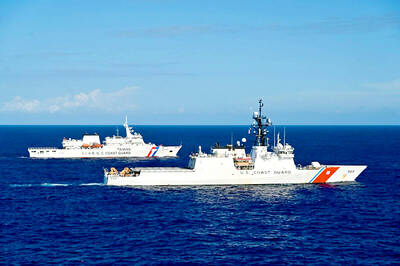
GROWING TIES: The CGA is planning a goodwill mission to the Philippines, in what would be the first time since 1975 a Taiwanese paramilitary vessel has visited the country The Coast Guard Administration (CGA) plans to significantly expand its participation in international security cooperative frameworks and its operational capabilities, a budget proposal for next year showed. The budget indicates a transformation of the CGA from a maritime law enforcement arm into a national defense and intelligence gathering entity capable of tackling larger regional security matters. The proposal showed that personnel from the coast guard’s Intelligence Division and Special Action Support Center are to participate in high-level national security talks with the US. As the CGA has dealt with China’s rising “gray zone” threats around Taiwan, it has become a valuable asset to
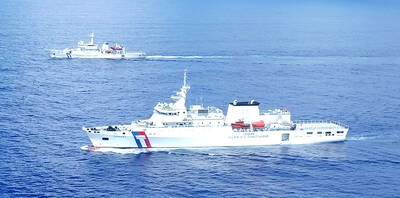
‘FRIENDSHIP FLEET’: A CGA official is scheduled to meet with the president of the Pacific nation, while one of the ships is to host a banquet and National Day event Two Coast Guard Administration (CGA) patrol vessels have docked at Malakal Harbor in Palau as part of an expedition exercise and diplomatic visit, during which a senior official is expected to meet with Palauan President Surangel Whipps Jr, the agency said yesterday. The two vessels, the 4,000-tonne-class Chiayi and the 1,000-tonne-class Penghu, set sail for Palau from Taiwan last week and arrived on Tuesday at Malakal Harbor, the CGA’s Fleet Branch said in a statement. The journey marks the second time the CGA has dispatched a “friendship fleet” to another country, after it sent its first-ever goodwill fleet, comprising the Hualien and
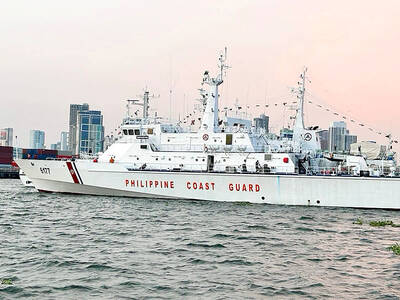
A patrol vessel donated by the Coast Guard Administration (CGA) to the Philippines was commissioned into the Philippine Coast Guard (PCG) on Friday, a Philippine non-governmental organization said. The CGA on Sept. 16 confirmed media reports that Taiwan had donated a retired 500-tonne patrol vessel to the Philippines. The Manila-based We Protect Our Seas (WPS) foundation, which served as an intermediary in the transfer, said that the vessel was formerly the CGA’s 500-tonne petrol vessel Kinmen (CG123). The WPS, in a statement issued on Friday, said the vessel, renamed as the BRP Sarangani, had been commissioned into the PCG the


 RSS
RSS