


On the final weekend before Saturday’s referendum, heavyweights from both major parties yesterday held events to garner support for their parties’ positions on the referendum questions.
On the ballot would be questions related to banning the importation of pork containing traces of the leanness-enhancing feed additive ractopamine, relocating a natural gas terminal project to protect algal reefs off Taoyuan’s Guanyin District (觀音), restarting construction of the Fourth Nuclear Power Plant in New Taipei City’s Gongliao District (貢寮) and holding referendums alongside elections.
Speaking at the Democratic Progressive Party’s (DPP) event in Tainan, President Tsai Ing-wen (蔡英文), who is DPP chairperson, said it was imperative that everyone support the government’s policies at a time of increasing pressure on Taiwan from China.
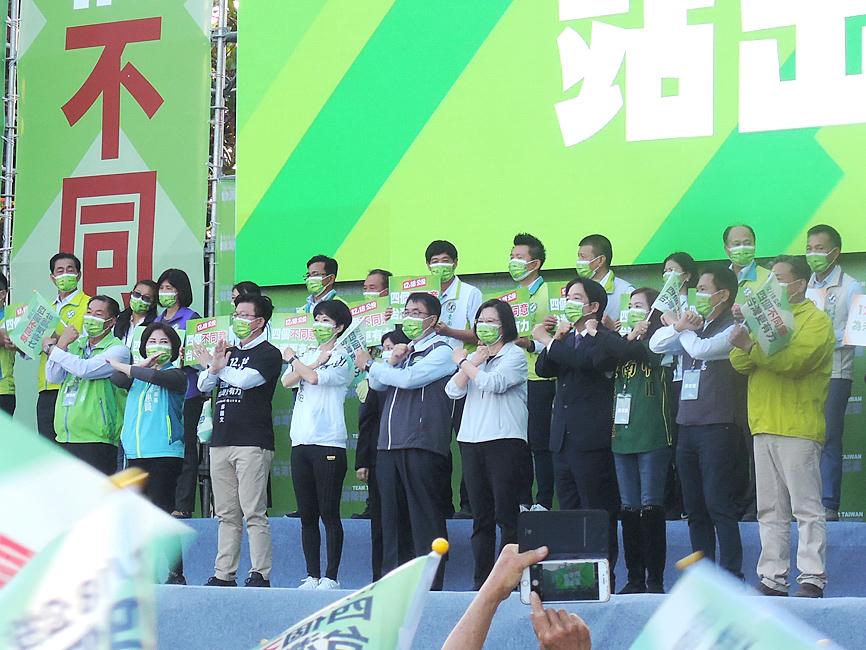
Photo: Tsai Wen-chu, Taipei Times
Tainan has traditionally had the highest participation rate in referendums, and she hoped residents of the southern city would vote again this year to “protect the heart of Taiwan,” she added.
Premier Su Tseng-chang (蘇貞昌) urged Taiwanese to vote “no” on all four referendum items and admonished the Chinese Nationalist Party (KMT) for initiating the questions.
“With these four referendums, the KMT is making a mess of Taiwan while cozying up to China. They are going to devastate Taiwan,” he said.
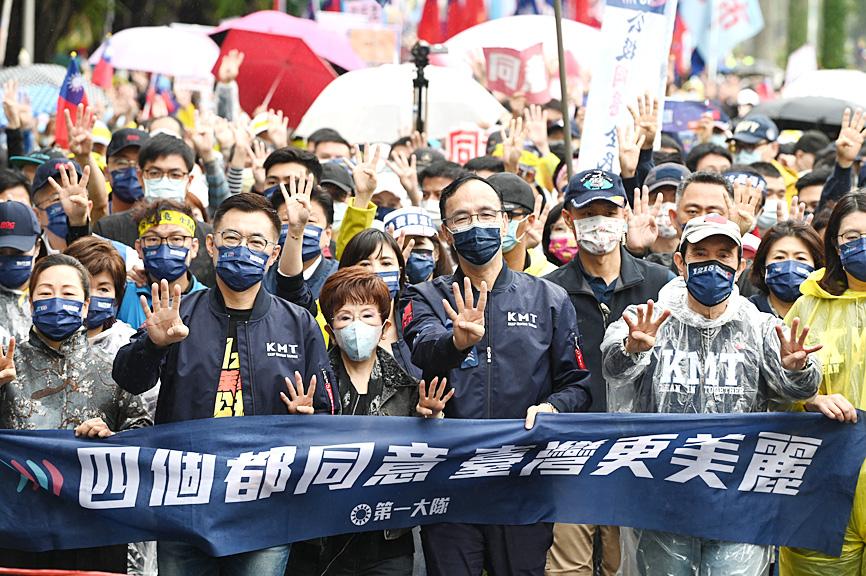
Photo: Tien Yu-hua, Taipei Times
The event was also attended by Vice President William Lai (賴清德), who earlier yesterday appeared at DPP rallies in Miaoli County and Hsinchu City, saying that the outcome of the referendums was of great concern to Taiwan’s economic development and democracy.
The DPP yesterday posted a short video on Facebook and YouTube featuring Keelung Mayor Lin Yu-chang (林右昌), Taoyuan Mayor Cheng Wen-tsan (鄭文燦) and Hsinchu Mayor Lin Chih-chien (林智堅), who encouraged people to vote “no” on the four items.
Separately yesterday, the KMT held a march in Taipei, calling for the public to vote “yes” on all questions.
KMT supporters and members, including Chairman Eric Chu (朱立倫), former president Ma Ying-jeou (馬英九), and several city mayors and county commissioners gathered at the Chiang Kai-shek Memorial Hall, chanting slogans and waving banners.
New Taipei City Mayor Hou You-yi (侯友宜) and Taichung Mayor Lu Shiow-yen (盧秀燕) were absent from the event.
In response to media queries, Chu said that both had expressed their full support for the four items.
“Whether in attendance at the event in person or online, the goal of all KMT mayors and commissioners today is to express the will of the people,” he said. “Vote ‘yes’ on all four referendums, so that Taiwan can be even more beautiful.”
After the event, the group marched toward the Presidential Office Building, where it met with participants of the Autumn Struggle, an annual protest organized by labor rights advocates.
The Autumn Struggle demonstrators laid out large banners on Ketegalan Boulevard calling for the protection of algal reefs off Taoyuan and a ban on imported pork containing traces of ractopamine.
Additional reporting by Yang Chun-hui and Tsai Chang-sheng
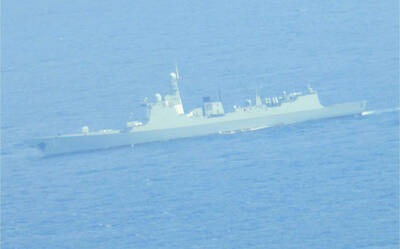
The military has spotted two Chinese warships operating in waters near Penghu County in the Taiwan Strait and sent its own naval and air forces to monitor the vessels, the Ministry of National Defense (MND) said. Beijing sends warships and warplanes into the waters and skies around Taiwan on an almost daily basis, drawing condemnation from Taipei. While the ministry offers daily updates on the locations of Chinese military aircraft, it only rarely gives details of where Chinese warships are operating, generally only when it detects aircraft carriers, as happened last week. A Chinese destroyer and a frigate entered waters to the southwest
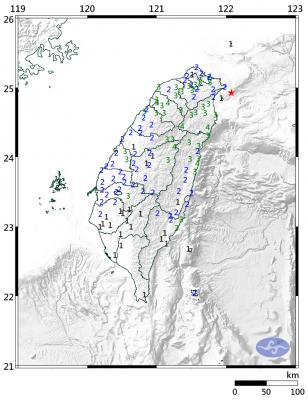
A magnitude 6.1 earthquake struck off the coast of Yilan County at 8:39pm tonight, the Central Weather Administration (CWA) said, with no immediate reports of damage or injuries. The epicenter was 38.7km east-northeast of Yilan County Hall at a focal depth of 98.3km, the CWA’s Seismological Center said. The quake’s maximum intensity, which gauges the actual physical effect of a seismic event, was a level 4 on Taiwan’s 7-tier intensity scale, the center said. That intensity level was recorded in Yilan County’s Nanao Township (南澳), Hsinchu County’s Guansi Township (關西), Nantou County’s Hehuanshan (合歡山) and Hualien County’s Yanliao (鹽寮). An intensity of 3 was
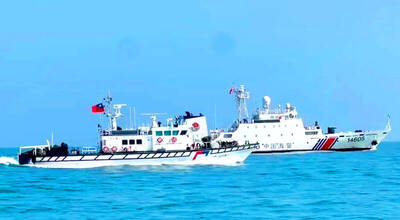
Instead of focusing solely on the threat of a full-scale military invasion, the US and its allies must prepare for a potential Chinese “quarantine” of Taiwan enforced through customs inspections, Stanford University Hoover fellow Eyck Freymann said in a Foreign Affairs article published on Wednesday. China could use various “gray zone” tactics in “reconfiguring the regional and ultimately the global economic order without a war,” said Freymann, who is also a nonresident research fellow at the US Naval War College. China might seize control of Taiwan’s links to the outside world by requiring all flights and ships entering or leaving Taiwan
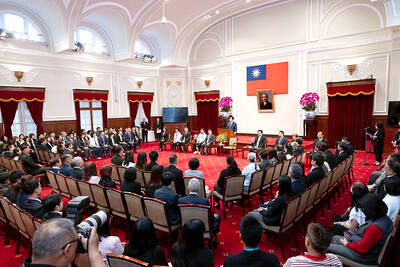
The next minimum wage hike is expected to exceed NT$30,000, President William Lai (賴清德) said yesterday during an award ceremony honoring “model workers,” including migrant workers, at the Presidential Office ahead of Workers’ Day today. Lai said he wished to thank the awardees on behalf of the nation and extend his most sincere respect for their hard work, on which Taiwan’s prosperity has been built. Lai specifically thanked 10 migrant workers selected for the award, saying that although they left their home countries to further their own goals, their efforts have benefited Taiwan as well. The nation’s industrial sector and small businesses lay


 RSS
RSS