

No loans were pledged to Nicaragua in the run-up to the Central American nation’s election on Nov. 7, the Ministry of Foreign Affairs said yesterday following the cessation of bilateral ties.
The ministry made the comment after the London-based Financial Times cited reports that said Taipei had agreed to provide a new loan to Nicaragua ahead of the election, which saw Nicaraguan President Daniel Ortega re-elected amid accusations by the US of voting irregularities.
Taiwanese banks refused to extend a loan pledged by Taiwanese authorities for fear of contravening US sanctions on Nicaragua, which were extended in the aftermath of Ortega’s re-election, the Financial Times reported.
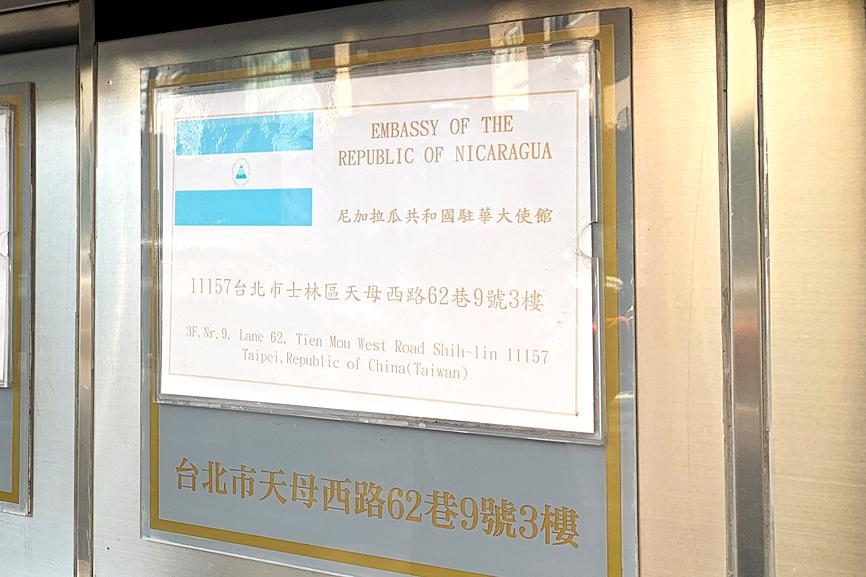
Photo: Sarah Wu, Reuters
Taiwan in February 2019 had agreed to provide a loan of US$100 million to its former ally, but the funds were to help Nicaragua rebuild its infrastructure in the wake of social unrest beginning in 2018 sparked by opposition to Ortega’s continued rule, the ministry said.
The bank it partnered with ultimately never provided the loan, due to “allocation issues,” it said without elaborating.
The loan was for “humanitarian assistance” and was not related in any way to last month’s disputed presidential election, the ministry said.
The US imposed a series of sanctions on Nicaraguan officials in 2018 due to what it described as human rights abuses and rampant corruption in the country under Ortega’s government.
Washington rolled out new sanctions on Nov. 15, denouncing Ortega’s re-election a week prior as a “sham” and saying that the Nicaraguan government was suppressing dissent and jailing opposition leaders.
In other news, the Ministry of Economic Affairs said that a free-trade agreement between Taiwan and Nicaragua remains in effect, despite the severing of formal diplomatic ties.
The pact was signed on June 16, 2006, and took effect on Jan. 1, 2008.
Either party can withdraw from the agreement with the exit taking effect 180 days after notification has been submitted, the economic ministry said.
Nicaragua has not provided such notification, so the pact remains in effect, it said.
Whether Managua would make a move on the deal is unclear, but Taiwan’s free-trade deal with El Salvador and Honduras is still in place, even though El Salvador broke diplomatic ties with Taiwan in 2018.
Even if Nicaragua were to end the agreement, it would have little effect on Taiwan’s foreign trade, the economic ministry said.
Taiwan’s exports to Nicaragua last year totaled US$22.94 million, or 0.01 percent of overall exports, while it imported US$143.56 million in goods from the Central American country, it said.
Taiwanese businesses that have invested in Nicaragua should also not be affected by the change in diplomatic status, given that they are registered as local businesses, it said.
Most Taiwanese businesses in Nicaragua are in the textile and tourism sectors, it said.

A Straits Exchange Foundation official today warned that yielding to political pressure in exchange for access to China’s entertainment industry rarely ends well, amid rumors that China is seeking to lure Taiwanese K-pop star Chou Tzu-yu (周子瑜). Chou, more commonly known as Tzuyu, is the only Taiwanese member of the girl group Twice. Her contract with JYP Entertainment is set to expire at the end of this year, and there have been widespread reports that she would not renew it. She is reportedly planning to pursue solo activities under her parents’ agency, Yu Hai Entertainment (瑜海娛樂), although China has also reportedly offered
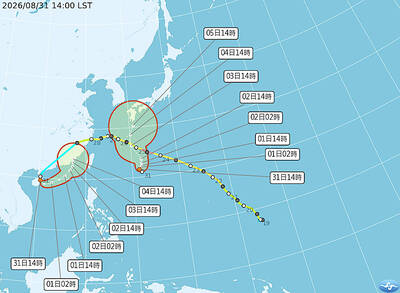
A tropical depression near Hainan that was once Typhoon Saudel may once again strengthen into a tropical storm, the Central Weather Administration (CWA) said yesterday, but a sea warning for waters around Taiwan is unlikely. CWA forecaster Huang En-hung (黃恩鴻) said that Saudel would return to being a weak tropical storm by late yesterday or early this morning. However, as the storm is to gradually weaken again and would head toward China’s Guangdong Province away from Taiwan, the chances that it would affect Taiwan enough for the CWA to issue a sea warning are relatively low,

The Coast Guard Administration (CGA) yesterday said that it had deployed vessels to “monitor” Chinese ships operating in waters off the east coast. The CGA said it dispatched vessels in response to a China Coast Guard announcement that it had carried out another “routine law-enforcement patrol” in waters off the east coast. “The CGA firmly rejects China’s cognitive warfare campaign of ‘law enforcement in name, jurisdictional expansion in practice,’” it said on X. As of 11am yesterday, two China Coast Guard ships were “loitering and drifting” about 105 nautical miles (195km) and 74 nautical miles east of Green Island (綠島) respectively, it said. It
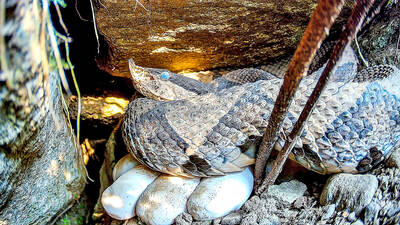
NATURE TAKES ITS COURSE: The agency’s head said he felt a sense of loss watching red-banded snakes eat the babies, as they had decided on non-intervention The Forestry and Nature Conservation Agency yesterday released a documentary on a hundred-pace viper that had incubated 16 eggs, all of which hatched, but only a baby viper escaped after they were attacked by red-banded snakes. The agency’s Taichung branch last year launched the viper reproduction monitoring project soon after forest rangers Lin Chun-yu (林俊佑) and Chou Chia-cheng (周家成) spotted a pregnant hundred-pace viper in a grass-covered burrow near a parking lot in Tbulan Village (松鶴部落). The Atayal village, in Taichung’s Heping District (和平), is headed by Ecyang Yapu, who was positive about the project and assisted in access control and power


 RSS
RSS