


Fewer traffic offenses can be reported by the public under updated regulations passed by the legislature yesterday in response to public and police frustration over excessive reporting.
According to the new rules, only offenses with serious implications for public safety can be reported, such as driving without a helmet or double parking.
Reporting minor infractions, such as parking on road lines, would no longer be permitted.
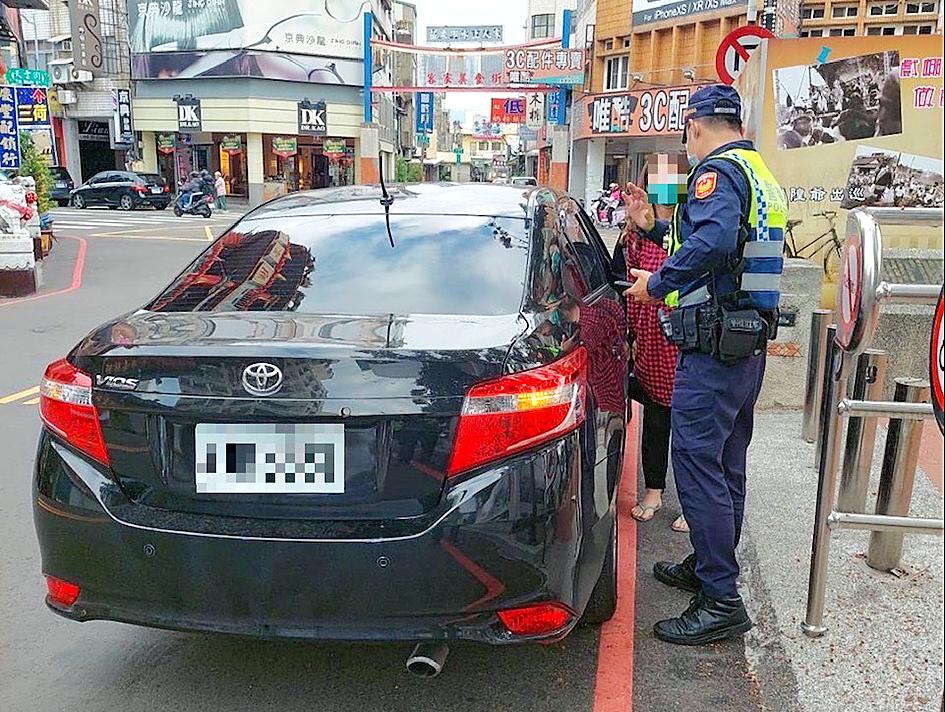
Photo: Chang Hsun-teng, Liberty Times
The number of traffic offenses reported by the public has climbed to an unsustainable volume for police in recent years, many of which are retaliatory.
National Police Agency data showed that reports nearly quadrupled from 1.53 million in 2016 to 5.98 million last year.
About one-third of all tickets issued by police last year, or 4.4 million, were reported by citizens.
About 60 percent of these, or 2.23 million, were for parking on a road line marking.
In response, the Legislative Yuan yesterday passed amendments to the Road Traffic Management and Penalty Act (道路交通管理處罰條例) limiting the types of offenses that can be reported.
Now only 46 types of relatively risky infractions that are difficult for police to monitor can be reported.
Moving offenses include leaking or dropping cargo, or emitting a foul odor; driving without a helmet; lighting a cigarette or holding a phone while driving; dangerous driving or transporting dangerous cargo on high-speed roadways; excessive honking or flashing; illegal passing, U-turns or weaving between vehicles; running a red light or railway crossing; and blocking emergency vehicles.
They also cover a limited number of stationary violations, including parking in an intersection, pedestrian crossing or sidewalk.
Parking within 10m of a bus stop or within 5m of an emergency vehicle depot can also be reported, as well as double parking and parking in a priority space.
To prevent excessive reporting, the same vehicle can only be reported once every six minutes and once per block. The existing statute of limitations would remain, with a driver exempted if police fail to issue a ticket within seven days.
The limited list is only meant to ease over-reporting, but does not mean that other infractions cannot be ticketed, Minister of Transportation and Communications Wang Kwo-tsai (王國材) said.

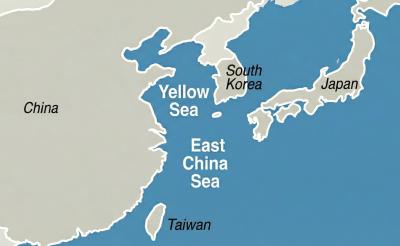
China has reserved offshore airspace in the Yellow Sea and East China Sea from March 27 to May 6, issuing alerts usually used to warn of military exercises, although no such exercises have been announced, the Wall Street Journal (WSJ) reported yesterday. Reserving such a large area for 40 days without explanation is an “unusual step,” as military exercises normally only last a few days, the paper said. These alerts, known as Notice to Air Missions (Notams), “are intended to inform pilots and aviation authorities of temporary airspace hazards or restrictions,” the article said. The airspace reserved in the alert is
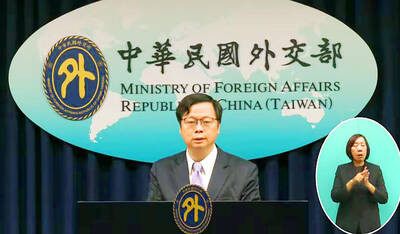
NAMING SPAT: The foreign ministry called on Denmark to propose an acceptable solution to the erroneous nationality used for Taiwanese on residence permits Taiwan has revoked some privileges for Danish diplomatic staff over a Danish permit that lists “Taiwan” as “China,” Eric Huang (黃鈞耀), head of the Ministry of Foreign Affairs’ Department of European Affairs, told a news conference in Taipei yesterday. Reporters asked Huang whether the Danish government had responded to the ministry’s request that it correct the nationality on Danish residence permits of Taiwanese, which has been listed as “China” since 2024. Taiwan’s representative office in Denmark continues to communicate with the Danish government, and the ministry has revoked some privileges previously granted to Danish representatives in Taiwan and would continue to review
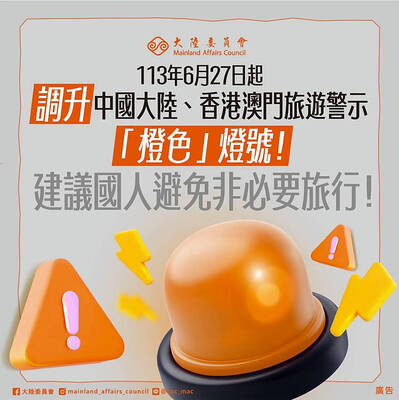
More than 6,000 Taiwanese students have participated in exchange programs in China over the past two years, despite the Mainland Affairs Council’s (MAC) “orange light” travel advisory, government records showed. The MAC’s publicly available registry showed that Taiwanese college and university students who went on exchange programs across the Strait numbered 3,592 and 2,966 people respectively. The National Immigration Agency data revealed that 2,296 and 2,551 Chinese students visited Taiwan for study in the same two years. A review of the Web sites of publicly-run universities and colleges showed that Taiwanese higher education institutions continued to recruit students for Chinese educational programs without

A bipartisan group of US senators has introduced a bill to enhance cooperation with Taiwan on drone development and to reduce reliance on supply chains linked to China. The proposed Blue Skies for Taiwan Act of 2026 was introduced by Republican US senators Ted Cruz and John Curtis, and Democratic US senators Jeff Merkley and Andy Kim. The legislation seeks to ease constraints on Taiwan-US cooperation in uncrewed aerial systems (UAS), including dependence on China-sourced components, limited access to capital and regulatory barriers under US export controls, a news release issued by Cruz on Wednesday said. The bill would establish a "Blue UAS


 RSS
RSS