

The Executive Yuan is to speed up legislative work on proposed amendments to the Criminal Code targeting the creators of deepfake and “revenge” porn, Cabinet spokesman Lo Ping-cheng (羅秉成) said yesterday.
Lo’s remarks came a day after prosecutors questioned a New Taipei City man, Raphael Lin (林秉樞) — the former boyfriend of Democratic Progressive Party (DPP) Legislator Kao Chia-yu (高嘉瑜) — over allegations of physical abuse and threats to distribute explicit photos or videos to intimidate women.
The Ministry of Justice last month submitted the proposed amendments to the Executive Yuan and officials are working toward presenting a bill to the legislature as soon as possible, Lo told a press conference after the weekly Cabinet meeting.

Photo: Liao Chen-huei, Taipei Times
Government ministries and departments are coordinating their efforts to draft policies and regulations that must be implemented if the proposed bill passes into law, he said.
Asked whether Kao’s political status has influenced prosecutors’ handling of the case, Lo said the government enforces the law fairly, expeditiously and without regard to social status or fame.
Meanwhile, DPP lawmakers — including Kao, Mark Ho (何志偉), Tsai Yi-yu (蔡易餘), Kuo Kuo-wen (郭國文) and Chiang Yung-chang (江永昌) — have proposed a separate bill to combat deepfakes that seeks to punish creators by amending forgery laws under Chapter 15 of the Criminal Code.
The proposed bill states that using technology to manipulate visual or audio recordings in a way that damages credibility on the Internet or harms a person’s reputation would be punished via a proposed clause under Article 220 of the Criminal Code.
The bill is to criminalize the unauthorized distribution of the recording of another person and the manipulation of a sexual recording — acts that are not defined as crimes under the current law.
In addition, the bill bans the use of sexual recordings that had been digitally or technologically manipulated.
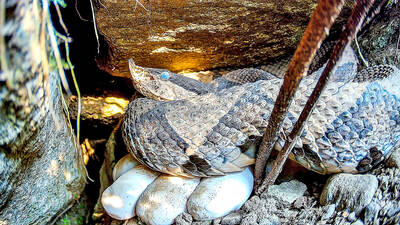
NATURE TAKES ITS COURSE: The agency’s head said he felt a sense of loss watching red-banded snakes eat the babies, as they had decided on non-intervention The Forestry and Nature Conservation Agency yesterday released a documentary on a hundred-pace viper that had incubated 16 eggs, all of which hatched, but only a baby viper escaped after they were attacked by red-banded snakes. The agency’s Taichung branch last year launched the viper reproduction monitoring project soon after forest rangers Lin Chun-yu (林俊佑) and Chou Chia-cheng (周家成) spotted a pregnant hundred-pace viper in a grass-covered burrow near a parking lot in Tbulan Village (松鶴部落). The Atayal village, in Taichung’s Heping District (和平), is headed by Ecyang Yapu, who was positive about the project and assisted in access control and power

The Coast Guard Administration (CGA) yesterday said that it had deployed vessels to “monitor” Chinese ships operating in waters off the east coast. The CGA said it dispatched vessels in response to a China Coast Guard announcement that it had carried out another “routine law-enforcement patrol” in waters off the east coast. “The CGA firmly rejects China’s cognitive warfare campaign of ‘law enforcement in name, jurisdictional expansion in practice,’” it said on X. As of 11am yesterday, two China Coast Guard ships were “loitering and drifting” about 105 nautical miles (195km) and 74 nautical miles east of Green Island (綠島) respectively, it said. It

A Straits Exchange Foundation official today warned that yielding to political pressure in exchange for access to China’s entertainment industry rarely ends well, amid rumors that China is seeking to lure Taiwanese K-pop star Chou Tzu-yu (周子瑜). Chou, more commonly known as Tzuyu, is the only Taiwanese member of the girl group Twice. Her contract with JYP Entertainment is set to expire at the end of this year, and there have been widespread reports that she would not renew it. She is reportedly planning to pursue solo activities under her parents’ agency, Yu Hai Entertainment (瑜海娛樂), although China has also reportedly offered
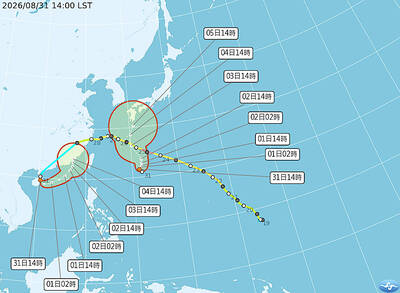
A tropical depression near Hainan that was once Typhoon Saudel may once again strengthen into a tropical storm, the Central Weather Administration (CWA) said yesterday, but a sea warning for waters around Taiwan is unlikely. CWA forecaster Huang En-hung (黃恩鴻) said that Saudel would return to being a weak tropical storm by late yesterday or early this morning. However, as the storm is to gradually weaken again and would head toward China’s Guangdong Province away from Taiwan, the chances that it would affect Taiwan enough for the CWA to issue a sea warning are relatively low,


 RSS
RSS