


The setup of a site for launching sounding rockets, of those for scientific use, has been approved by Aboriginal residents of a village in Pingtung County, the Ministry of Science and Technology said on Monday.
The site is temporary while the ministry seeks another property where it could establish a permanent launch site for commercial use.
It marks another milestone since the promulgation of the Space Development Act (太空發展法) in June, and signals a first step as the nation sets in place the infrastructure needed to develop space technologies, the ministry said in a news release.
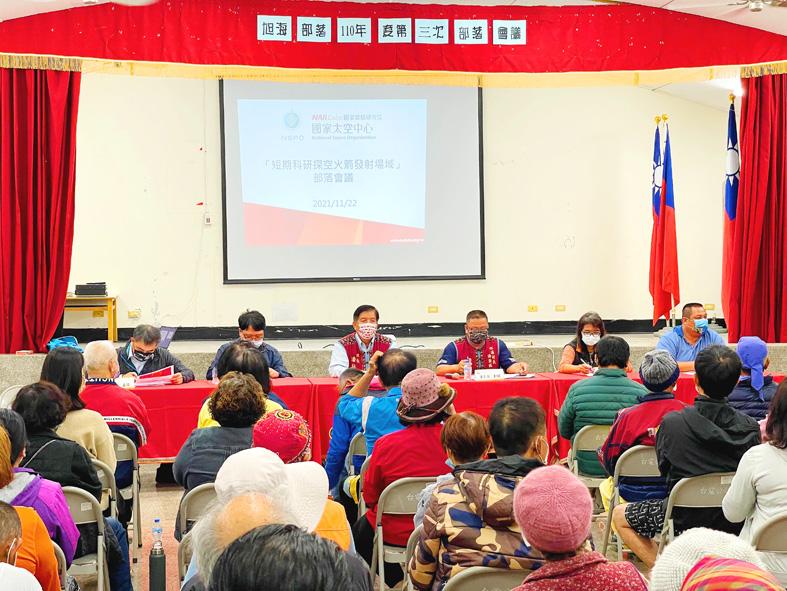
Photo courtesy of the Ministry of Science and Technology
A community conference held on Monday by residents of Syuhai Village (旭海) in the county’s Mudan Township (牡丹) approved the use of the launch site with 85 of 112 households in favor — more than half, it said.
The meeting had been scheduled in May, but was postponed due to the COVID-19 pandemic, the ministry added.
The ministry is accepting applications from scientific teams that could use the site to test their sounding rockets, it said.
The National Space Organization (NSPO) is to share profits generated by the launch site in a bid to promote technological development while protecting Aboriginal rights, the ministry said.
The agency would consider the number of launches, the level of launch noise and vibration, and other factors in deciding subsidies for local residents, NSPO Deputy Director-General and spokeswoman Vicky Chu (朱崇惠) said, without specifying the feedback fund.
Since a meeting with Syuhai residents on April 22, the NSPO had sent an agency official to facilitate communication with the village every week, except for during a COVID-19 alert from May to July, she said.
No development would be conducted at the site, which measures 0.97 hectares, Chu said.
At least two scientific teams are waiting to use the site.
Researchers had been using the site to test rockets until launching tests by local company Taiwan Innovative Space at another site in Taitung County from late 2019 to early last year sparked a legal controversy and prompted the ministry to establish a site via legislation.
National Cheng Kung University chair professor Chao Yei-chin (趙怡欽) said his NSPO-commissioned project, an advanced hybrid system for sounding rockets, has been postponed for more than one year.
Chao’s rocket features a two-stage design and a function to jettison payload fairings, and is expected to reach an apogee of 80km or more, the NSPO’s Web site shows.
Chao said that he would prepare the documents needed to apply to use the site, while his team prepares a mobile launch pad, as the ministry does not offer such equipment.
National Yang Ming Chiao Tung University’s (NYCU) Advanced Rocket Research Center (ARRC) is also waiting to use the site.
Its ministry-funded project, the launch of an HTTP-3A rocket, has also been postponed for one year, ARRC Deputy Director Wei Shih-sin (魏世昕) said, adding that the project was led by NSPO Director-General Wu Jong-shinn (吳宗信) when Wu taught at NYCU.
Despite the delay, it is a positive development that the ministry is now providing guidelines to follow when testing sounding rockets, Wei said.

The Centers for Disease Control (CDC) yesterday reported the first case of a new COVID-19 subvariant — BA.3.2 — in a 10-year-old Singaporean girl who had a fever upon arrival in Taiwan and tested positive for the disease. The girl left Taiwan on March 20 and the case did not have a direct impact on the local community, it said. The WHO added the BA.3.2 strain to its list of Variants Under Monitoring in December last year, but this was the first imported case of the COVID-19 variant in Taiwan, CDC Deputy Director-General Lin Ming-cheng (林明誠) said. The girl arrived in Taiwan on

South Korea is planning to revise its controversial electronic arrival card, a step Taiwanese officials said prompted them to hold off on planned retaliatory measures, a South Korean media report said yesterday. A Yonhap News Agency report said that the South Korean Ministry of Foreign Affairs is planning to remove the “previous departure place” and “next destination” fields from its e-arrival card system. The plan, reached after interagency consultations, is under review and aims to simplify entry procedures and align the electronic form with the paper version, a South Korean ministry official said. The fields — which appeared only on the electronic form

The Ministry of Foreign Affairs (MOFA) is suspending retaliation measures against South Korea that were set to take effect tomorrow, after Seoul said it is updating its e-arrival system, MOFA said today. The measures were to be a new round of retaliation after Taiwan on March 1 changed South Korea's designation on government-issued alien resident certificates held by South Korean nationals to "South Korea” from the "Republic of Korea," the country’s official name. The move came after months of protests to Seoul over its listing of Taiwan as "China (Taiwan)" in dropdown menus on its new online immigration entry system. MOFA last week

A bipartisan group of US senators has introduced a bill to enhance cooperation with Taiwan on drone development and to reduce reliance on supply chains linked to China. The proposed Blue Skies for Taiwan Act of 2026 was introduced by Republican US senators Ted Cruz and John Curtis, and Democratic US senators Jeff Merkley and Andy Kim. The legislation seeks to ease constraints on Taiwan-US cooperation in uncrewed aerial systems (UAS), including dependence on China-sourced components, limited access to capital and regulatory barriers under US export controls, a news release issued by Cruz on Wednesday said. The bill would establish a "Blue UAS


 RSS
RSS