


Moderna and Pfizer-BioNTech COVID-19 vaccines are to be offered for first and second doses, whether uniformly or as mixed vaccinations, in the 15th round of national COVID-19 inoculations, the Central Epidemic Command Center (CECC) said yesterday, adding that the AstraZeneca vaccine is also to be offered as the second dose.
The round begins on Thursday and ends on Dec. 1, it added.
Eligible recipients are those who registered their vaccine preference in the national online COVID-19 vaccination booking system before 4pm on Thursday last week, and meet the requirements for the three types of vaccines, the CECC said.
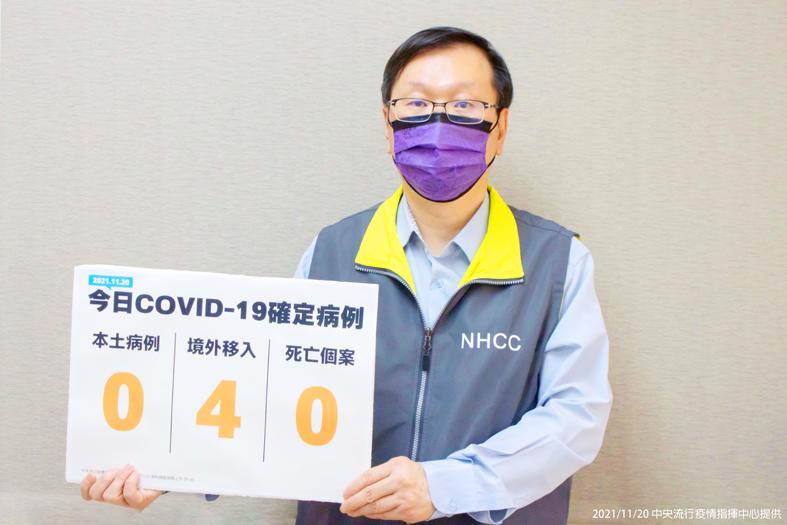
Photo courtesy of the CECC
Eligible recipients for the Pfizer-BioNTech vaccine are people who were born on or before Nov. 25, 2009, for the first dose, and born on or before Dec. 31, 2003, and have received the first dose of the Pfizer-BioNTech vaccine on or before Oct. 28 for the second dose, the CECC said.
For the Moderna vaccine, people who were born on or before Dec. 31, 2003, can receive the first dose, and people who were born on or before Dec. 31, 2003, and have received the first dose of the Moderna vaccine on or before Oct. 28, can receive the second dose, it said.
People who were born on or before Nov. 25, 2003, and have received a first dose of the AstraZeneca vaccine on or before Sept. 30 are eligible for a second dose of the AstraZeneca vaccine, it said.
People who were born on or before Nov. 25, 2003, and have received a first dose of the AstraZeneca vaccine on or before Sept. 30 can choose either the Moderna vaccine or the Pfizer-BioNTech vaccine as their second dose if they registered for the mixed vaccine regimen, it said.
Bookings for the Pfizer-BioNTech vaccine open at 10am on Tuesday, while bookings for the AstraZeneca vaccine or the Moderna vaccine start at 2pm on Tuesday; all end at 12pm on Wednesday, it said.
Centers for Disease Control Deputy Director-General Chuang Jen-hsiang (莊人祥), who is the CECC’s spokesman, said that 294,053 COVID-19 vaccines were administered on Friday, and the nation’s first-dose vaccination rate has reached 76.9 percent, while the full vaccination rate is at 46.8 percent.
Regarding a questions about whether people should receive a third dose of a COVID-19 vaccine as a booster shot, Chuang said that the Advisory Committee on Immunization Practices is to call a meeting later this month to discuss the plans, including the recommended vaccines for people who received two doses of the same vaccine or mixed vaccines, as well as the priority groups for vaccination.
Chuang also addressed a public query over an interim report released by National Taiwan University Hospital on Friday, which suggested that receiving two doses of the AstraZeneca vaccine can only provide about 10 to 20 percent of protection against the Delta variant of SARS-CoV-2, while the AstraZeneca-Moderna combination provided nearly 100 percent protection.
Chuang said that the hospital’s study was an assay conducted in a laboratory to measure neutralizing antibody titers in the blood samples of participants vaccinated against the Delta variant.
However, a Swedish study suggested that people who are fully vaccinated with the AstraZeneca vaccine had about 50 percent protection against the Delta variant, and people who received a mixed vaccine regimen had about 68 percent protection, he said.
Chuang said that the two studies were conducted differently, and the center’s specialists would reference studies conducted in the “real world” rather than the laboratory to compare the difference between different vaccination regimens.
Meanwhile, Taiwan reported four imported cases yesterday: two men and two women who arrived from Indonesia, Myanmar and Vietnam.
Chuang said that three had vaccine breakthrough infections, of which two were fully vaccinated with the Sinopharm vaccine, and one with the AstraZeneca vaccine.
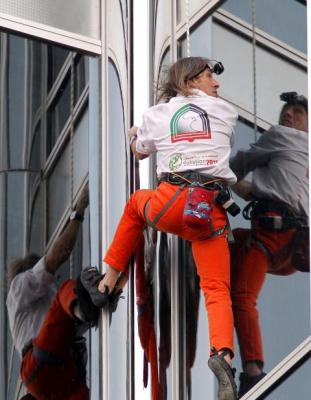
Alain Robert, known as the "French Spider-Man," praised Alex Honnold as exceptionally well-prepared after the US climber completed a free solo ascent of Taipei 101 yesterday. Robert said Honnold's ascent of the 508m-tall skyscraper in just more than one-and-a-half hours without using safety ropes or equipment was a remarkable achievement. "This is my life," he said in an interview conducted in French, adding that he liked the feeling of being "on the edge of danger." The 63-year-old Frenchman climbed Taipei 101 using ropes in December 2004, taking about four hours to reach the top. On a one-to-10 scale of difficulty, Robert said Taipei 101

Nipah virus infection is to be officially listed as a category 5 notifiable infectious disease in Taiwan in March, while clinical treatment guidelines are being formulated, the Centers for Disease Control (CDC) said yesterday. With Nipah infections being reported in other countries and considering its relatively high fatality rate, the centers on Jan. 16 announced that it would be listed as a notifiable infectious disease to bolster the nation’s systematic early warning system and increase public awareness, the CDC said. Bangladesh reported four fatal cases last year in separate districts, with three linked to raw date palm sap consumption, CDC Epidemic Intelligence
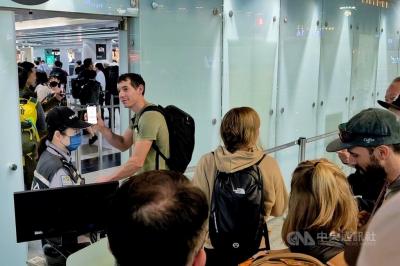
US climber Alex Honnold left Taiwan this morning a day after completing a free-solo ascent of Taipei 101, a feat that drew cheers from onlookers and gained widespread international attention. Honnold yesterday scaled the 101-story skyscraper without a rope or safety harness. The climb — the highest urban free-solo ascent ever attempted — took just more than 90 minutes and was streamed live on Netflix. It was covered by major international news outlets including CNN, the New York Times, the Guardian and the Wall Street Journal. As Honnold prepared to leave Taiwan today, he attracted a crowd when he and his wife, Sanni,

Two Taiwanese prosecutors were questioned by Chinese security personnel at their hotel during a trip to China’s Henan Province this month, the Mainland Affairs Council (MAC) said yesterday. The officers had personal information on the prosecutors, including “when they were assigned to their posts, their work locations and job titles,” MAC Deputy Minister and spokesman Liang Wen-chieh (梁文傑) said. On top of asking about their agencies and positions, the officers also questioned the prosecutors about the Cross-Strait Joint Crime-Fighting and Judicial Mutual Assistance Agreement, a pact that serves as the framework for Taiwan-China cooperation on combating crime and providing judicial assistance, Liang


 RSS
RSS