


Eight of last year’s Tang Prize laureates yesterday received their awards at a virtual ceremony to recognize their significant contributions in the fields of primatology, immunology, sinology and law.
The awards ceremony took place in Taipei yesterday afternoon after a one-year postponement due to COVID-19.
The laureates included British primatologist Jane Goodall, who was awarded the sustainable development prize for her groundbreaking work that redefines the relationship between humans and animals, the Tang Prize Foundation said.
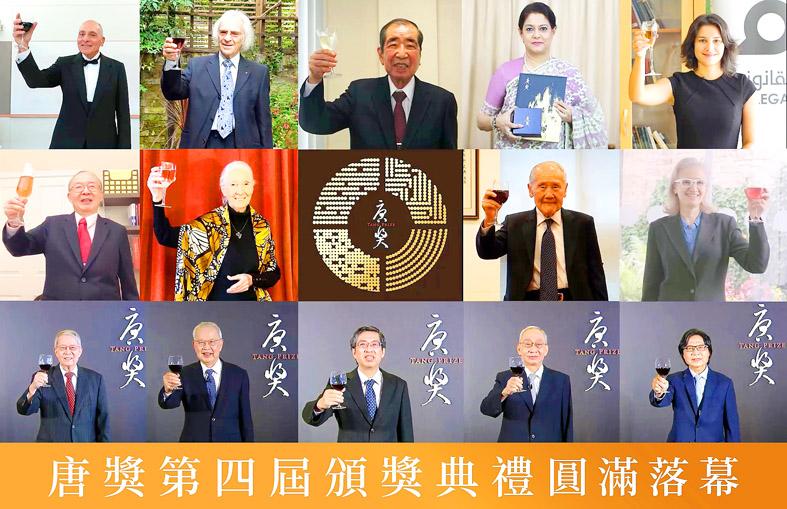
Photo courtesy of the Tang Prize Foundation
Goodall thanked the foundation for the award, which she said would enable her and the Jane Goodall Institute to “do so much more.”
Immunologists Charles Dinarello, Tadamitsu Kishimoto and Marc Feldmann shared the biopharmaceutical science award for the decades they spent researching pro-inflammatory proteins.
Dinarello encouraged young scientists to be committed to their research.
“Never think that there are no discoveries left for you to make ... as long as we have ethical considerations and caution, science has no boundaries,” he said.
“I am very glad that our very basic study through almost half a century came in useful to medicine and saved many patients in the world,” Kishimoto said of the research that led him to develop Actemra, a rheumatoid arthritis drug that is also being used as a COVID-19 treatment under emergency use authorization.
Feldmann said it was a pleasure to share the award with two long-term friends and competitors.
The Tang Prize for sinology went to Wang Gungwu (王賡武), an Indonesian-born Singaporean historian, for his six decades studying China and Sino-Southeast Asian relations.
“I hope that ... the Tang Prize will draw wider attention to the value of Sinic civilization to the betterment of the human condition,” Wang said on the development of sinology.
The foundation presented the rule of law prize to three non-governmental organizations: the Bangladesh Environmental Lawyers Association, Colombia-based Dejusticia: The Center for Law, Justice and Society and The Legal Agenda headquartered in Lebanon.
“These organizations have shown remarkable resilience in promoting greater individual, social and environmental justice in places where the foundations of the rule of law are under severe challenge,” said Yeh Jiunn-rong (葉俊榮), who chairs the Tang Prize Selection Committee for Rule of Law.
They “bring about social changes by utilizing legal means, in particular strategic litigation, in fighting for the rights and well-being of people in individual cases, as well as instigating judiciary rulings that forge enduring changes,” he added.
The winners of each award receive a cash prize of up to NT$40 million (US$1.44 million) and an additional research grant of up to NT$10 million, the foundation said.
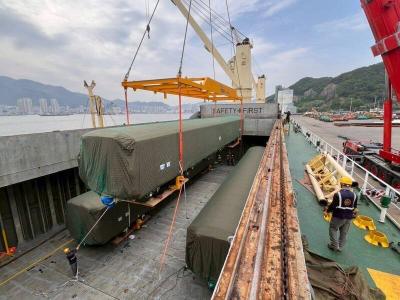
The first of 10 new high-capacity trains purchased from South Korea’s Hyundai Rotem arrived at the Port of Taipei yesterday to meet the demands of an expanding metro network, Taipei Rapid Transit Corp (TRTC) said yesterday. The train completed a three-day, 1,200km voyage from the Port of Masan in South Korea, the company said. Costing NT$590 million (US$18.79 million) each, the new six-carriage trains feature a redesigned interior based on "human-centric" transportation concepts, TRTC said. The design utilizes continuous longitudinal seating to widen the aisles and optimize passenger flow, while also upgrading passenger information displays and driving control systems for a more comfortable
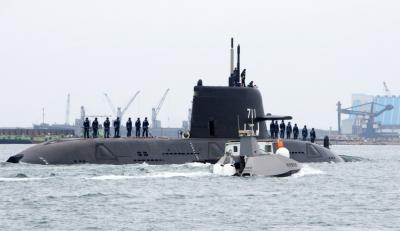
Taiwan's first indigenous defense submarine, the SS-711 Hai Kun (海鯤, or Narwhal), departed for its 13th sea trial at 7am today, marking its seventh submerged test, with delivery to the navy scheduled for July. The outing also marked its first sea deployment since President William Lai (賴清德) boarded the submarine for an inspection on March 19, drawing a crowd of military enthusiasts who gathered to show support. The submarine this morning departed port accompanied by CSBC Corp’s Endeavor Manta (奮進魔鬼魚號) uncrewed surface vessel and a navy M109 assault boat. Amid public interest in key milestones such as torpedo-launching operations and overnight submerged trials,
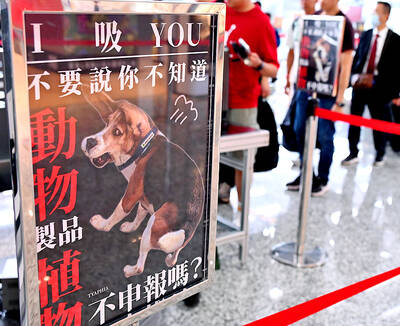
Quarantine awareness posters at Taiwan Taoyuan International Airport have gone viral for their use of wordplay. Issued by the airport branch of the Animal and Plant Health Inspection Agency, the posters feature sniffer dogs making a range of facial expressions, paired with advisory messages built around homophones. “We update the messages for holidays and campaign needs, periodically refreshing materials to attract people’s attention,” quarantine officials said. “The aim is to use the dogs’ appeal to draw focus to quarantine regulations.” A Japanese traveler visiting Taiwan has posted a photo on X of a poster showing a quarantine dog with a

Taiwan’s coffee community has launched a “one-person-one-e-mail” campaign, calling for people to send a protest-e-mail to the World Coffee Championships (WCC) urging it to redesignate Taiwanese competitors as from “Taiwan,” rather than “Chinese Taipei.” The call followed sudden action last week after the WCC changed all references to Taiwanese competitors from “Taiwan” to “Chinese Taipei,” including recent World Latte Art champion Bala (林紹興), who won the World Latte Art Championship in San Diego earlier this month. When Bala received the trophy, he was referred to as representing Taiwan, as well as in the announcement on the WCC’s Web site, until it


 RSS
RSS