


The Ministry of Foreign Affairs yesterday signed an agreement with the Central American Bank for Economic Integration (CABEI) to establish a joint trust fund, with Taiwan planning to donate US$5 million over five years.
Minister of Foreign Affairs Joseph Wu (吳釗燮) and CABEI President Dante Mossi signed the agreement while meeting over videoconference.
Minister of Finance Su Jain-rong (蘇建榮), Central Bank Deputy Governor Chen Nan-kuang (陳南光), and ambassadors of Belize, Guatemala, Honduras and Nicaragua, as well as CABEI’s Taiwan office members, also attended the virtual event, the ministry said in a news release.
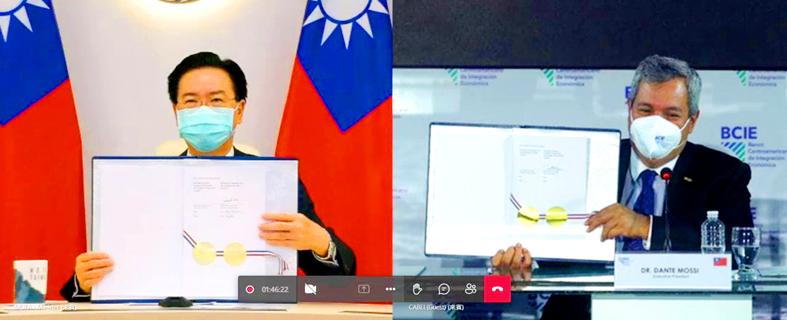
Photo courtesy of the Ministry of Foreign Affairs via CNA
Headquartered in Tegucigalpa, CABEI on July 6 opened its first overseas office in Taiwan, with Chen and Su serving as the nation’s representatives on its board of directors, it said.
Starting this year until 2025, the ministry would donate US$1 million to the fund each year to help the four diplomatic allies implement CABEI’s technical cooperation and capacity building projects, it said.
The government would select Taiwanese companies or consultants to join the projects to help the countries improve their economic and social developments, and boost Taiwanese industry’s profile in the region, it added.
The Central American countries’ development needs have changed, Chen was quoted as saying in the statement, adding that he hopes CABEI properly utilizes the funds.
Taiwan and CABEI would next year mark 30 years of partnership, Wu said.
In the post-COVID-19-pandemic era, Taiwan would continue working with CABEI, the nation’s diplomatic allies and other friendly countries to promote the region’s sustainable and inclusive developments, he said.
Thanking Taiwan for its contributions to CABEI over the years, Mossi said the agreement for the fund marks a milestone of bilateral partnership.
Honduran Minister of Finance Luis Mata said he appreciated Taiwan offering technical and financial aid to the country, adding that Taiwan-Honduras ties are firm and steady.
In other news, the Ministry of Foreign Affairs on Wednesday said that China’s Global Times was spreading disinformation to sabotage Taiwan-Honduras relations.
The newspaper said that numerous social media accounts criticizing Honduras’ left-wing candidate in the Nov. 28 presidential election might be related to the Democratic Progressive Party.
The Global Times has been identified by the US government as a “foreign mission,” the ministry said, adding that it is an organ of the Chinese government and does not qualify as media.
Taiwan would respect the outcome of the Honduran presidential election, it added.

NATIONAL SECURITY: Authorities are working to confirm the identities of the military personnel involved and investigating possible illegal conduct and regulatory violations Authorities are probing possible national security implications after Kinmen police and immigration officers on Sunday found a Chinese woman allegedly posing as a tourist while engaging in prostitution involving more than 10 military personnel. The woman, surnamed Chen (陳), has since been deported, authorities said, adding that investigators are still working to confirm the identities of those implicated, as the records only listed code names and aliases. The case stemmed from a report received by the Kinmen District Prosecutors’ Office on Friday last week from the Jinhu Precinct of the Kinmen County Police Bureau. On Sunday, police, along with the National Immigration

GLOBALGIVING: ‘ Caving to external pressure is not acceptable for an organization that has cultivated justice reform and human rights for 30 years,’ one NGO said A slew of non-government organizations (NGOs) have withdrawn from the GlobalGiving fundraising platform after it announced it would use “Chinese Taipei” instead of “Taiwan” from next month. The Taiwan Good Rice Association wrote on Facebook on Friday that it was informed on April 28 via a teleconference call of the change, which was made because the platform wanted to operate in China. Taiwan Good Rice is to terminate all cooperative relationships with GlobalGiving in response to the platform’s “unilateral and non-negotiable” decision to remove references to Taiwan, the NGO said. “Taiwan is in the official name of Taiwan Good Rice Association and the

HEAVY WEATHER: Typhoon Jangmi is due to crash straight into the Ryukyus as airlines look to shift flights to larger aircraft or cancel flights to Okinawa entirely Taiwan’s international air carriers announced flight adjustments over the weekend as Typhoon Jangmi is forecast to hit the Ryukyu Islands today and tomorrow. The Central Weather Administration (CWA) upgraded Jangmi from a tropical storm to a typhoon at 8am yesterday, with the eye located 580km south of Naha city. It was moving north at 19kph. Today, China Airlines’ CI-120, CI-121, CI-122 and CI-123 flights between Taoyuan and Naha, Okinawa, have been canceled as well as CI-132 and CI-133 between Kaohsiung and Naha. EVA Air’s BR-112, BR-113, BR-186 and BR-185 flights between Taoyuan and Naha are also canceled. Low-cost carrier Tigerair Taiwan canceled IT-230,

Chinese Nationalist Party (KMT) Chairwoman Cheng Li-wun (鄭麗文) yesterday briefed her party’s Central Standing Committee regarding her scheduled visit to the US between Monday next week and June 16, saying that her purpose would be to persuade the US that the Republic of China (ROC) Constitution was a “one China” constitution that would foster stable and peaceful cross-strait relations. The ROC Constitution is the most important defense for all Taiwanese citizens, as it upholds our democracy and has contributed to our robust economy, which aligns with international and US interests, she said. “We would not be troublemakers and drag the US under,”


 RSS
RSS