


The military’s upgraded Lockheed Martin F-16s are a major boost to Taiwan’s defense, defense experts said yesterday, as the air force marked the commission of the jets in a ceremony at Chiayi Air Base.
The program, which is to involve adding active electronically scanned array (AESA) radar systems, advanced equipment and airframe modifications, is to bring 141 legacy F-16A/Bs jets to the F-16V Block 20 standard.
Compared with the pre-upgrade models, the F-16V Block 20 is 1.8 times more effective, 2.2 times better at threat detection, 2.45 times better at cooperative engagements and 1.6 times better at weapons integration, National Policy Foundation senior assistant research fellow Chieh Chung (揭仲) said.
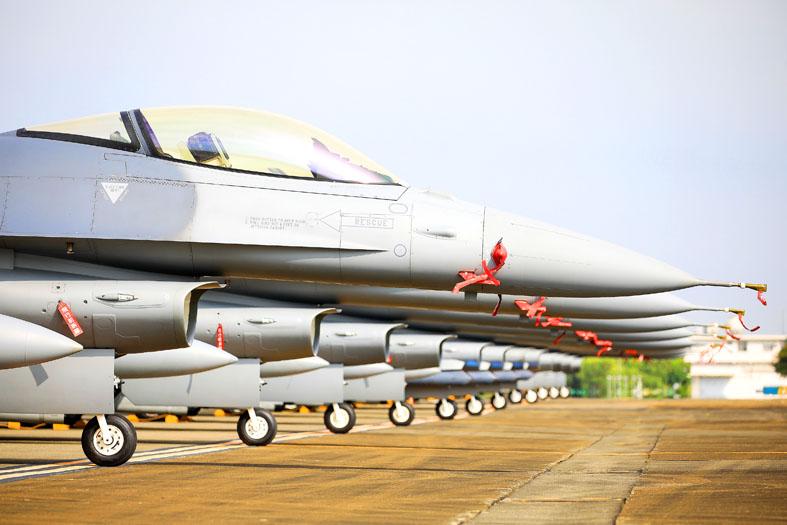
Photo: Cheng I-hwa, Bloomberg
The AESA-type AN/APG-83 radar system represents a 30 percent improvement in detection range over the APG66(v3) system that it replaces, and is more effective in detecting the Chinese People’s Liberation Army’s (PLA) Chengdu J-20 stealth fighters, Chieh said.
The upgrade program and procurement of 66 F-16V Block 70 jets from the US is to give the air force nearly 210 AESA-equipped fighter jets, he said, adding that the aircraft “significantly reduce China’s advantage in stealth fighters.”
Although Taiwan’s air force once boasted a peak strength of 330 fighters, all but 80 aircraft were incapable of communicating or sharing tactical imagery in real time with the Northrop Grumman E-2K airborne radar systems, the Heng Shan Military Command Center and the Keelung-class destroyers, Chieh said.
“The air force’s potential to defeat a numerically superior enemy in modern air defense operations is greatly enhanced by the integrated tactical network capabilities offered by 4.5-generation fighters such as F-16Vs,” he said.
The fighter jets also fit well within the military’s doctrine, which calls for long-distance strike abilities against PLA offensive weapon systems, and emphasizes the importance of defense in depth, he said.
The F-16V’s capability to attack sea and ground-based targets with precision-guided munitions is crucial for carrying out military operations in the deep, expansive defense zone envisioned by the Ministry of National Defense’s report for this year, he said.
The document says that the armed forces’ concept of all-out defense has shifted from defending beachheads and waters near Taiwan to pushing the defense zone toward the enemy, he said.
Under the revised doctrine, the nation’s defensive perimeter encompasses the seas off China’s Fujian Province, the Miyako Strait, the western reaches of the Pacific Ocean and the Bashi Channel, he said.
Lin Ying-yu (林穎佑), an assistant professor of strategic and international affairs at National Chung Cheng University, said that the AESA-equipped F-16Vs would be a welcome improvement for the air force.
However, the military should avoid wearing out its fighter pilots and ground crews with more careful management of sorties, Lin said, adding that the human factor should not be ignored in favor of technological ones.
Additional reporting by CNA

The Centers for Disease Control (CDC) yesterday reported the first case of a new COVID-19 subvariant — BA.3.2 — in a 10-year-old Singaporean girl who had a fever upon arrival in Taiwan and tested positive for the disease. The girl left Taiwan on March 20 and the case did not have a direct impact on the local community, it said. The WHO added the BA.3.2 strain to its list of Variants Under Monitoring in December last year, but this was the first imported case of the COVID-19 variant in Taiwan, CDC Deputy Director-General Lin Ming-cheng (林明誠) said. The girl arrived in Taiwan on

South Korea is planning to revise its controversial electronic arrival card, a step Taiwanese officials said prompted them to hold off on planned retaliatory measures, a South Korean media report said yesterday. A Yonhap News Agency report said that the South Korean Ministry of Foreign Affairs is planning to remove the “previous departure place” and “next destination” fields from its e-arrival card system. The plan, reached after interagency consultations, is under review and aims to simplify entry procedures and align the electronic form with the paper version, a South Korean ministry official said. The fields — which appeared only on the electronic form

The Ministry of Foreign Affairs (MOFA) is suspending retaliation measures against South Korea that were set to take effect tomorrow, after Seoul said it is updating its e-arrival system, MOFA said today. The measures were to be a new round of retaliation after Taiwan on March 1 changed South Korea's designation on government-issued alien resident certificates held by South Korean nationals to "South Korea” from the "Republic of Korea," the country’s official name. The move came after months of protests to Seoul over its listing of Taiwan as "China (Taiwan)" in dropdown menus on its new online immigration entry system. MOFA last week

A bipartisan group of US senators has introduced a bill to enhance cooperation with Taiwan on drone development and to reduce reliance on supply chains linked to China. The proposed Blue Skies for Taiwan Act of 2026 was introduced by Republican US senators Ted Cruz and John Curtis, and Democratic US senators Jeff Merkley and Andy Kim. The legislation seeks to ease constraints on Taiwan-US cooperation in uncrewed aerial systems (UAS), including dependence on China-sourced components, limited access to capital and regulatory barriers under US export controls, a news release issued by Cruz on Wednesday said. The bill would establish a "Blue UAS


 RSS
RSS