


The absence of a timeline for addressing the “Taiwan issue” in a “historical” Chinese Communist Party (CCP) resolution adopted last week indicates there is no change in Beijing’s Taiwan policy, despite saying it is central to party philosophy, National Security Council Secretary-General Wellington Koo (顧立雄) said yesterday.
As only the third such document issued by the CCP, the historical resolution adopted on Thursday last week after the Central Committee’s sixth plenum launches Chinese President Xi Jinping (習近平) into the upper echelons of party history.
Although it mentions the “unswerving historical mission” of the CCP to ‘unify’ the country, it mainly serves to solidify Xi’s central position within the party, Koo told a budgetary hearing hosted by the Legislative Yuan’s Judiciary and Organic Laws and Statutes Committee.
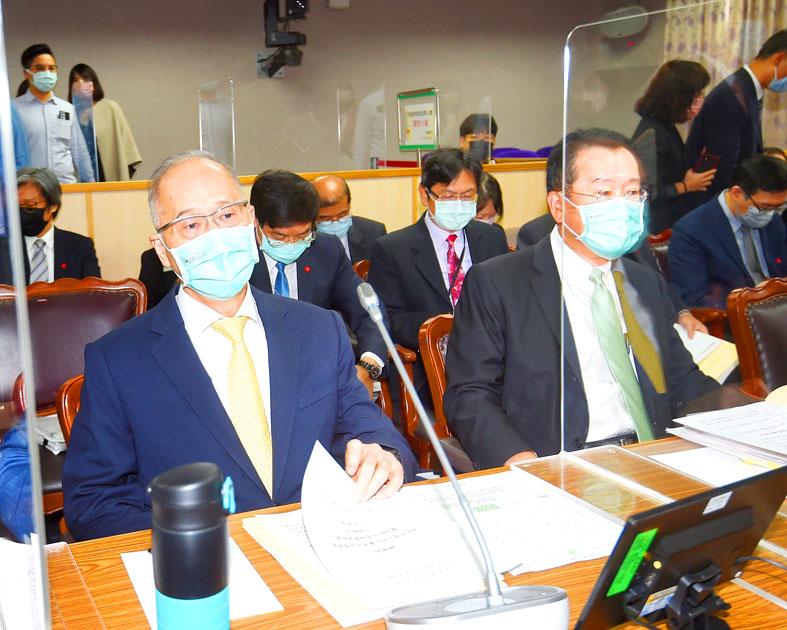
Photo: Fang Pin-chao, Taipei Times
Two-thirds of the resolution praises Xi, who seeks to retain power in next year’s 20th National Party Congress, Koo said.
The Taiwan comment was an obligatory mention that does not differ from previous CCP statements, he added.
Asked about US President Joe Biden’s recent comments on Taiwanese independence, Koo said that his tone was similar to the “four commitments” set out by President Tsai Ing-wen (蔡英文) on Double Ten National Day.
After his call with Xi on Monday, Biden told reporters in New Hampshire on Tuesday that Taiwan is “independent. It makes its own decisions.”
He later clarified that he was not encouraging independence, adding: “I said that they have to decide — they, Taiwan, not us.”
The comments were similar in tone to Tsai’s commitments that “the Republic of China and the People’s Republic of China should not be subordinate to each other,” and that the future of Taiwan should be decided by Taiwanese, Koo said.
Long-standing US commitments to Taiwan based on the “six assurances” and Three Joint Communiques were also reiterated later that day by White House National Security Adviser Jake Sullivan, Koo added.
Koo also sought to assuage concern about Biden’s support for the “one China” policy during his call with Xi, saying that the US and China have different definitions of the term.
The US fully understands and has not objected to Tsai’s sentiment that the two sides of the Taiwan Strait should not be subordinate to one another, he said.
US policy toward China is gradually becoming clearer, first by it firmly opposing any change in cross-strait stability by non-peaceful means, Koo said.
Washington has simultaneously adopted a clear strategy of deterrence, uniting with like-minded nations to demonstrate a military presence in the region, he added.

The Centers for Disease Control (CDC) yesterday reported the first case of a new COVID-19 subvariant — BA.3.2 — in a 10-year-old Singaporean girl who had a fever upon arrival in Taiwan and tested positive for the disease. The girl left Taiwan on March 20 and the case did not have a direct impact on the local community, it said. The WHO added the BA.3.2 strain to its list of Variants Under Monitoring in December last year, but this was the first imported case of the COVID-19 variant in Taiwan, CDC Deputy Director-General Lin Ming-cheng (林明誠) said. The girl arrived in Taiwan on

South Korea is planning to revise its controversial electronic arrival card, a step Taiwanese officials said prompted them to hold off on planned retaliatory measures, a South Korean media report said yesterday. A Yonhap News Agency report said that the South Korean Ministry of Foreign Affairs is planning to remove the “previous departure place” and “next destination” fields from its e-arrival card system. The plan, reached after interagency consultations, is under review and aims to simplify entry procedures and align the electronic form with the paper version, a South Korean ministry official said. The fields — which appeared only on the electronic form

The Ministry of Foreign Affairs (MOFA) is suspending retaliation measures against South Korea that were set to take effect tomorrow, after Seoul said it is updating its e-arrival system, MOFA said today. The measures were to be a new round of retaliation after Taiwan on March 1 changed South Korea's designation on government-issued alien resident certificates held by South Korean nationals to "South Korea” from the "Republic of Korea," the country’s official name. The move came after months of protests to Seoul over its listing of Taiwan as "China (Taiwan)" in dropdown menus on its new online immigration entry system. MOFA last week

A bipartisan group of US senators has introduced a bill to enhance cooperation with Taiwan on drone development and to reduce reliance on supply chains linked to China. The proposed Blue Skies for Taiwan Act of 2026 was introduced by Republican US senators Ted Cruz and John Curtis, and Democratic US senators Jeff Merkley and Andy Kim. The legislation seeks to ease constraints on Taiwan-US cooperation in uncrewed aerial systems (UAS), including dependence on China-sourced components, limited access to capital and regulatory barriers under US export controls, a news release issued by Cruz on Wednesday said. The bill would establish a "Blue UAS


 RSS
RSS