


Lawmakers yesterday established a Trans-Pacific Aerospace Parliamentary Alliance to deepen relations with Japan and other Asia-Pacific countries to consolidate the nation’s role in the global space economy.
The alliance is chaired by Democratic Progressive Party (DPP) Legislator Chung Chia-pin (鍾佳濱), with New Power Party Legislator Chiu Hsien-chih (邱顯智) and Taiwan People’s Party Legislator Ann Kao (高虹安) serving as deputy chairs. No Chinese Nationalist Party (KMT) lawmaker is involved in the alliance.
The efforts of the National Space Organization (NSPO) and local businesses to develop satellites and ground stations over the past three decades have borne fruit and, hopefully, after the promulgation of the Space Development Act (太空發展法) in June, a national rocket launch site would soon be established to facilitate the development of the domestic local space industry, Chung said.
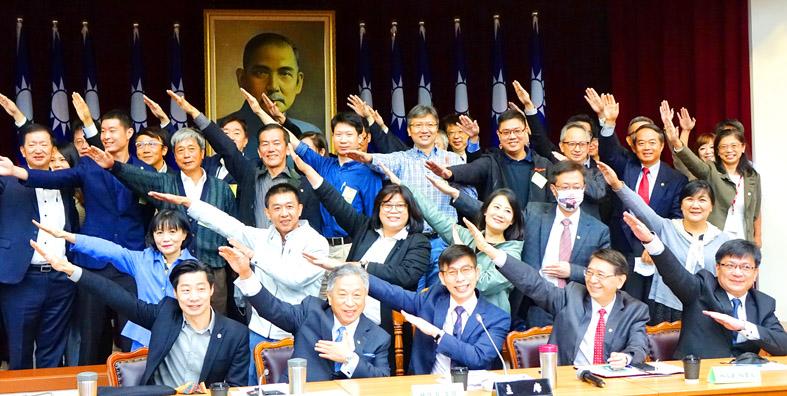
Photo: Liu Hsin-de, Taipei Times
The alliance aims to foster ties with countries having advanced space technology — such as Japan, South Korea and New Zealand — or emerging space economies such as Indonesia and Malaysia, he said.
Taiwan should utilize its geographical advantages and local manufacturing strength to develop rockets and provide launch services for satellite developers, he added.
While the US did not want Taiwan to develop launch rockets a few decades ago, the trend has “changed somewhat,” as the global space industry has become increasingly commercialized, Chung said.
NSPO Director-General Wu Jong-shinn (吳宗信), who joined the videoconference, expressed the hope that the alliance, with its flexibility as a parliamentary group, would usher in more opportunities to interact with counterparts in Japan, India and other countries.
As low Earth orbit communications satellites are expected to become more like consumer electronics products, local firms should build on their strengths in information and communications technology to enter the global space economy, he said.
While Taiwan cannot participate in the International Telecommunication Union (ITU) due to political factors, many things can be done through parliamentary exchanges, said Jessika Ko (柯莉娟), a lawyer who serves as a consultant to the alliance.
For example, it is important to establish internationally recognized standards for verifying aerospace materials and components, so Taiwanese products can be exported to more countries at higher prices, she said.
She urged the government to establish a more complete legal framework to back up the local space industry, instead of merely treating it as a “fad.”
Promoting space tech used to be the duty of the Ministry of Science and Technology, which oversees the NSPO, while the Ministry of Economic Affairs has started to weigh in and assist local firms to enter the industry, Vice Minister of Economic Affairs Tseng Wen-sheng (曾文生) said.
Taiwan should play a leading role in developing launch rockets in the western Pacific region, as the ability to launch a satellite into space is an amalgamation of a nation’s industrial techniques, he said.
Deputy Minister of Foreign Affairs Tien Chung-kwang (田中光), as well as representatives from National Central University, Odysseus Space, HelioX Cosmos Co, CMOS Sensor Inc, Chunghwa Telecom Co and Epotech Composite Corp, also attended the event.

The Centers for Disease Control (CDC) yesterday reported the first case of a new COVID-19 subvariant — BA.3.2 — in a 10-year-old Singaporean girl who had a fever upon arrival in Taiwan and tested positive for the disease. The girl left Taiwan on March 20 and the case did not have a direct impact on the local community, it said. The WHO added the BA.3.2 strain to its list of Variants Under Monitoring in December last year, but this was the first imported case of the COVID-19 variant in Taiwan, CDC Deputy Director-General Lin Ming-cheng (林明誠) said. The girl arrived in Taiwan on

South Korea is planning to revise its controversial electronic arrival card, a step Taiwanese officials said prompted them to hold off on planned retaliatory measures, a South Korean media report said yesterday. A Yonhap News Agency report said that the South Korean Ministry of Foreign Affairs is planning to remove the “previous departure place” and “next destination” fields from its e-arrival card system. The plan, reached after interagency consultations, is under review and aims to simplify entry procedures and align the electronic form with the paper version, a South Korean ministry official said. The fields — which appeared only on the electronic form

The Ministry of Foreign Affairs (MOFA) is suspending retaliation measures against South Korea that were set to take effect tomorrow, after Seoul said it is updating its e-arrival system, MOFA said today. The measures were to be a new round of retaliation after Taiwan on March 1 changed South Korea's designation on government-issued alien resident certificates held by South Korean nationals to "South Korea” from the "Republic of Korea," the country’s official name. The move came after months of protests to Seoul over its listing of Taiwan as "China (Taiwan)" in dropdown menus on its new online immigration entry system. MOFA last week
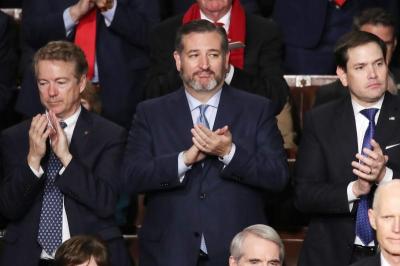
A bipartisan group of US senators has introduced a bill to enhance cooperation with Taiwan on drone development and to reduce reliance on supply chains linked to China. The proposed Blue Skies for Taiwan Act of 2026 was introduced by Republican US senators Ted Cruz and John Curtis, and Democratic US senators Jeff Merkley and Andy Kim. The legislation seeks to ease constraints on Taiwan-US cooperation in uncrewed aerial systems (UAS), including dependence on China-sourced components, limited access to capital and regulatory barriers under US export controls, a news release issued by Cruz on Wednesday said. The bill would establish a "Blue UAS


 RSS
RSS