

Top officials at National Tsing Hua University (NTHU) had allegedly covered up the illegal operation of a Beijing-funded research institute set up to lure Taiwanese information technology talent to China at its main campus in Hsinchu City, Democratic Progressive Party Legislator Fan Yun (范雲) said yesterday, as she was joined by members of the Taiwan Citizen Front and Economic Democracy Union in urging the officials to resign.
Taiwan Citizen Front member Hsu Kuang-tse (許冠澤) told a news briefing at the legislature in Taipei that then-NTHU vice president Wu Cheng-wen (吳誠文) in 2016 attended the opening event of the Cross-Strait Tsinghua Research Institute (清華海峽研究院).
NTHU president Hocheng Hong (賀陳弘) and former NTHU president Chen Lih-juann (陳力俊) in 2019 met with representatives of China’s Tsinghua University, which had been involved in establishing the institute, Hsu said, showing reporters pictures of and other documents on the meetings.
“NTHU is deceiving the public by denying any knowledge and trying to conceal their collaboration with the Chinese side,” Hsu said.
While NTHU is a key incubator of high-tech talent for the Hsinchu Science Park (新竹科學園區), its top officials are involved in the nation’s brain drain to China, he said.
Fan said that NTHU officials had been lying about their involvement since the affair was brought to light in a report by the Liberty Times (the Taipei Times’ sister newspaper) on Monday.
“They sent text messages to students and staff to shift the responsibility to NTHU’s alumni association,” which assisted in setting up the institute, she said.
The report revealed that the institute was founded in Xiamen, China, in 2015 by NTHU’s alumni association-affiliated Tzu-Chiang Foundation of Science and Technology, Beijing-based Tsinghua University and the Xiamen City Government.
The institute’s purpose was allegedly to conduct research, develop and invest in technologies, as well as to recruit Taiwanese high-tech talent.
The involved NTHU officials might have contravened the Act Governing Relations Between the People of the Taiwan Area and the Mainland Area (臺灣地區與大陸地區人民關係條例) and compromised Taiwan’s national security, members of the legislative Foreign Affairs and National Defense Committee said at a committee meeting.
The Ministry of Education on Monday ordered the institute to shut immediately and send its Chinese staff home.
NTHU on Tuesday issued a statement denying its involvement in the institute’s establishment.
The university said that it had no knowledge of the institute’s activities, as it was founded by the alumni group.
The statement quoted alumni group members as saying that they had no cooperation agreement or any other contact with the institute, and were not aware of its operations.
Economic Democracy Union researcher Chiang Min-yen (江旻諺) told yesterday’s news briefing at the legislature that this was likely a cover-up.
There is evidence that the university and the alumni group had been collaborating with the Chinese side for several years, Chiang said.
The institute had a political agenda in line with China’s attempts to subordinate Taiwan, Chiang said.
The cooperation might have led to cross-strait exchange programs headed by top NTHU officials, who had taken student groups to China, where they might have met with officials of Beijing’s Taiwan Affairs Office, Chiang said.
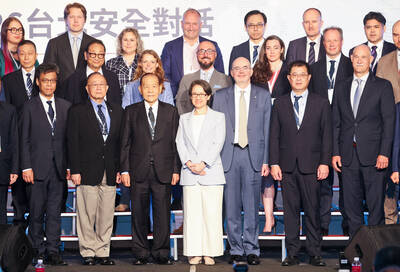
Taiwan’s growing defense preparations might be sending a stronger signal to the US than to Beijing, highlighting the need for Taipei to tailor its deterrence efforts to different audiences, a US security academic said yesterday. Stanford University Freeman Spogli Institute for International Studies fellow Oriana Skylar Mastro made the comment during a Taipei Security Dialogue panel examining lessons Taiwan could draw from the wars in Ukraine and the Middle East. Mastro said she was impressed by Taiwan’s increased defense spending, emphasis on asymmetric capabilities and efforts to prepare society for conflict, but questioned whom those initiatives were influencing. She said when she asked
A total of 400 foreign “high- level” professionals have been naturalized as Republic of China (Taiwan) citizens over the past decade as the government has eased nationality rules to attract talent from a wider range of fields, the Ministry of the Interior said yesterday. The 400th high-level professional, who works in the electronics industry, was approved for ROC citizenship on Aug. 26, the MOI said. The MOI quoted the newly naturalized citizen as saying that Taiwan is a leader in fields such as semiconductors, electronics manufacturing, artificial intelligence development and energy technology. He also said
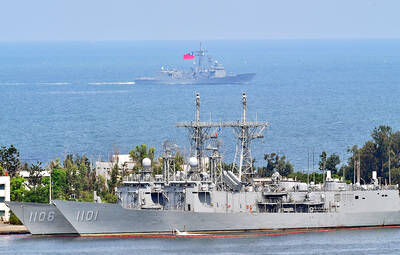
SIZE MATTERS: Large ships are politically attractive as visible symbols of national defense, but small surface combatants are more likely to survive an initial strike Taiwan needs to restructure its naval fleet from focusing on large warships, which are “sitting ducks” for China’s advanced tracking technology, to smaller, stealthy corvettes that are harder to detect but retain sufficient firepower to deter a Chinese invasion, a Taiwanese academic and a former US military commander said in an article published on Friday in the journal Foreign Affairs. Taiwan does not need a fleet capable of competing with the Chinese navy for traditional control of the Taiwan Strait, but rather “sea denial” capabilities that would prevent China from freely using the waterway, Taiwanese aerospace and security expert Holmes Liao
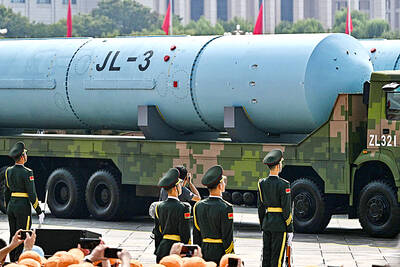
SUB-LAUNCHED SUBOPTIMAL: The JL-3, an upgraded version of the missile test-fired earlier in the summer, would have the range to strike at much of the country Refits to Chinese nuclear submarines to carry JL-3 intercontinental ballistic missiles would put much of the US in striking distance, Taiwanese defense analysts said in a report commissioned by the Mainland Affairs Council. Researchers from National Defense University’s Graduate Institute of China Military Affairs Studies said that the Chinese People’s Liberation Army Navy (PLAN) in July test-fired a missile with a training warhead. Chinese state media reported without elaborating that a PLAN nuclear-powered ballistic missile submarine (SSBN) launched a missile with a training warhead, which accurately hit the designated target area in the Pacific, the report said. The launch was a rare display


 RSS
RSS