


The Ministry of Foreign Affairs yesterday denied accusations by a group of students from Africa, who said that officials discriminated against them in processing their visa applications.
In an online news conference yesterday, the students accused the Taipei Trade Office in Nigeria of blocking their visa applications.
One student went to the office in August to schedule an appointment, but was told that an appointment was only available in December, the students said.
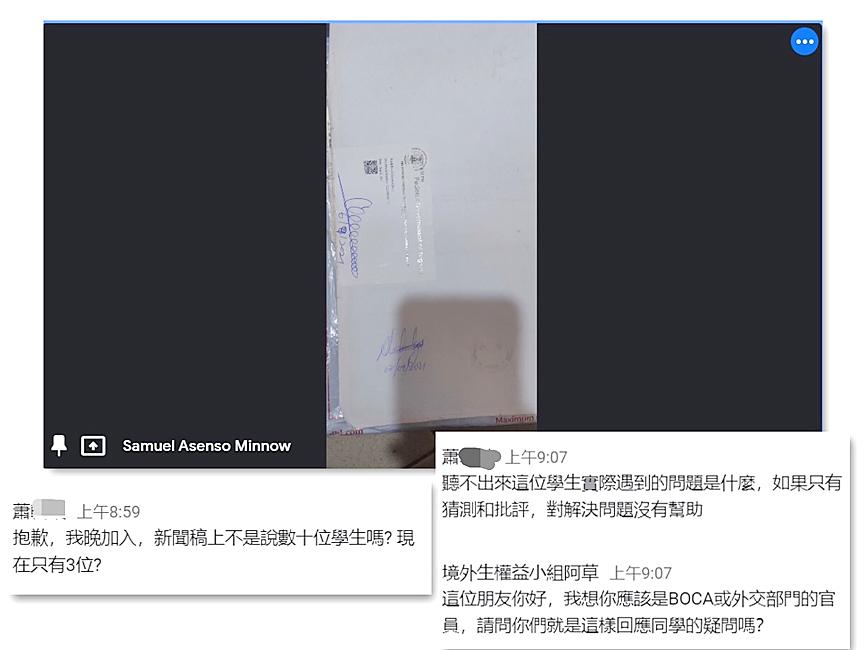
Photo: screen grab from the Internet
Many of the students had applied for visas at other foreign embassies, but what they experienced at the Taiwan office was terrible, they said.
Some students who had been granted government scholarships obtained visas more quickly, but this was unfair, because other students might have been granted full-tuition scholarships by their host schools, they said.
The students have sought help from the Taiwan International Student Movement, an advocacy group for the rights of international students, which also called on the ministry to stop discriminating against African students.
At a separate news conference yesterday, ministry spokeswoman Joanne Ou (歐江安) said that governments in some countries report more forged documents than others, so Taiwan’s overseas representative offices in such places are required to verify the authenticity of applications with local government agencies to help prevent illegal activity.
The time that it takes to verify documents varies from country to country, depending on the response time of local agencies, Ou said, adding that no discrimination is tolerated at its offices.
When the COVID-19 pandemic emerged, the government implemented strict border controls, she said.
However, since Aug. 23, overseas students have been allowed to enter Taiwan and overseas offices have been accepting applications for student visas, Ou said.
Of the 40 applications for student visas at its Nigeria office from Sept. 1 to Monday, 18 did not submit their documents on time, five failed a review due to fabricated documents or false accounts during visa interviews, eight passed a review and the rest are to be reviewed, she said.
Given that the Ministry of Education has required overseas students for this semester to enter Taiwan by Dec. 15, the ministry has asked the office in Nigeria to move up its appointments, she said, adding that it moved all of its appointments to before Nov. 22.
Over the past three years, the Nigerian office has approved more than 800 visas, mostly for applicants from Nigeria, the Gambia, Ghana and Cameroon, Ou said.
There are many factors to consider when reviewing visa applications, including screening of applicant identities, assessing their motives for wanting to immigrate, the possibility that they will overstay or work illegally and the risk of disease transmission — processes that are in place in every country, she said.

The Centers for Disease Control (CDC) yesterday reported the first case of a new COVID-19 subvariant — BA.3.2 — in a 10-year-old Singaporean girl who had a fever upon arrival in Taiwan and tested positive for the disease. The girl left Taiwan on March 20 and the case did not have a direct impact on the local community, it said. The WHO added the BA.3.2 strain to its list of Variants Under Monitoring in December last year, but this was the first imported case of the COVID-19 variant in Taiwan, CDC Deputy Director-General Lin Ming-cheng (林明誠) said. The girl arrived in Taiwan on

South Korea is planning to revise its controversial electronic arrival card, a step Taiwanese officials said prompted them to hold off on planned retaliatory measures, a South Korean media report said yesterday. A Yonhap News Agency report said that the South Korean Ministry of Foreign Affairs is planning to remove the “previous departure place” and “next destination” fields from its e-arrival card system. The plan, reached after interagency consultations, is under review and aims to simplify entry procedures and align the electronic form with the paper version, a South Korean ministry official said. The fields — which appeared only on the electronic form

The Ministry of Foreign Affairs (MOFA) is suspending retaliation measures against South Korea that were set to take effect tomorrow, after Seoul said it is updating its e-arrival system, MOFA said today. The measures were to be a new round of retaliation after Taiwan on March 1 changed South Korea's designation on government-issued alien resident certificates held by South Korean nationals to "South Korea” from the "Republic of Korea," the country’s official name. The move came after months of protests to Seoul over its listing of Taiwan as "China (Taiwan)" in dropdown menus on its new online immigration entry system. MOFA last week

A bipartisan group of US senators has introduced a bill to enhance cooperation with Taiwan on drone development and to reduce reliance on supply chains linked to China. The proposed Blue Skies for Taiwan Act of 2026 was introduced by Republican US senators Ted Cruz and John Curtis, and Democratic US senators Jeff Merkley and Andy Kim. The legislation seeks to ease constraints on Taiwan-US cooperation in uncrewed aerial systems (UAS), including dependence on China-sourced components, limited access to capital and regulatory barriers under US export controls, a news release issued by Cruz on Wednesday said. The bill would establish a "Blue UAS


 RSS
RSS