


A study led by Taiwanese doctoral student Huang Yung-kun (黃永坤) and published in the August issue of the journal Global Ecology and Conservation hopes to shed light on the vocal behavior of mountain hawk-eagles.
The paper is likely the first in the international community to examine voiceprint and quantitative data, Huang said.
Before the paper, there were recordings of two kinds of sounds emitted by mountain hawk-eagles: the sound they make when flying and the sound that hatchlings make when they want to be fed.
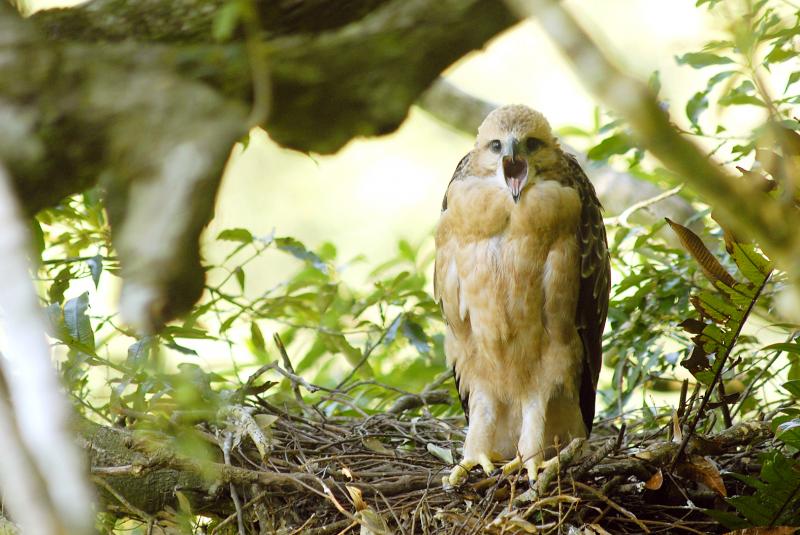
Photo courtesy of the National Pingtung University of Science and Technology via CNA
Over the past 17 years, Huang said that he has recorded five more sounds that hawk-eagles make: the sound mothers make when asking for food, a warning sound, a sound they make when interacting with their young, a trilling sound and another high-frequency sound.
The functions denoted by the seven sounds are only roughly categorized, Huang said, adding that a single sound might have more than one function.
The sounds emitted by the hawk-eagles are typically on the low end of the spectrum, at about 2,000 hertz (Hz) to 3,000Hz, with high-frequency calls only reaching 6,000Hz, Huang said, adding that the sounds are easily drowned out by birds with louder or more frequent calling patterns, such as the thrush.
The hawk-eagle is considered holy by the Paiwan community, and Paiwan leaders and warriors often wear their feathers to signify their importance, he said.
Due to disappearing habitats and overhunting, the number of mountain hawk-eagles has sharply declined and the population of 300 to 1,400 birds, depending on the calculation method, is considered a category 1 conservation species.
The paper was coauthored by Huang’s former professor at National Pingtung University of Science and Technology, Sun Yuan-hsun (孫元勳); Chen Hou-chun (陳厚均) of Mahidol University in Bangkok; and Chiang Po-jen (姜博仁) of the Formosan Wild Sound Conservation Science Center.

Considering that most countries issue more than five denominations of banknotes, the central bank has decided to redesign all five denominations, the bank said as it prepares for the first major overhaul of the banknotes in more than 24 years. Central bank Governor Yang Chin-lung (楊金龍) is expected to report to the Legislative Yuan today on the bank’s operations and the redesign’s progress. The bank in a report sent to the legislature ahead of today’s meeting said it had commissioned a survey on the public’s preferences. Survey results showed that NT$100 and NT$1,000 banknotes are the most commonly used, while NT$200 and NT$2,000

The Centers for Disease Control (CDC) yesterday reported the first case of a new COVID-19 subvariant — BA.3.2 — in a 10-year-old Singaporean girl who had a fever upon arrival in Taiwan and tested positive for the disease. The girl left Taiwan on March 20 and the case did not have a direct impact on the local community, it said. The WHO added the BA.3.2 strain to its list of Variants Under Monitoring in December last year, but this was the first imported case of the COVID-19 variant in Taiwan, CDC Deputy Director-General Lin Ming-cheng (林明誠) said. The girl arrived in Taiwan on

South Korea is planning to revise its controversial electronic arrival card, a step Taiwanese officials said prompted them to hold off on planned retaliatory measures, a South Korean media report said yesterday. A Yonhap News Agency report said that the South Korean Ministry of Foreign Affairs is planning to remove the “previous departure place” and “next destination” fields from its e-arrival card system. The plan, reached after interagency consultations, is under review and aims to simplify entry procedures and align the electronic form with the paper version, a South Korean ministry official said. The fields — which appeared only on the electronic form

The Ministry of Foreign Affairs (MOFA) is suspending retaliation measures against South Korea that were set to take effect tomorrow, after Seoul said it is updating its e-arrival system, MOFA said today. The measures were to be a new round of retaliation after Taiwan on March 1 changed South Korea's designation on government-issued alien resident certificates held by South Korean nationals to "South Korea” from the "Republic of Korea," the country’s official name. The move came after months of protests to Seoul over its listing of Taiwan as "China (Taiwan)" in dropdown menus on its new online immigration entry system. MOFA last week


 RSS
RSS