


Democratic Progressive Party (DPP) lawmakers yesterday condemned the description of “toxic pork” and “deranged pork” by Chinese Nationalist Party (KMT) politicians while campaigning against US meat imports in the run-up to a referendum.
“KMT politicians are on the one hand eating US beef and on the other hand insulting it,” DPP Legislator Tsai Yi-yu (蔡易餘) said during yesterday’s legislative caucus briefing. “The KMT is doing this on China’s behalf, to turn Taiwan against the US.”
Tsai cited KMT Chairman Eric Chu’s statements opposing the Jan. 1 policy change allowing imports of US pork containing traces of the leanness-enhancing additive.
Chu allegedly made comments about US “toxic pork” and “deranged pork” in Hoklo, also known as Taiwanese, when speaking on the KMT’s opposition to the import of US pork products.
Tsai said that the DPP administration adhered to the measures set by the Codex Alimentarius Commission, a global organization that sets food standards, by allowing 10 parts per billion of ractopamine in pork and beef products.
“This is an important worldwide standard followed by the UN and the WHO, which most countries adhere to, including member nations of Trade and Investment Framework Agreements and other international trading bodies that Taiwan is applying to join as a member,” Tsai said.
“Chu knows these facts, but he is leading KMT to distort the truth and malign US pork,” he added.
“When Eric Chu was campaigning to be KMT chairman, he said he stands for a US-friendly approach. Then he said that US pork is ‘toxic,’” DPP legislative caucus director Liu Shyh-fang (劉世芳) said.
“When Chu was the mayor of New Taipei City, he was not opposed to the rules [on US beef and pork imports]. This will have a boomerang effect and come back to strike the KMT,” Liu said.
Separately, DPP Legislator Wang Ting-yu (王定宇) in a social media post also criticized Chu’s comments.
Wang wrote that the KMT is being hypocritical, as former president Ma Ying-jeou (馬英九) had relaxed restrictions on US beef imports in 2012.
“I do not understand why the wealthy elites of the KMT are fighting against US pork and creating turmoil on this issue,” he wrote, adding that new guidelines have brought reciprocal benefits for Taiwan.
“We experienced a large increase in the export of Taiwanese agricultural products to the US,” he said.
Meanwhile, DPP Legislator Lai Jui-lung (賴瑞隆) at the legislative caucus briefing criticized KMT lawmakers for demanding the resignation of Kaohsiung Mayor Chen Chi-mai (陳其邁) over last month’s fire at a residential building resulting in 46 deaths.
Lai said that the Kaohsiung City Government had provided assistance and relief to the victims, following up with pledges to increase inspections and conduct other follow-up work.
Lai and other DPP members said that Chu was the mayor of New Taipei City in 2015 at the time of a blaze at a water park that killed 15 people and injured 500 others.
They said that Chu did not resign and did not offer an apology for more than a year.

The military has spotted two Chinese warships operating in waters near Penghu County in the Taiwan Strait and sent its own naval and air forces to monitor the vessels, the Ministry of National Defense (MND) said. Beijing sends warships and warplanes into the waters and skies around Taiwan on an almost daily basis, drawing condemnation from Taipei. While the ministry offers daily updates on the locations of Chinese military aircraft, it only rarely gives details of where Chinese warships are operating, generally only when it detects aircraft carriers, as happened last week. A Chinese destroyer and a frigate entered waters to the southwest
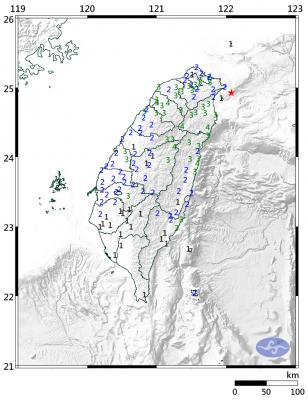
A magnitude 6.1 earthquake struck off the coast of Yilan County at 8:39pm tonight, the Central Weather Administration (CWA) said, with no immediate reports of damage or injuries. The epicenter was 38.7km east-northeast of Yilan County Hall at a focal depth of 98.3km, the CWA’s Seismological Center said. The quake’s maximum intensity, which gauges the actual physical effect of a seismic event, was a level 4 on Taiwan’s 7-tier intensity scale, the center said. That intensity level was recorded in Yilan County’s Nanao Township (南澳), Hsinchu County’s Guansi Township (關西), Nantou County’s Hehuanshan (合歡山) and Hualien County’s Yanliao (鹽寮). An intensity of 3 was
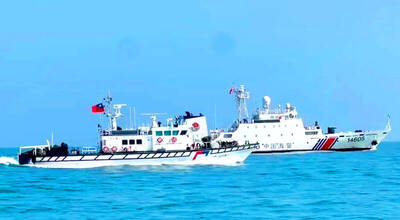
Instead of focusing solely on the threat of a full-scale military invasion, the US and its allies must prepare for a potential Chinese “quarantine” of Taiwan enforced through customs inspections, Stanford University Hoover fellow Eyck Freymann said in a Foreign Affairs article published on Wednesday. China could use various “gray zone” tactics in “reconfiguring the regional and ultimately the global economic order without a war,” said Freymann, who is also a nonresident research fellow at the US Naval War College. China might seize control of Taiwan’s links to the outside world by requiring all flights and ships entering or leaving Taiwan
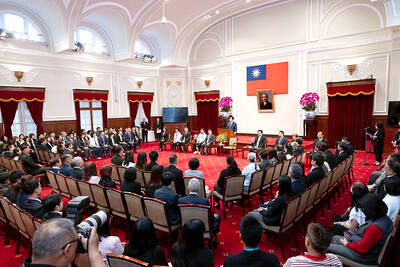
The next minimum wage hike is expected to exceed NT$30,000, President William Lai (賴清德) said yesterday during an award ceremony honoring “model workers,” including migrant workers, at the Presidential Office ahead of Workers’ Day today. Lai said he wished to thank the awardees on behalf of the nation and extend his most sincere respect for their hard work, on which Taiwan’s prosperity has been built. Lai specifically thanked 10 migrant workers selected for the award, saying that although they left their home countries to further their own goals, their efforts have benefited Taiwan as well. The nation’s industrial sector and small businesses lay


 RSS
RSS