


Taiwan and the Czech Republic share the determination to defend democracy and freedom, Minister of Foreign Affairs Joseph Wu (吳釗燮) told a forum in Prague yesterday, calling on democratic countries to unite against authoritarianism.
Wu made the remarks at a forum cohosted by the Czech Academy of Sciences and Czech think tank Sinopsis titled “Towards a productive relationship: Engaging with Taiwan in multiple domains.”
“As a former political scientist studying democratization, I have always wanted to visit late [Czech] president Vaclav Havel’s motherland,” Wu is cited as saying in a statement released by the Ministry of Foreign Affairs.
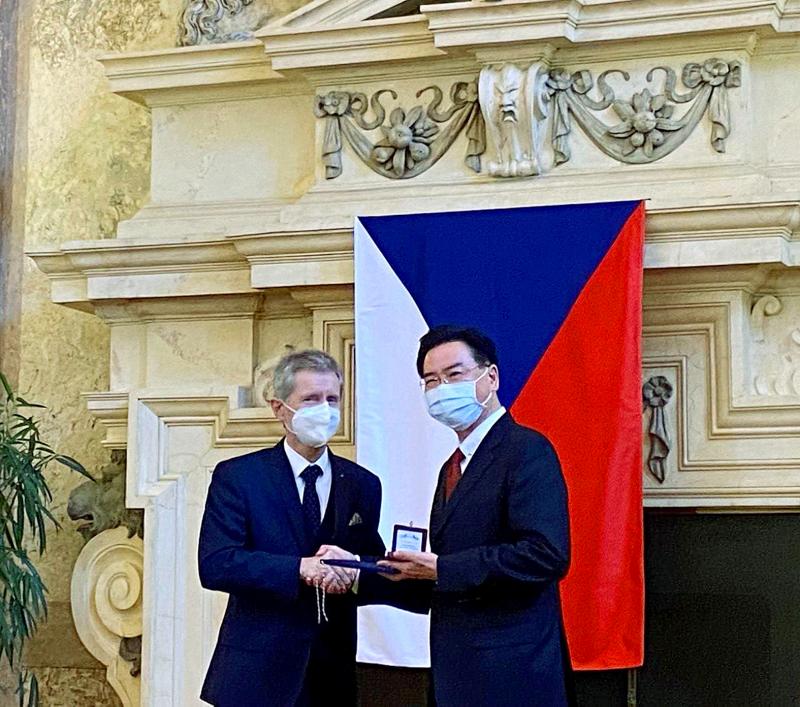
Photo courtesy of the Minister of Foreign Affairs
“The pursuit of freedom and democracy has always been the most important reason that our two countries are closely connected,” he said.
The combination of new technologies and social media has empowered people around the world to voice their views, but at the same time, democracy’s enemies have become increasingly bold and outspoken, Wu said.
“Our democratic accomplishments … need to be underpinned by determination and principles. This is especially true in times when authoritarianism continuously seeks to undermine the values and institutions that we all cherish,” he said.
When democracies are threatened around the world, “we need to work with and support each other. United we stand, divided we fall,” he said.
Taiwan is willing to share its valuable experiences in economic and technological developments with like-minded countries around the world and serve as “a force for good” against authoritarianism, Wu said.
Wu is part of a delegation to Europe that has since Sunday been visiting Slovakia and the Czech Republic.
Wu is invited to a meeting of the Inter-Parliamentary Alliance on China, an international group of lawmakers, in Rome tomorrow, which he might attend via videoconference due to the visit’s tight schedule, the ministry said.
The ministry did not confirm media reports that Wu would also visit Poland and Brussels.
Moreover, a 66-person trade and investment delegation is visiting Lithuania, after leaving the Czech Republic on Tuesday.
Taiwan and Lithuania have agreed to establish representative offices in each other’s capitals, despite pressure from the Chinese government.
Lithuania’s representative office is expected to open at the beginning of next year, Lithuanian Minister of the Economy and Innovation Ausrine Armonaite said.
A Taiwanese firm might open a semiconductor factory in Lithuania, she said.
During a bilateral trade and investment forum yesterday, Taiwan and Lithuania signed six memorandums of understanding in life sciences, information and communications technology, financial technology, electric vehicles, laser technology, semiconductors and food processing.
Additional reporting by CNA

FUKUOKA SITUATION: Japanese media reported that the pathogen is expected to be identified by the summer, while the CDC downplayed the idea that it was hMPV A “mysterious cold-like illness” reported in Japan’s Fukuoka Prefecture does not seem to be a new disease, but Japanese authorities have been asked about the situation, the Centers for Disease Control (CDC) said yesterday. The Fukuoka Prefectural Medical Association on Wednesday told a news conference that a “mystery cold” that has become a hot topic on social media is “highly likely to be caused by some kind of viral infection,” Japan’s KBC News reported. “Many people are experiencing symptoms starting with a sore throat, followed by a runny nose, phlegm and a severe cough,” KBC News reported, citing association officials. Health authorities are

Nvidia Corp CEO Jensen Huang (黃仁勳) arrived in Taiwan yesterday ahead of upcoming AI and technology events, saying he plans to meet with clients and Taiwan Semiconductor Manufacturing Co Chairman C.C. Wei (魏哲家) during his visit. After landing at Taipei Songshan Airport, Huang posed for photos with fans and handed out Yakult drinks to reporters and supporters waiting at the scene, saying he has “a lot to do” during the trip. Asked about reports that Nvidia’s planned headquarters site in Taipei’s Beitou Shilin Technology Park could break ground on May 27, Huang said that if the company holds an event, he would

The Ministry of Finance this afternoon announced the winning numbers for the March-April uniform invoice lottery. The winning number for the NT$10 million (US$318,060) special prize is 19531471, and the winning number for the NT$2 million grand prize is 85941329. Three numbers were drawn for the NT$200,000 first prize: 07225810, 20231230 and 83518781. Those with receipts matching the last seven digits of any of the first-prize numbers will win the NT$40,000 second prize, while those matching the last six digits will win the NT$10,000 third prize. Those whose receipts match the last five digits of the first-prize numbers can claim the NT$4,000 fourth prize,
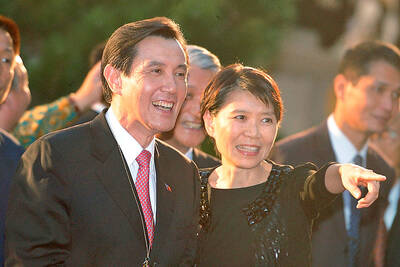
Former president Ma Ying-jeou (馬英九) yesterday expressed “shock and regret” over a statement issued by his wife without his consent, and rejected her assertion that his eldest sister, Ma Yi-nan (馬以南), would manage his medical care or act as his spokesperson amid an ongoing embezzlement probe into his foundation. Ma Ying-jeou in a statement said he was shocked by a statement by his wife, Chou Mei-ching (周美青), regarding his affairs. Ma Yi-nan “must not” be in charge of his healthcare and other personal affairs, nor can she be allowed to represent the Ma family, the former president said. He said he was also


 RSS
RSS