


Chinese Nationalist Party (KMT) Chairman Eric Chu (朱立倫) yesterday spoke of “four safeguards” as he called on Chinese President Xi Jinping (習近平) to recognize the “undeniable fact that Sun Yat-sen’s (孫逸仙) overthrow of the Qing Dynasty established the Republic of China [ROC].”
Chu made the remarks at an exhibit at Taipei’s Zhongshan Hall to mark the 76th anniversary of Retrocession Day, when the KMT claims the Japanese ceded Taiwan to the ROC.
For 100 years, Taiwan’s history has been inextricably tied to the ROC, Chu said.
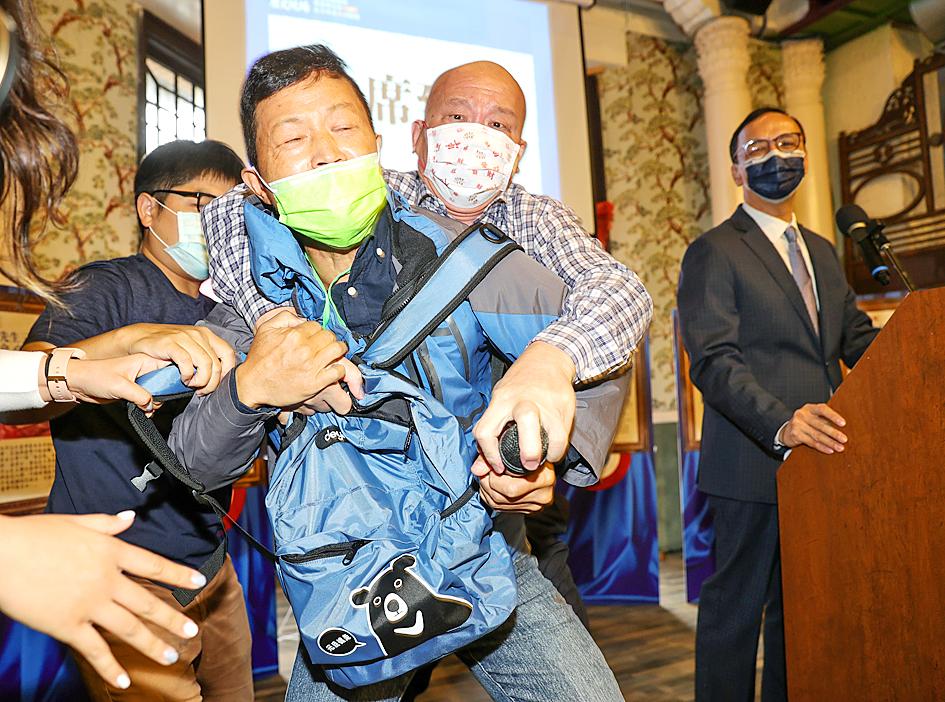
Photo: CNA
“It was through our resolve and hard work that we took back Taiwan. It was the hard work of the KMT that led to the protection, strengthening and democratization of Taiwan,” he said.
Chu criticized President Tsai Ing-wen (蔡英文) for saying during her National Day speech that the ROC’s history on Taiwan started in 1949, the year KMT forces retreated from China and fled to Taiwan. Chu said that Taiwan had been a part of the ROC since 1945 when the Japanese surrendered the island and relinquished control.
Explaining his “four safeguards,” Chu said the KMT would “safeguard the Constitution; safeguard the democracy and freedom that comprised the spirit behind the nation’s founding; safeguard the safety, peace and prosperity of the 23 million Taiwanese; and safeguard the dignity of the ROC and the facts regarding its history.”
Chu said that if the KMT returns to power, he would make Taiwan Retrocession Day a national holiday.
“It was only through the retrocession of Taiwan that we were able to defend and strengthen Taiwan, and that we are able to have democracy in Taiwan today,” he said.
At one point when Chu was speaking at the podium, Taiwan Republic Office director Chilly Chen (陳峻涵) approached the podium, raised a banner and shouted that Retrocession Day was “the day Taiwan fell back into enemy hands.”
He was forcibly removed.
Also yesterday, Deh Tzu-tsai (鄭自才) and Wang Wen-hong (王文宏), two senior advocates of Taiwan independence, condemned the KMT for promoting the idea of Taiwan Retrocession Day and led supporters to protest outside the Ministry of Foreign Affairs.
“The people of Taiwan and the Penghu Islands must know our history, that what took place 76 years ago was not Taiwan’s Retrocession Day, but was the day that Taiwan and the Penghu Islands came under enemy occupation,” said Deh, chairman of the Sovereign State for Formosa and Pescadores Party.
The narrative of a retrocession for Taiwan and Penghu, as territories returned to the ROC is not an honest recounting of history, he added.
Deh said that the KMT military dictatorship of the time covered up the fact that after Japan’s defeat, Taiwan came under custodianship of Allied forces as headed by the US, and Taiwan’s political status was not settled.
“The ROC regime perpetrated the biggest lie of the century by distorting it as Allied forces retroceding Taiwan to the ROC, which then declared it as retrocession of Taiwan back to the embrace of the Chinese motherland, which is a fraudulent claim,” he said.
Wang, chairman of the 228 Victims Care Association of Taiwan, said that after examining historical documents, “it is clear that ROC regime did not obtain the sovereignty nor the right to govern Taiwan and Penghu.”
“The sovereignty issue can only be settled when a referendum is held for Taiwanese to vote for self-determination,” he said.

The Centers for Disease Control (CDC) yesterday reported the first case of a new COVID-19 subvariant — BA.3.2 — in a 10-year-old Singaporean girl who had a fever upon arrival in Taiwan and tested positive for the disease. The girl left Taiwan on March 20 and the case did not have a direct impact on the local community, it said. The WHO added the BA.3.2 strain to its list of Variants Under Monitoring in December last year, but this was the first imported case of the COVID-19 variant in Taiwan, CDC Deputy Director-General Lin Ming-cheng (林明誠) said. The girl arrived in Taiwan on

South Korea is planning to revise its controversial electronic arrival card, a step Taiwanese officials said prompted them to hold off on planned retaliatory measures, a South Korean media report said yesterday. A Yonhap News Agency report said that the South Korean Ministry of Foreign Affairs is planning to remove the “previous departure place” and “next destination” fields from its e-arrival card system. The plan, reached after interagency consultations, is under review and aims to simplify entry procedures and align the electronic form with the paper version, a South Korean ministry official said. The fields — which appeared only on the electronic form

The Ministry of Foreign Affairs (MOFA) is suspending retaliation measures against South Korea that were set to take effect tomorrow, after Seoul said it is updating its e-arrival system, MOFA said today. The measures were to be a new round of retaliation after Taiwan on March 1 changed South Korea's designation on government-issued alien resident certificates held by South Korean nationals to "South Korea” from the "Republic of Korea," the country’s official name. The move came after months of protests to Seoul over its listing of Taiwan as "China (Taiwan)" in dropdown menus on its new online immigration entry system. MOFA last week

A bipartisan group of US senators has introduced a bill to enhance cooperation with Taiwan on drone development and to reduce reliance on supply chains linked to China. The proposed Blue Skies for Taiwan Act of 2026 was introduced by Republican US senators Ted Cruz and John Curtis, and Democratic US senators Jeff Merkley and Andy Kim. The legislation seeks to ease constraints on Taiwan-US cooperation in uncrewed aerial systems (UAS), including dependence on China-sourced components, limited access to capital and regulatory barriers under US export controls, a news release issued by Cruz on Wednesday said. The bill would establish a "Blue UAS


 RSS
RSS