


Democratic Progressive Party (DPP) members worried about December’s referendum vote after a recall vote on Saturday are calling for more campaigning to avoid another setback.
The recall of Taiwan Statebuilding Party Legislator Chen Po-wei (陳柏惟) has sparked concern within the DPP of a snowball effect heading into the referendums on Dec. 18, sources said.
On the ballot will be questions related to banning the importation of pork containing traces of the leanness-enhancing additive ractopamine, relocation of a natural gas terminal to protect algal reefs off Taoyuan’s Guanyin District (觀音), activating the Fourth Nuclear Power Plant in New Taipei City’s Gongliao District (貢寮) and holding referendums alongside elections.
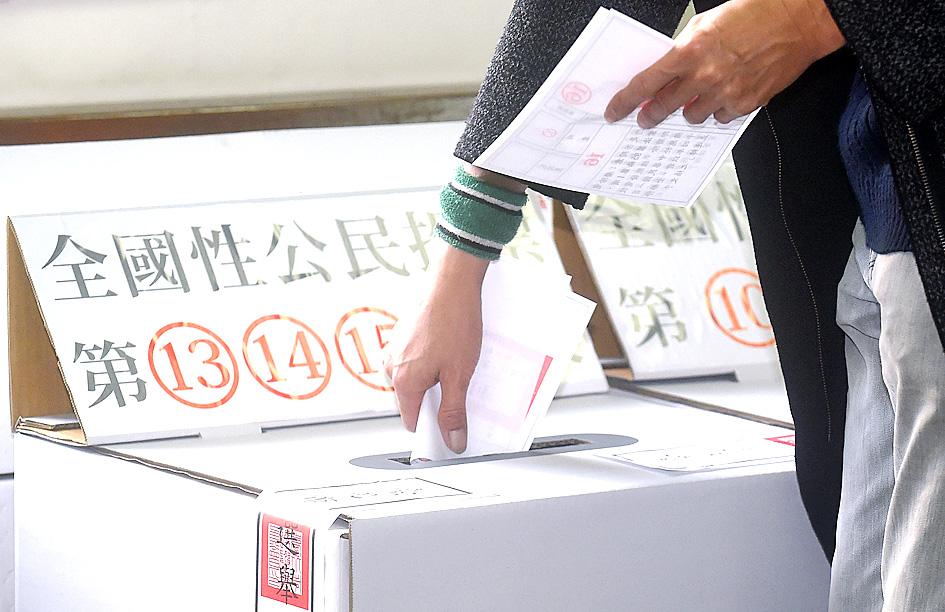
Photo: Liao Chen-huei, Taipei Times
The DPP earlier this year planned to hold more than 300 explanatory sessions across the nation, but due to a COVID-19 outbreak that began in May and the postponement of the referendum vote from August, they have yet to happen.
The Chinese Nationalist Party (KMT) is hoping to ride the surge following Chen’s recall, leading to calls within the DPP to meet the challenge head-on as time is running short.
Sources said the DPP intends to restart the postponed explanatory sessions to open a public dialogue on the referendum topics.
DPP caucus whip Liu Shyh-fang (劉世芳) on Saturday said the government is facing a tough battle and needs to tread lightly, as the referendum would represent a vote of confidence on its policy.
Suggesting that the government treat the referendum like a general election, she said officials need to come out and explain their positions in plain language.
She recommended the DPP bring together experts and organizations to hold discussions with the public, meeting them where they are.
DPP caucus secretary-general Tsai Shih-ying (蔡適應) echoed the call, adding that the party must defend these challenges to the administration if it hopes to prevent the referendums from passing.
Meanwhile, KMT Chairman Eric Chu (朱立倫), fresh off the recall victory, told a news conference that the party would put its full weight behind the referendums.
Seeking to focus on what it believes are the weaknesses of the DPP administration, the KMT hopes people will cast a vote of no confidence on the government with the referendums, he said.
After the recall election, the party cannot waste even a day before pushing for its next goal, KMT Culture and Communications Committee director-general Ling Tao (凌濤) said yesterday.
The think tank, and the legislative and central arms of the party have already agreed on the importance of the referendums, he said, promising a comprehensive strategy within the week.
Referendums are not an election, but a demonstration of the people’s will, he said, adding that the KMT would stand on the people’s side — that is, they are hoping for a “yes” across the board.
Additional reporting by Lee Hsin-fang and Chien Hui-ju

Actor Darren Wang (王大陸) was sentenced to six months in prison, commutable to a fine, by the New Taipei District Court today for contravening the Personal Data Protection Act (個人資料保護法) in a case linked to an alleged draft-dodging scheme. Wang allegedly paid NT$3.6 million (US$114,380) to an illegal group to help him evade mandatory military service through falsified medical documents, prosecutors said. He transferred the funds to Chen Chih-ming (陳志明), the alleged mastermind of a draft-evasion ring, although he lost contact with him as he was already in detention on fraud charges, they said. Chen is accused of helping a

SECURITY: Starlink owner Elon Musk has taken pro-Beijing positions, and allowing pro-China companies to control Taiwan’s critical infrastructure is risky, a legislator said Starlink was reluctant to offer services in Taiwan because of the nation’s extremely high penetration rates in 4G and 5G services, the Ministry of Digital Affairs said yesterday. The ministry made the comments at a meeting of the legislature’s Transportation Committee, which reviewed amendments to Article 36 of the Telecommunications Management Act (電信管理法). Article 36 bans foreigners from holding more than 49 percent of shares in public telecommunications networks, while shares foreigners directly and indirectly hold are also capped at 60 percent of the total, unless specified otherwise by law. The amendments, sponsored by Chinese Nationalist Party (KMT) Legislator Ko

The eastern extension of the Taipei MRT Red Line could begin operations as early as late June, the Taipei Department of Rapid Transit Systems said yesterday. Taipei Rapid Transit Corp said it is considering offering one month of free rides on the new section to mark its opening. Construction progress on the 1.4km extension, which is to run from the current terminal Xiangshan Station to a new eastern terminal, Guangci/Fengtian Temple Station, was 90.6 percent complete by the end of last month, the department said in a report to the Taipei City Council's Transportation Committee. While construction began in October 2016 with an

NON-RED SUPPLY: Boosting the nation’s drone industry is becoming increasingly urgent as China’s UAV dominance could become an issue in a crisis, an analyst said Taiwan’s drone exports to Europe grew 41.7-fold from 2024 to last year, with demand from Ukraine’s fight against Russian aggression the most likely driver of growth, a study showed. The Institute for Democracy, Society and Emerging Technology (DSET) in a statement on Wednesday said it found that many of Taiwan’s uncrewed aerial vehicle (UAV) sales were from Poland and the Czech Republic. These countries likely transferred the drones to Ukraine to aid it in its fight against the Russian invasion that started in 2022, it said. Despite the gains, Taiwan is not the dominant drone exporter to these markets, ranking second and fourth


 RSS
RSS