


Two US senators on Wednesday introduced bipartisan legislation that they said is aimed at lowering tensions and reducing the risk of conflict in the Taiwan Strait.
The Taiwan Actions Supporting Security by Undertaking Regular Engagements (Taiwan ASSURE) Act, proposed by Democratic Senator Edward Markey and Republican Senator Dan Sullivan, supports dialogue to mitigate misunderstandings and promote transparency, a statement issued on Friday by Markey’s office said.
“We must find ways to lower tensions and avoid miscalculation in the Taiwan Strait,” said Markey, who chairs the East Asia Subcommittee of the Senate Foreign Relations Committee.
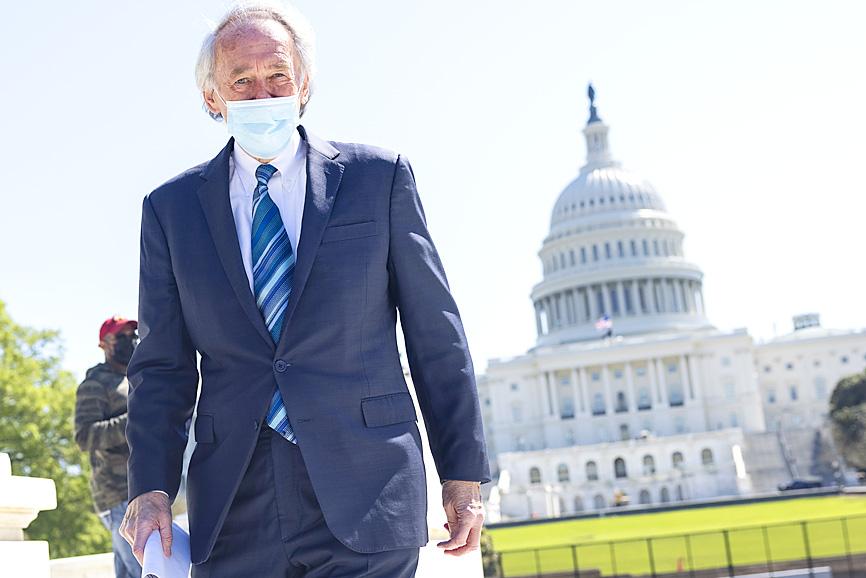
Photo: EPA-EFE
The proposed legislation would authorize about US$2 million annually from next year to 2025 for the US Department of State and Department of Defense to support strategic dialogues to be facilitated by independent nonprofit organizations in which participants meet to discuss cross-strait stability issues.
The proposed act says that the US should engage regional counterparts in these dialogues to increase strategic awareness among all parties, as well as facilitate US-China dialogues.
“Bilateral confidence-building measures and crisis stability dialogues between the United States and the PRC [People’s Republic of China] are important mechanisms for maintaining deterrence and stability across the Taiwan Strait and should be prioritized,” the statement said.
The US and China should prioritize the use of a military crisis hotline so leaders of the two countries can communicate directly in order to quickly resolve misunderstanding that could lead to military escalation, the bill says.
The legislation would require the US state and defense secretaries to evaluate the feasibility of establishing a partnership between the US National Guard and Taiwan’s Reserve Command, a move that has been welcomed by the Taiwanese government but criticized by China as “playing with fire” and could have the effect of provoking Beijing into taking further military action.
The bill would also require the US state and defense departments to submit unclassified reports detailing the military-to-military dialogues and confidence-building measures, as well as diplomatic engagements in which cross-strait issues were discussed, between the US and China during the previous 10 years from the passing of the act.
The proposed bill would also allow the US to provide annual funding of US$6 million between next year and 2025 to the Global Cooperation and Training Framework, a platform for Taiwan to share its expertise on issues from public health to disaster relief with international partners.
Markey said the US must continue to support Taiwan’s participation in the international community and “help the country withstand cross-strait coercion, while taking clear action to avoid conflict in the region.”

The Centers for Disease Control (CDC) yesterday reported the first case of a new COVID-19 subvariant — BA.3.2 — in a 10-year-old Singaporean girl who had a fever upon arrival in Taiwan and tested positive for the disease. The girl left Taiwan on March 20 and the case did not have a direct impact on the local community, it said. The WHO added the BA.3.2 strain to its list of Variants Under Monitoring in December last year, but this was the first imported case of the COVID-19 variant in Taiwan, CDC Deputy Director-General Lin Ming-cheng (林明誠) said. The girl arrived in Taiwan on

South Korea is planning to revise its controversial electronic arrival card, a step Taiwanese officials said prompted them to hold off on planned retaliatory measures, a South Korean media report said yesterday. A Yonhap News Agency report said that the South Korean Ministry of Foreign Affairs is planning to remove the “previous departure place” and “next destination” fields from its e-arrival card system. The plan, reached after interagency consultations, is under review and aims to simplify entry procedures and align the electronic form with the paper version, a South Korean ministry official said. The fields — which appeared only on the electronic form

The Ministry of Foreign Affairs (MOFA) is suspending retaliation measures against South Korea that were set to take effect tomorrow, after Seoul said it is updating its e-arrival system, MOFA said today. The measures were to be a new round of retaliation after Taiwan on March 1 changed South Korea's designation on government-issued alien resident certificates held by South Korean nationals to "South Korea” from the "Republic of Korea," the country’s official name. The move came after months of protests to Seoul over its listing of Taiwan as "China (Taiwan)" in dropdown menus on its new online immigration entry system. MOFA last week
A bipartisan group of US senators has introduced a bill to enhance cooperation with Taiwan on drone development and to reduce reliance on supply chains linked to China. The proposed Blue Skies for Taiwan Act of 2026 was introduced by Republican US senators Ted Cruz and John Curtis, and Democratic US senators Jeff Merkley and Andy Kim. The legislation seeks to ease constraints on Taiwan-US cooperation in uncrewed aerial systems (UAS), including dependence on China-sourced components, limited access to capital and regulatory barriers under US export controls, a news release issued by Cruz on Wednesday said. The bill would establish a "Blue UAS


 RSS
RSS