


Chinese Nationalist Party (KMT) lawmakers yesterday proposed a motion to have Premier Su Tseng-chang (蘇貞昌) listed as persona non grata and not be allowed to attend future legislative sessions, but it was struck down by Democratic Progressive Party (DPP) lawmakers.
“To preserve our legislature’s dignity and safeguard this nation’s constitutional framework ... we request that the legislature condemn Su for showing disrespect to legislators, to list him as persona non grata,” the motion read.
It was referring to an argument Su had with KMT Legislator Cheng Li-wun (鄭麗文) during a legislative session on Tuesday after Cheng demanded to know whether the government had plans to develop nuclear submarines.
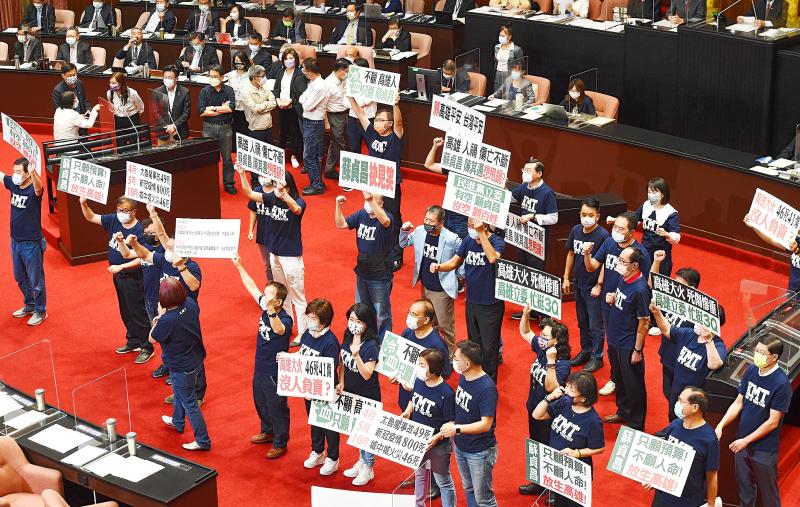
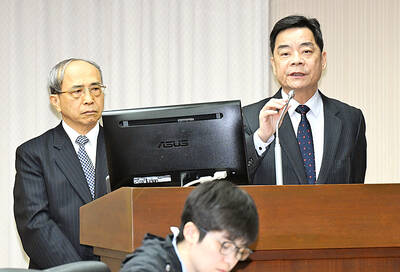
Photo: Liao Chen-huei, Taipei Times
Su did not give a direct response.
“I’m afraid you will be the first and [President] Tsai Ing-wen (蔡英文) will be the second to surrender to China in the event of a war,” Cheng said.
“We will not be as shameless as you people,” Su replied.
Su’s remarks prompted anger from Cheng, while the KMT caucus demanded that Su apologize for the word “shameless.”
DPP lawmakers used their legislative majority to defeat the motion in a vote.
The KMT caucus then proposed another motion.
“Legislative Speaker You Si-kun (游錫堃) must preside over legislative sessions with impartiality when dealing with Cabinet officials’ misconduct,” it said.
It was also rejected.
Earlier, the legislative session opened with a moment’s silence for the victims of a fire at a building in Kaohsiung on Thursday.
The KMT caucus then proposed a recess as its lawmakers shouted: “Recess right now. Save Kaohsiung.”
KMT lawmakers said that they wanted Su to head the relief efforts in Kaohsiung and “we do not need to tie up Su in the legislature.”
Su was due to present a policy report, but KMT lawmakers obstructed him and used delaying tactics to prevent the premier from delivering his report.
The DPP caucus proposed a motion to expedite the day’s session by not allowing legislators to question issues related to legislative procedures, the agenda and questions about the legislature’s authorized powers.
When the motion was passed, KMT lawmakers vociferously protested, banging their fists and metal containers on their desks.
A group of KMT legislators rushed to surround You, with DPP lawmakers countering the move to protect You and prevent any physical altercation.
With the legislative chamber degenerating into disarray and the floor occupied by KMT lawmakers holding placards, You called a break until next week.
The KMT was trying to force a recess so the scheduled agenda for next week could not proceed, including deliberations on the government’s budget for next year, “so that is why our party had to oppose the KMT’s motions,” DPP caucus whip Ker Chien-ming (柯建銘) said.
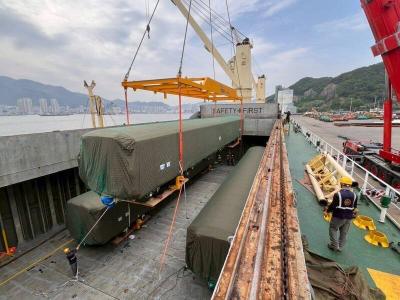
The first of 10 new high-capacity trains purchased from South Korea’s Hyundai Rotem arrived at the Port of Taipei yesterday to meet the demands of an expanding metro network, Taipei Rapid Transit Corp (TRTC) said yesterday. The train completed a three-day, 1,200km voyage from the Port of Masan in South Korea, the company said. Costing NT$590 million (US$18.79 million) each, the new six-carriage trains feature a redesigned interior based on "human-centric" transportation concepts, TRTC said. The design utilizes continuous longitudinal seating to widen the aisles and optimize passenger flow, while also upgrading passenger information displays and driving control systems for a more comfortable
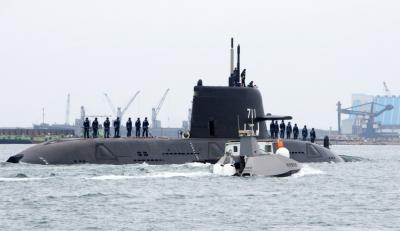
Taiwan's first indigenous defense submarine, the SS-711 Hai Kun (海鯤, or Narwhal), departed for its 13th sea trial at 7am today, marking its seventh submerged test, with delivery to the navy scheduled for July. The outing also marked its first sea deployment since President William Lai (賴清德) boarded the submarine for an inspection on March 19, drawing a crowd of military enthusiasts who gathered to show support. The submarine this morning departed port accompanied by CSBC Corp’s Endeavor Manta (奮進魔鬼魚號) uncrewed surface vessel and a navy M109 assault boat. Amid public interest in key milestones such as torpedo-launching operations and overnight submerged trials,
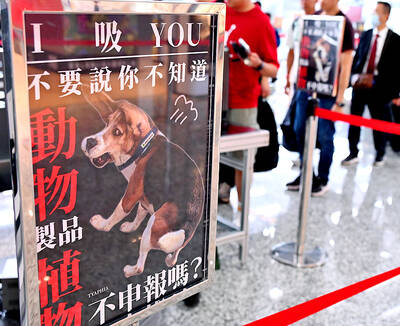
Quarantine awareness posters at Taiwan Taoyuan International Airport have gone viral for their use of wordplay. Issued by the airport branch of the Animal and Plant Health Inspection Agency, the posters feature sniffer dogs making a range of facial expressions, paired with advisory messages built around homophones. “We update the messages for holidays and campaign needs, periodically refreshing materials to attract people’s attention,” quarantine officials said. “The aim is to use the dogs’ appeal to draw focus to quarantine regulations.” A Japanese traveler visiting Taiwan has posted a photo on X of a poster showing a quarantine dog with a
SECURITY RISK: A university student sent a general alarm signal to THSRC’s control center on April 5, causing four operating trains to temporarily halt services The Ministry of Transportation and Communications yesterday pledged to submit a report on ways to harden the communication security of railway systems after a university student hacked into Taiwan High Speed Rail Corp’s (THSRC) radio communications system and disrupted operations of four high-speed rail trains last month. Investigation by the police and prosecutors found that the university student and radio enthusiast, surnamed Lin (林), first used a software-defined radio (SDR) filter to analyze THSRC signals, downloaded the data to a computer, cracked the parameters and then programmed the codes into his radio devices. Lin then sent a general alarm signal to


 RSS
RSS