


A shipment of 1.13 million doses of the Moderna COVID-19 vaccine is due to arrive in Taiwan early today, while the next round of Pfizer-BioNTech vaccines to be administered under a national program has been expanded to include people aged 45 or older.
Deputy Minister of the Interior Chen Tsung-yen (陳宗彥), the Central Epidemic Command Center’s (CECC) deputy head, said that the Moderna vaccines purchased directly from the manufacturer were slated to arrive at Taiwan Taoyuan International Airport from Atlanta, Georgia, between last night and early this morning.
The doses would be reserved primarily as second shots for people who received their first jab of the Moderna vaccine on or before July 16, the CECC said.
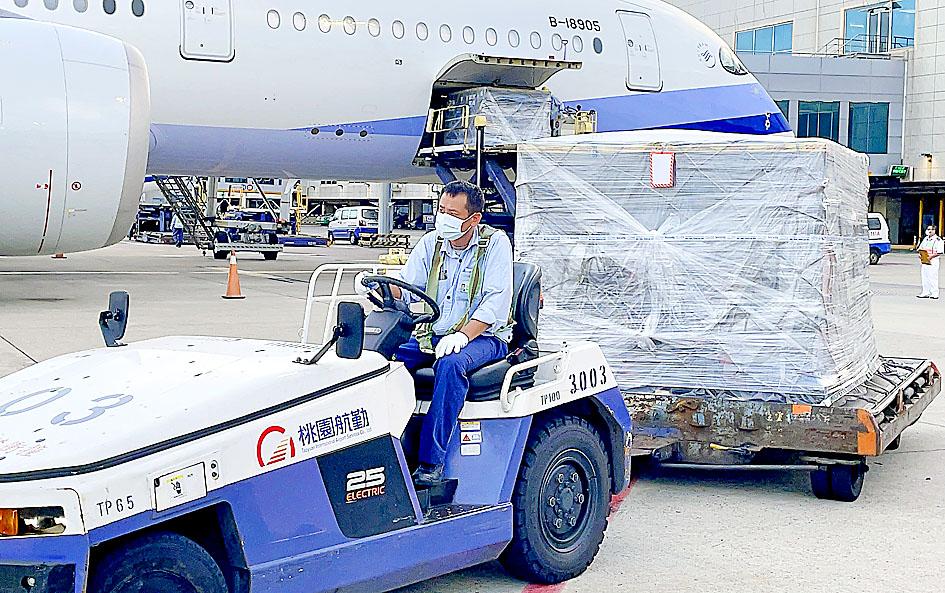
Photo: Chu Pei-hsiung, Taipei Times
Taiwan also took delivery of a seventh shipment of 889,200 doses of the Pfizer-BioNTech COVID-19 vaccine early yesterday morning, Chen told the CECC’s daily news briefing.
The BioNTech shipment arrived at the airport from Germany as part of a combined 15 million doses ordered separately by the Hon Hai Precision Co-affilaited Yonglin Foundation, Taiwan Semiconductor Manufacturing Co and the Buddhist Compassion Relief Tzu Chi Foundation to be donated to the government for public distribution.
With yesterday’s shipment, Taiwan has now received about 5.09 million of the 15 million doses, the CECC said.
Eligibility for the upcoming round of Pfizer-BioNTech vaccines will be lowered to include people aged 45 and older, from the previously intended target of 47 and older announced by the CECC on Monday, Chen said.
People wishing to receive their first shot of this brand can make online appointments next week from 10am on Monday to midday on Wednesday, he said.
Also included in this round is the AstraZeneca vaccine, targeting second shots for people aged 18 or older who had a first AstraZeneca jab on or before July 22, he said.
Second AstraZeneca jabs will also be available to those aged 54 or older who had their first AstraZeneca dose on or before July 30, Chen added.

The military has spotted two Chinese warships operating in waters near Penghu County in the Taiwan Strait and sent its own naval and air forces to monitor the vessels, the Ministry of National Defense (MND) said. Beijing sends warships and warplanes into the waters and skies around Taiwan on an almost daily basis, drawing condemnation from Taipei. While the ministry offers daily updates on the locations of Chinese military aircraft, it only rarely gives details of where Chinese warships are operating, generally only when it detects aircraft carriers, as happened last week. A Chinese destroyer and a frigate entered waters to the southwest

A magnitude 6.1 earthquake struck off the coast of Yilan County at 8:39pm tonight, the Central Weather Administration (CWA) said, with no immediate reports of damage or injuries. The epicenter was 38.7km east-northeast of Yilan County Hall at a focal depth of 98.3km, the CWA’s Seismological Center said. The quake’s maximum intensity, which gauges the actual physical effect of a seismic event, was a level 4 on Taiwan’s 7-tier intensity scale, the center said. That intensity level was recorded in Yilan County’s Nanao Township (南澳), Hsinchu County’s Guansi Township (關西), Nantou County’s Hehuanshan (合歡山) and Hualien County’s Yanliao (鹽寮). An intensity of 3 was

Japanese Prime Minister Sanae Takaichi’s comment last year on Tokyo’s potential reaction to a Taiwan-China conflict has forced Beijing to rewrite its invasion plans, a retired Japanese general said. Takaichi told the Diet on Nov. 7 last year that a Chinese naval blockade or military attack on Taiwan could constitute a “survival-threatening situation” for Japan, potentially allowing Tokyo to exercise its right to collective self-defense. Former Japan Ground Self-Defense Force general Kiyofumi Ogawa said in a recent speech that the remark has been interpreted as meaning Japan could intervene in the early stages of a Taiwan Strait conflict, undermining China’s previous assumptions
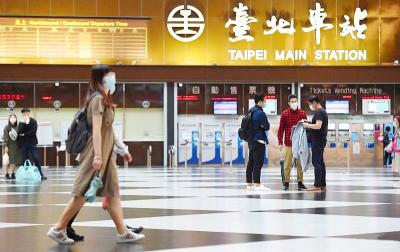
Taiwan Railways Corp (TRC) today announced that Shin Kong Mitsukoshi has been selected as the preferred bidder to operate the Taipei Railway Station shopping mall, replacing the current operator, Breeze Development Co Ltd. Among eight qualified firms that delivered presentations and were evaluated by a review committee, Shin Kong Mitsukoshi was ranked first, while Breeze was named the runner-up, the rail company said in a statement. Contract negotiations are to proceed in accordance with regulations, it said, adding that if negotiations with the top bidder fail, it could invite the second-ranked applicant to enter talks. Breeze in a statement today expressed doubts over


 RSS
RSS