


Taiwan yesterday received its sixth shipment of Pfizer-BioNTech COVID-19 vaccines, while another shipment of the vaccines, as well as a batch of Moderna COVID-19 vaccines, are scheduled to arrive today, the Central Epidemic Command Center (CECC) said.
Yesterday’s shipment of 889,200 doses arrived at Taiwan Taoyuan International Airport on a China Airlines flight at 5:34am.
It is part of 15 million Pfizer-BioNTech doses ordered by three private entities — the Hon Hai Precision Industries Co-affiliated Yonglin Foundation, Taiwan Semiconductor Manufacturing Co, and the Buddhist Compassion Relief Tzu Chi Foundation — and donated to the government for distribution among the public.
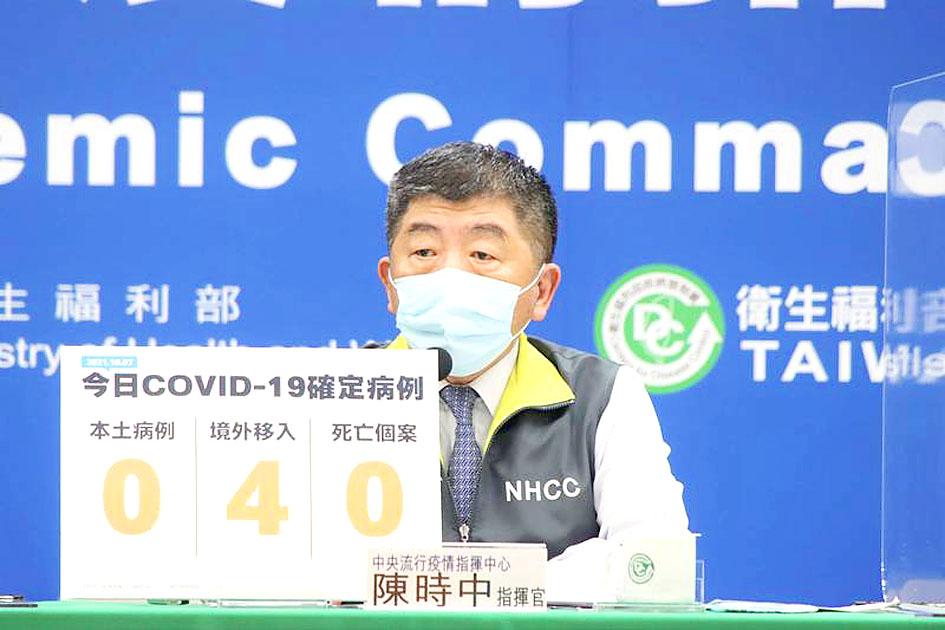
Photo courtesy of the CECC
As of yesterday, Taiwan had received more than 4.2 million doses of the vaccine.
Another shipment of doses of the same brand, as well as a batch of the Moderna vaccine, are scheduled to arrive in Taiwan today, said Minister of Health and Welfare Chen Shih-chung (陳時中), who heads the center, without elaborating on the number of expected doses.
Chen said that with more doses arriving, the CECC might expand the eligibility for the Pfizer-BioNTech vaccine to all members of the public aged 12 or older who have not yet received a first dose.
People aged 12 to 22 or older than 46, as well as people with serious or rare conditions, are currently eligible.
The expected Moderna vaccines would be administered as second doses and priority would be given to those who had their first Moderna shot before July 16, Chen said.
As inspections usually take about 10 days, Chen said he hopes that the newly arrived doses would be administered as early as Oct. 22.
To date, nearly 13.61 million people, or 58 percent of the population of 23.45 million, have received one shot of a COVID-19 vaccine, but only 15.3 percent, or 3.6 million people, have had the two doses needed to be considered fully vaccinated, CECC data showed.
Chen on Wednesday told the center’s daily news conference that Taiwan would by the end of the year secure supplies of molnupiravir, an antiviral that US company Merck said significantly reduced the risk of hospitalization or death from COVID-19 during clinical trials.
The government has held talks with the drugmaker and is planning to import molnupiravir as soon as it has received emergency use authorization from the US Food and Drug Administration, he said.
Meanwhile, the CECC yesterday reported four new imported COVID- 19 cases, but no domestic infections or deaths.
Yesterday was the eighth consecutive day without a new domestic case, it said.
Meanwhile, a copilot working for a Taiwanese airline who had spent two days with her family before testing positive for COVID-19 was infected with the Delta variant of SARS-CoV-2, the center said.
The CECC listed the case as imported, but said that it is unsure whether she contracted the virus in the US or in Singapore.

The Centers for Disease Control (CDC) yesterday reported the first case of a new COVID-19 subvariant — BA.3.2 — in a 10-year-old Singaporean girl who had a fever upon arrival in Taiwan and tested positive for the disease. The girl left Taiwan on March 20 and the case did not have a direct impact on the local community, it said. The WHO added the BA.3.2 strain to its list of Variants Under Monitoring in December last year, but this was the first imported case of the COVID-19 variant in Taiwan, CDC Deputy Director-General Lin Ming-cheng (林明誠) said. The girl arrived in Taiwan on

South Korea is planning to revise its controversial electronic arrival card, a step Taiwanese officials said prompted them to hold off on planned retaliatory measures, a South Korean media report said yesterday. A Yonhap News Agency report said that the South Korean Ministry of Foreign Affairs is planning to remove the “previous departure place” and “next destination” fields from its e-arrival card system. The plan, reached after interagency consultations, is under review and aims to simplify entry procedures and align the electronic form with the paper version, a South Korean ministry official said. The fields — which appeared only on the electronic form

The Ministry of Foreign Affairs (MOFA) is suspending retaliation measures against South Korea that were set to take effect tomorrow, after Seoul said it is updating its e-arrival system, MOFA said today. The measures were to be a new round of retaliation after Taiwan on March 1 changed South Korea's designation on government-issued alien resident certificates held by South Korean nationals to "South Korea” from the "Republic of Korea," the country’s official name. The move came after months of protests to Seoul over its listing of Taiwan as "China (Taiwan)" in dropdown menus on its new online immigration entry system. MOFA last week

A bipartisan group of US senators has introduced a bill to enhance cooperation with Taiwan on drone development and to reduce reliance on supply chains linked to China. The proposed Blue Skies for Taiwan Act of 2026 was introduced by Republican US senators Ted Cruz and John Curtis, and Democratic US senators Jeff Merkley and Andy Kim. The legislation seeks to ease constraints on Taiwan-US cooperation in uncrewed aerial systems (UAS), including dependence on China-sourced components, limited access to capital and regulatory barriers under US export controls, a news release issued by Cruz on Wednesday said. The bill would establish a "Blue UAS


 RSS
RSS