


The Economic Democracy Union yesterday proposed expanding the scope of personnel subject to cross-strait travel restrictions, saying that proposals to protect key industries would not be sufficient to curtail theft of sensitive trade secrets.
The Mainland Affairs Council earlier this year proposed amendments to the Act Governing Relations Between the People of the Taiwan Area and the Mainland Area (臺灣地區與大陸地區人民關係條例) that would require those working in “national core technologies” to apply before traveling to China.
The amendments, which have been sent to the Executive Yuan for approval, would also set a fine of NT$2 million to NT$10 million (US$71,505 to US$357,526) for contravening the rule.
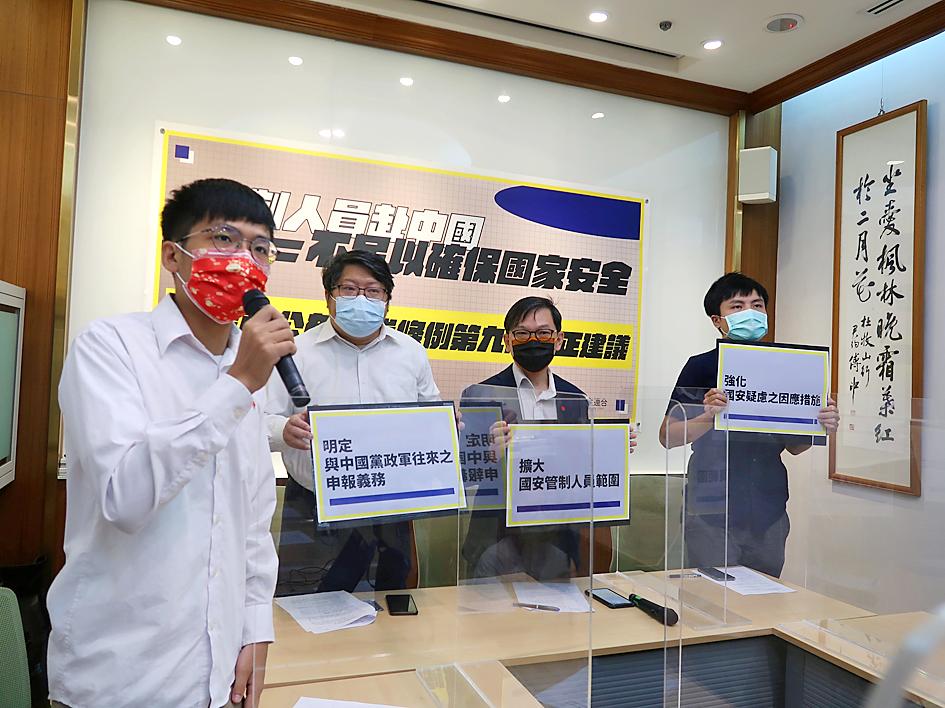
Photo: Chen Yu-fu, Taipei Times
Aimed at protecting the nation’s economic competitiveness, the regulations would only apply to those working for companies that have been commissioned by or have received subsidies from the government.
The law as it stands is already far too limited in scope to have an effect, Taiwan Citizen Front head Hsu Kuang-tse (許冠澤) told a news conference at the Legislative Yuan in Taipei.
As an example, Hsu cited an espionage case involving retired army lieutenant colonel Cheng Chih-wen (鄭智文) and his father, former Labor Party chairman Cheng Chao-ming (鄭昭明).
The two were accused of meeting a Chinese agent in Tokyo, Singapore, Malaysia and Vietnam, accepting gifts in exchange for information, assisting in setting up a spy network in Taiwan and promising to persuade others to surrender in the event of a Chinese invasion, Hsu said.
The father and son in August last year were found guilty of crimes against national security, receiving suspended sentences of 10 months and one year respectively in addition to fines.
The light sentences relative to their crimes exposes a need for not only judicial reform, but also changes to the law restricting travel by sensitive personnel, Hsu said.
Hsu was referring to Article 9 of the act, which formerly required all Taiwanese to apply with the Ministry of the Interior before traveling to China, Institutum Iurisprudentiae Academia Sinica researcher Chiou Wen-tsong (邱文聰) said.
Since 2003, the rule has been gradually eased and now only requires eight categories of people to apply, including those involved in national security, high-level officials, military and police, he added.
The latest proposed amendment seeks to expand the list to include those involved in key technologies, but Chiou said it would not be enough.
For a start, he suggested expanding its scope to include personnel working at research institutes in “national key areas,” as well as those who play critical roles in the nation’s infrastructure.
The government has approved four universities’ plans to set up institutes researching artificial intelligence, semiconductors, finance and other key areas with corporate partners, with half of their funding provided by the National Development Fund, he said.
Such institutes are no less important to national security and economic development than the personnel listed in the council’s proposed amendment and should therefore be included in the law, he said.
Otherwise, it would be akin to “smashing your own feet with a rock,” Chiou added.
As for the second category, Economic Democracy Union convener Lai Chung-chiang (賴中強) raised for example all of the people involved in creating and managing the new electronic identification cards.
If the card system goes online, the programmers, system engineers and executives involved in its creation would have access to the “digital identity key” for all Taiwanese, making them potential targets if they visit China, Lai said.
As nearly all previous cases involved contact with a Chinese agent in other countries, “only restricting travel to China is not enough,” he added.
Such personnel should be required to file detailed reports of their interactions with sensitive contacts from China, Hong Kong or Macau, he said.
To ensure that the requirement “is not toothless,” Taiwan Citizen Front secretary-general Chiang Min-yen (江旻諺) recommended revising penalties to allow at most three years in prison and fines of up to NT$10 million for failing to report or filing a false report, the same penalty handed to those found guilty of causing a public official to report misinformation.

The Centers for Disease Control (CDC) yesterday reported the first case of a new COVID-19 subvariant — BA.3.2 — in a 10-year-old Singaporean girl who had a fever upon arrival in Taiwan and tested positive for the disease. The girl left Taiwan on March 20 and the case did not have a direct impact on the local community, it said. The WHO added the BA.3.2 strain to its list of Variants Under Monitoring in December last year, but this was the first imported case of the COVID-19 variant in Taiwan, CDC Deputy Director-General Lin Ming-cheng (林明誠) said. The girl arrived in Taiwan on

South Korea is planning to revise its controversial electronic arrival card, a step Taiwanese officials said prompted them to hold off on planned retaliatory measures, a South Korean media report said yesterday. A Yonhap News Agency report said that the South Korean Ministry of Foreign Affairs is planning to remove the “previous departure place” and “next destination” fields from its e-arrival card system. The plan, reached after interagency consultations, is under review and aims to simplify entry procedures and align the electronic form with the paper version, a South Korean ministry official said. The fields — which appeared only on the electronic form

The Ministry of Foreign Affairs (MOFA) is suspending retaliation measures against South Korea that were set to take effect tomorrow, after Seoul said it is updating its e-arrival system, MOFA said today. The measures were to be a new round of retaliation after Taiwan on March 1 changed South Korea's designation on government-issued alien resident certificates held by South Korean nationals to "South Korea” from the "Republic of Korea," the country’s official name. The move came after months of protests to Seoul over its listing of Taiwan as "China (Taiwan)" in dropdown menus on its new online immigration entry system. MOFA last week
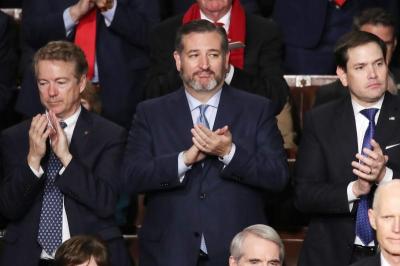
A bipartisan group of US senators has introduced a bill to enhance cooperation with Taiwan on drone development and to reduce reliance on supply chains linked to China. The proposed Blue Skies for Taiwan Act of 2026 was introduced by Republican US senators Ted Cruz and John Curtis, and Democratic US senators Jeff Merkley and Andy Kim. The legislation seeks to ease constraints on Taiwan-US cooperation in uncrewed aerial systems (UAS), including dependence on China-sourced components, limited access to capital and regulatory barriers under US export controls, a news release issued by Cruz on Wednesday said. The bill would establish a "Blue UAS


 RSS
RSS