


The Ministry of National Defense and the American Institute in Taiwan (AIT) have inked a deal to maintain ground support equipment for US-made Patriot Advanced Capability-3 (PAC-3) missiles, as well as other missiles in Taiwan.
Ministry representatives first negotiated the NT$1.4 billion (US$50.39 million) contract with AIT officials on Aug. 31, the ministry said in an award notification issued on the Taiwan Buying Network on Monday.
The deal would provide maintenance services for US-made missiles, including the PAC-3 systems, until 2025, it said, adding that the Republic of China Air Force Command Headquarters would take charge of Taiwan’s contractual obligations.
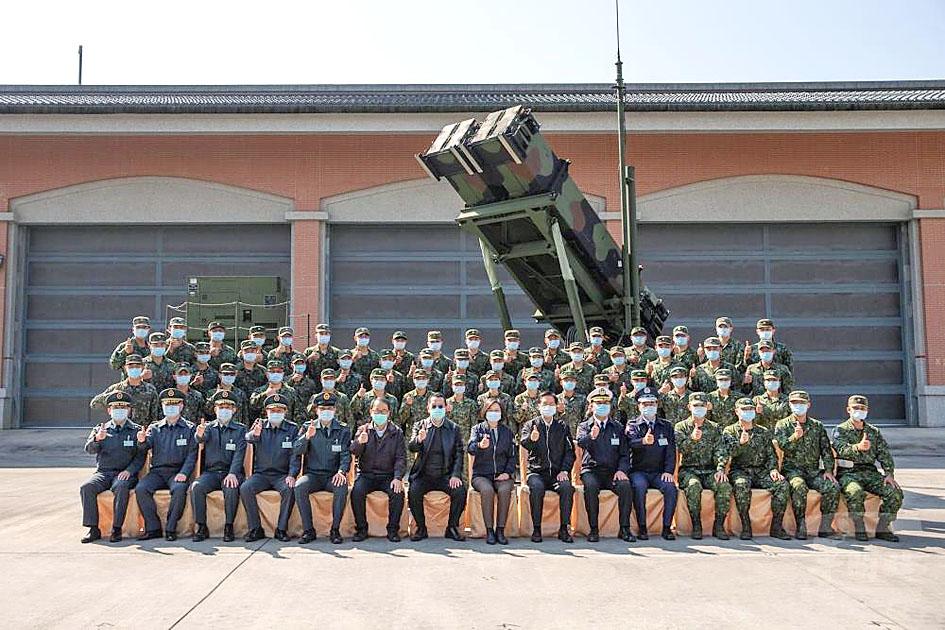
Photo copied by Wu Shu-wei, Taipei Times
The deal is part of the PAC-3 sales package that includes the missiles, related systems, and maintenance and support services, a ministry official said on condition of anonymity.
According to the package deal, Taiwan’s PAC-3 missile defense systems that are near the end of their service life would be returned to the US for refurbishment, they said.
The PAC-3 is Taiwan’s primary missile defense system against the Chinese People’s Liberation Army’s (PLA) sophisticated missile arsenal, whose range covers all of Taiwan.
The PLA’s missile forces increasingly use mobile launch platforms in addition to fixed batteries, a development that deeply concerns Taiwanese defense officials.
In its 2021 People’s Liberation Army Capability Report, which was submitted to the legislature on Sept. 1, the ministry said that the PLA Rocket Force continues to develop strike missiles with stealth capabilities, as well as those that can penetrate air-defense systems, change trajectory mid-air and ignore electronic interference.
The PLA Rocket Force is rapidly fielding new systems and improving training standards to augment its capabilities to carry out attacks against Taiwan and counter precision stand-off weapons fielded by other foreign adversaries, it said.
The Chinese military is expected to replace older ballistic and cruise missiles with the new short-range DF-16, as well as the improved medium-range DF-16, DF-17, DF-10A and the DF-100 cruise missile, it said.

The Centers for Disease Control (CDC) yesterday reported the first case of a new COVID-19 subvariant — BA.3.2 — in a 10-year-old Singaporean girl who had a fever upon arrival in Taiwan and tested positive for the disease. The girl left Taiwan on March 20 and the case did not have a direct impact on the local community, it said. The WHO added the BA.3.2 strain to its list of Variants Under Monitoring in December last year, but this was the first imported case of the COVID-19 variant in Taiwan, CDC Deputy Director-General Lin Ming-cheng (林明誠) said. The girl arrived in Taiwan on

South Korea is planning to revise its controversial electronic arrival card, a step Taiwanese officials said prompted them to hold off on planned retaliatory measures, a South Korean media report said yesterday. A Yonhap News Agency report said that the South Korean Ministry of Foreign Affairs is planning to remove the “previous departure place” and “next destination” fields from its e-arrival card system. The plan, reached after interagency consultations, is under review and aims to simplify entry procedures and align the electronic form with the paper version, a South Korean ministry official said. The fields — which appeared only on the electronic form

The Ministry of Foreign Affairs (MOFA) is suspending retaliation measures against South Korea that were set to take effect tomorrow, after Seoul said it is updating its e-arrival system, MOFA said today. The measures were to be a new round of retaliation after Taiwan on March 1 changed South Korea's designation on government-issued alien resident certificates held by South Korean nationals to "South Korea” from the "Republic of Korea," the country’s official name. The move came after months of protests to Seoul over its listing of Taiwan as "China (Taiwan)" in dropdown menus on its new online immigration entry system. MOFA last week

A bipartisan group of US senators has introduced a bill to enhance cooperation with Taiwan on drone development and to reduce reliance on supply chains linked to China. The proposed Blue Skies for Taiwan Act of 2026 was introduced by Republican US senators Ted Cruz and John Curtis, and Democratic US senators Jeff Merkley and Andy Kim. The legislation seeks to ease constraints on Taiwan-US cooperation in uncrewed aerial systems (UAS), including dependence on China-sourced components, limited access to capital and regulatory barriers under US export controls, a news release issued by Cruz on Wednesday said. The bill would establish a "Blue UAS


 RSS
RSS