


An increased defense budget, improving people’s livelihoods and pushing for sustainable development were among the items Premier Su Tseng-chang (蘇貞昌) presented in a written report to the Legislative Yuan yesterday.
Frequent Chinese military incursions into Taiwan’s air defense identification zone have destabilized regional security, Su wrote in the report.
“Therefore our armed forces must monitor these actions and prepare for contingencies,” the report said. “We must have the resolve to defend our nation, build up stronger armed forces and unite all Taiwanese.”
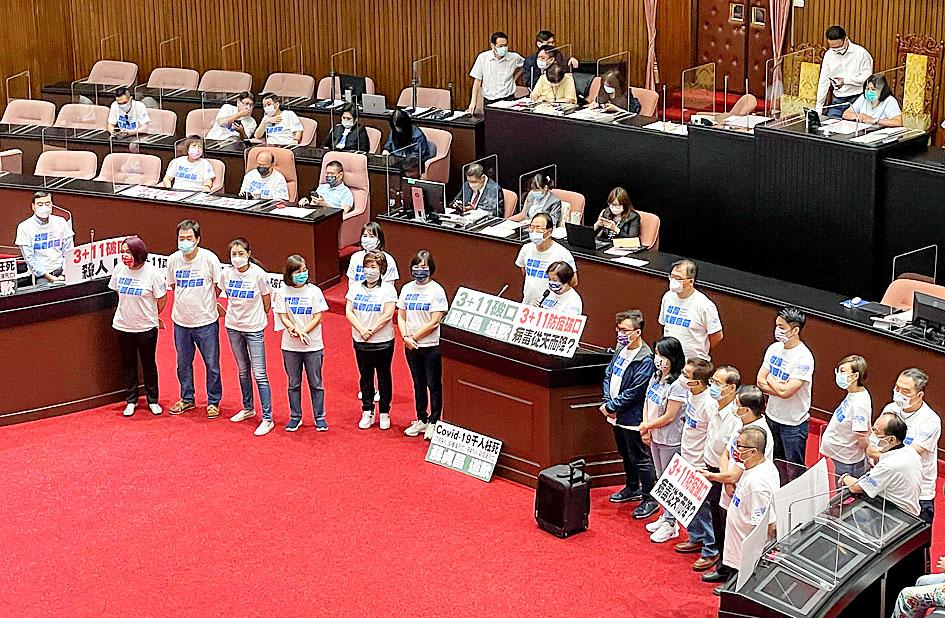
Photo: Liu Hsin-de, Taipei Times
“We must show the international community that we are standing up for ourselves,” it said. “Only if we help ourselves will other countries come to our aid in a time of need.”
The defense budget for next year is a record NT$470 billion (US$16.95 billion), it said.
The Executive Yuan last week submitted to the legislature for approval amendments to increase spending to NT$240 billion over five years on arms procurement for the navy and air force, the report said.
Taiwan’s fleet of 141 US-made F-16A/B fighters are being upgraded to F-16Vs, with Taiwan’s first F-16V wing to be commissioned in November to bolster the nation’s strategic air defense, the report said.
To improve people’s livelihoods, the government is to allocate more than NT$86 billion to help parents raise children — a sixfold increase from 2016 — Su wrote.
Subsidies for families raising a child last month were raised to NT$3,500 per month, up from NT$2,500, and they are to rise to NT$5,000 by August next year, he wrote, adding that a target to install air-conditioners in all classrooms by March next year would be met.
Taiwan has filed an application to join the Comprehensive and Progressive Agreement for Trans-Pacific Partnership (CPTPP), the report said.
“We are able to comply with the high standards under the international trading framework, and our government is taking steps to seek support from CPTPP member nations,” it said.
“Joining would enable Taiwan to expand its exports and attract more foreign investment, thereby elevating the nation’s competitiveness,” it said. “We are ready to contribute to economic growth in the region, so we can create win-win situations for all members of the trade group.”
Regarding sustainable development, it said that production of COVID-19 vaccines in Taiwan is vital, as they are a strategic product.
“If a country cannot produce its own vaccines, it will be forever subordinate to others,” the report said. “Taiwan is one of a few countries in the world with the capability to produce its own vaccines, and the government will continue to encourage biotechnology and healthcare development.”
Taiwan will work diligently to be a key player in the worldwide supply chain for biotechnology and pharmaceutical products, it said, adding that the Executive Yuan has proposed a bill for the legislature to consider aimed at providing more support and incentives for the nation’s biomedical and pharmaceutical industries.

The Centers for Disease Control (CDC) yesterday reported the first case of a new COVID-19 subvariant — BA.3.2 — in a 10-year-old Singaporean girl who had a fever upon arrival in Taiwan and tested positive for the disease. The girl left Taiwan on March 20 and the case did not have a direct impact on the local community, it said. The WHO added the BA.3.2 strain to its list of Variants Under Monitoring in December last year, but this was the first imported case of the COVID-19 variant in Taiwan, CDC Deputy Director-General Lin Ming-cheng (林明誠) said. The girl arrived in Taiwan on

South Korea is planning to revise its controversial electronic arrival card, a step Taiwanese officials said prompted them to hold off on planned retaliatory measures, a South Korean media report said yesterday. A Yonhap News Agency report said that the South Korean Ministry of Foreign Affairs is planning to remove the “previous departure place” and “next destination” fields from its e-arrival card system. The plan, reached after interagency consultations, is under review and aims to simplify entry procedures and align the electronic form with the paper version, a South Korean ministry official said. The fields — which appeared only on the electronic form

The Ministry of Foreign Affairs (MOFA) is suspending retaliation measures against South Korea that were set to take effect tomorrow, after Seoul said it is updating its e-arrival system, MOFA said today. The measures were to be a new round of retaliation after Taiwan on March 1 changed South Korea's designation on government-issued alien resident certificates held by South Korean nationals to "South Korea” from the "Republic of Korea," the country’s official name. The move came after months of protests to Seoul over its listing of Taiwan as "China (Taiwan)" in dropdown menus on its new online immigration entry system. MOFA last week

A bipartisan group of US senators has introduced a bill to enhance cooperation with Taiwan on drone development and to reduce reliance on supply chains linked to China. The proposed Blue Skies for Taiwan Act of 2026 was introduced by Republican US senators Ted Cruz and John Curtis, and Democratic US senators Jeff Merkley and Andy Kim. The legislation seeks to ease constraints on Taiwan-US cooperation in uncrewed aerial systems (UAS), including dependence on China-sourced components, limited access to capital and regulatory barriers under US export controls, a news release issued by Cruz on Wednesday said. The bill would establish a "Blue UAS


 RSS
RSS