


A team of Taiwanese researchers yesterday said they had collaborated with Japanese researchers to develop a new memory device that can transmit both electronic and light signals.
The team comprised researchers from National Taiwan Normal University (NTNU), National Taiwan University and Japan’s Kyushu University, NTNU professor of electro-optical engineering Lee Ya-ju (李亞儒) told a news conference in Taipei.
Many researchers are seeking to produce next-generation memory devices to replace the widely used flash memory and while resistive random access memory (RRAM) is considered an alternative, its operational speed has some room for improvement, Lee said.
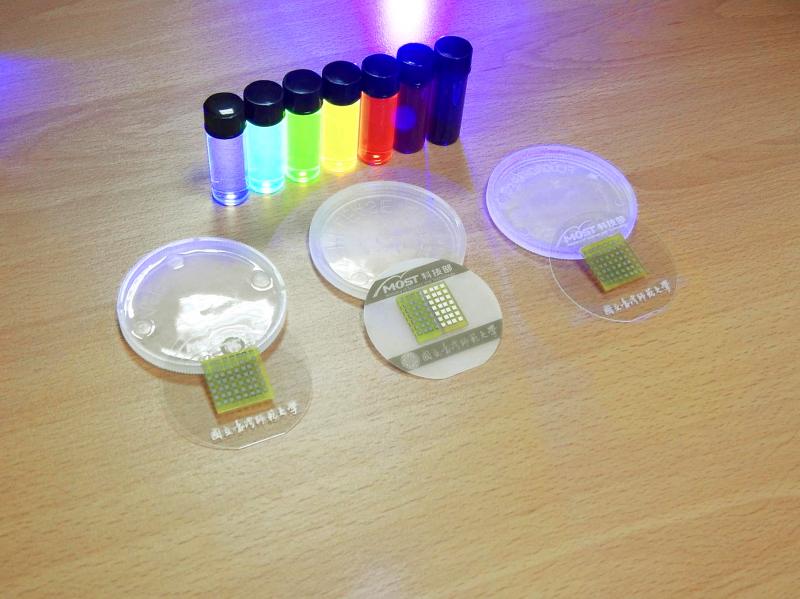
Photo courtesy of the Ministry of Science and Technology
Semiconductor researchers have combined RRAM and light-emitting diodes to develop light-emitting memory devices, but the fabrication process is more complicated due to the need to integrate various materials, he said.
To overcome the problem, Lee said his team turned to cesium lead bromide to develop perovskite quantum dots for a memory device.
Perovskite is a natural mineral that can be chemically synthesized and has been widely used in semiconductor manufacturing.
Using cesium lead bromide is one of the ways to synthesize perovskite, but some toxicity of lead has to be tolerated for the material to be stable, Lee said.
The team also used silver to make the device’s electrodes, he added.
When they applied different voltages to the device, the varieties of ions in the device changed, allowing it to store and read data electronically or optically, Lee said.
Through perovskite quantum dots of different sizes, the device emits different colors to indicate whether it is reading ones or zeros, he said.
The team’s findings were published in the journal Nature Communications in July.
The team’s technique might change the future of consumer electronics, given light transmits data faster than electronics, NTNU College of Technology and Engineering dean Kao Wen-chung (高文忠) said.
The research has expanded the use of perovskite and set a new example for the integration of electronics and photonics, said the Ministry of Science and Technology, which funded the project.

Taiwanese can file complaints with the Tourism Administration to report travel agencies if their activities caused termination of a person’s citizenship, Mainland Affairs Council Minister Chiu Chui-cheng (邱垂正) said yesterday, after a podcaster highlighted a case in which a person’s citizenship was canceled for receiving a single-use Chinese passport to enter Russia. The council is aware of incidents in which people who signed up through Chinese travel agencies for tours of Russia were told they could obtain Russian visas and fast-track border clearance, Chiu told reporters on the sidelines of an event in Taipei. However, the travel agencies actually applied

New measures aimed at making Taiwan more attractive to foreign professionals came into effect this month, the National Development Council said yesterday. Among the changes, international students at Taiwanese universities would be able to work in Taiwan without a work permit in the two years after they graduate, explainer materials provided by the council said. In addition, foreign nationals who graduated from one of the world’s top 200 universities within the past five years can also apply for a two-year open work permit. Previously, those graduates would have needed to apply for a work permit using point-based criteria or have a Taiwanese company

The Shilin District Prosecutors’ Office yesterday indicted two Taiwanese and issued a wanted notice for Pete Liu (劉作虎), founder of Shenzhen-based smartphone manufacturer OnePlus Technology Co (萬普拉斯科技), for allegedly contravening the Act Governing Relations Between the People of the Taiwan Area and the Mainland Area (臺灣地區與大陸地區人民關係條例) by poaching 70 engineers in Taiwan. Liu allegedly traveled to Taiwan at the end of 2014 and met with a Taiwanese man surnamed Lin (林) to discuss establishing a mobile software research and development (R&D) team in Taiwan, prosecutors said. Without approval from the government, Lin, following Liu’s instructions, recruited more than 70 software

Chinese spouse and influencer Guan Guan’s (關關) residency permit has been revoked for repeatedly posting pro-China videos that threaten national security, the National Immigration Agency confirmed today. Guan Guan has said many controversial statements in her videos posted to Douyin (抖音), including “the red flag will soon be painted all over Taiwan” and “Taiwan is an inseparable part of China,” and expressing hope for expedited reunification. The agency last year received multiple reports alleging that Guan Guan had advocated for armed reunification. After verifying the reports, the agency last month issued a notice requiring her to appear and explain her actions. Guan


 RSS
RSS