


A delegation of French senators is planning to visit Taiwan, the Ministry of Foreign Affairs confirmed on Monday, without providing any further details.
The ministry was responding to a report in French media that the delegation, to be led by French Senator Alain Richard, head of the French Senate’s Taiwan Friendship Group, would visit Taiwan from Oct. 4 to 11.
Other members of the delegation would include French senators Max Brisson and Andre Vallini, both vice presidents of the friendship group, as well as French Senator Olivier Cadic, the group’s secretary, French online media outlet La Lettre A reported.
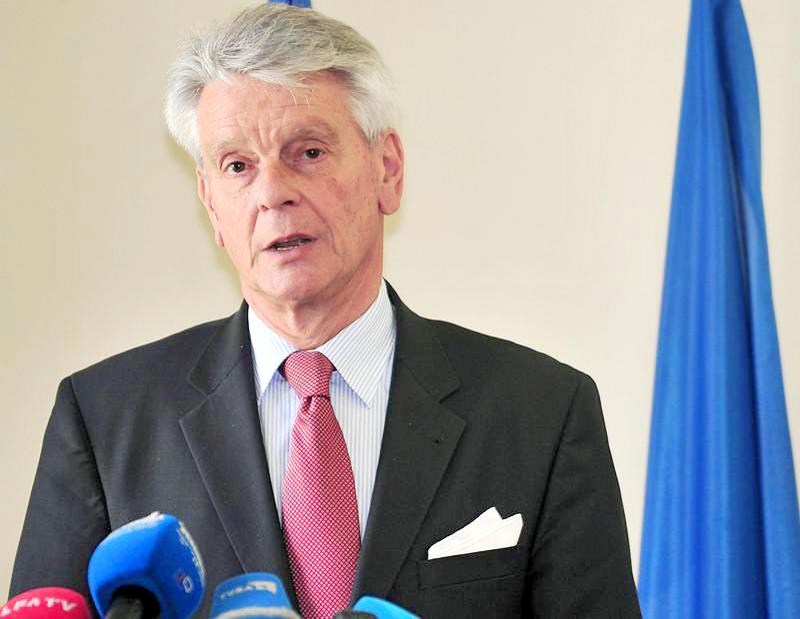
Photo: AFP
The ministry did not confirm the dates of the visit, saying only that it welcomed the visit, but that related details were still being planned.
Taiwan’s representative office in Paris is working closely with Richard to make the arrangements, the ministry said in a statement.
The visit would have to comply with COVID-19 prevention and quarantine measures, and take the latest pandemic situation into consideration, the ministry said, without elaborating.
Under disease prevention regulations, all arrivals from overseas are required to undergo 14 days of quarantine.
Richard had wanted to visit Taiwan as early as March.
China expressed opposition to that trip in February in a letter to Richard from Chinese Ambassador to France Lu Shaye (盧沙野), which Paris criticized as Chinese interference in its institutions.
Richard is a long-term supporter of Taiwan, and the former French minister of defense has previously visited the nation in 2015 and 2018.
A promoter of Taiwan-France exchanges, Richard is also the initiator of a resolution adopted by the French Senate in May in support of Taiwan’s international participation.
In an interview with the Central News Agency in late March, Richard said the main purpose of the visit would be to see how Taiwan has dealt with the COVID-19 pandemic and the economic strides it has made, as well as to discuss regional and global strategies.

The Centers for Disease Control (CDC) yesterday reported the first case of a new COVID-19 subvariant — BA.3.2 — in a 10-year-old Singaporean girl who had a fever upon arrival in Taiwan and tested positive for the disease. The girl left Taiwan on March 20 and the case did not have a direct impact on the local community, it said. The WHO added the BA.3.2 strain to its list of Variants Under Monitoring in December last year, but this was the first imported case of the COVID-19 variant in Taiwan, CDC Deputy Director-General Lin Ming-cheng (林明誠) said. The girl arrived in Taiwan on

South Korea is planning to revise its controversial electronic arrival card, a step Taiwanese officials said prompted them to hold off on planned retaliatory measures, a South Korean media report said yesterday. A Yonhap News Agency report said that the South Korean Ministry of Foreign Affairs is planning to remove the “previous departure place” and “next destination” fields from its e-arrival card system. The plan, reached after interagency consultations, is under review and aims to simplify entry procedures and align the electronic form with the paper version, a South Korean ministry official said. The fields — which appeared only on the electronic form

The Ministry of Foreign Affairs (MOFA) is suspending retaliation measures against South Korea that were set to take effect tomorrow, after Seoul said it is updating its e-arrival system, MOFA said today. The measures were to be a new round of retaliation after Taiwan on March 1 changed South Korea's designation on government-issued alien resident certificates held by South Korean nationals to "South Korea” from the "Republic of Korea," the country’s official name. The move came after months of protests to Seoul over its listing of Taiwan as "China (Taiwan)" in dropdown menus on its new online immigration entry system. MOFA last week

A bipartisan group of US senators has introduced a bill to enhance cooperation with Taiwan on drone development and to reduce reliance on supply chains linked to China. The proposed Blue Skies for Taiwan Act of 2026 was introduced by Republican US senators Ted Cruz and John Curtis, and Democratic US senators Jeff Merkley and Andy Kim. The legislation seeks to ease constraints on Taiwan-US cooperation in uncrewed aerial systems (UAS), including dependence on China-sourced components, limited access to capital and regulatory barriers under US export controls, a news release issued by Cruz on Wednesday said. The bill would establish a "Blue UAS


 RSS
RSS