


Stephen Bonner, an ace US fighter pilot and one of the last surviving members of the swashbuckling “Flying Tigers” who fought the Japanese for the Chinese Nationalist Party (KMT) during World War II, has died, friends and colleagues announced on Thursday.
He was 103.
The Flying Tigers, an assembly of US volunteer fighter pilots forming the Aviation Volunteer Group based in Kunming, China, operated out of what was then Burma in the early 1940s in support of Chiang Kai-shek (蔣介石) against the Japanese, conducting dangerous missions over Japanese-occupied China and shooting down hundreds of enemy bombers.
They initially operated as mercenaries with the tacit support of the US government, given Washington’s official neutrality toward imperial Japan before the attacks on Pearl Harbor in Hawaii in late 1941.
Serving under US Army lieutenant general Claire Chennault — who led the Republic of China (ROC) Air Force during the war before the KMT’s retreat to Taiwan in the Chinese Civil War — in 1943 and 1944, Bonner flew “five confirmed and five probable aerial victories, and additionally was credited with damaging two more fighters and bombers,” Sino-American Aviation Heritage Foundation chairman Jeff Green said.
“With his remarkable longevity, Steve would become the last living ‘Fighter Ace’ to have flown in China during the Second World War,” Green said, describing him as a “gallant soldier and a Christian gentleman.”
Later in life, Bonner became an advocate for the commemoration of the Flying Tigers’ legacy and US-China dialogue, founding the Sino-American Aviation Heritage Foundation and receiving the Congressional Gold Medal.
He also visited China with fellow veterans in 2005, where they were named honorary citizens of Kunming.
Public Television Service produced a documentary series on the Flying Tigers, which operated in the Chinese-Burma-India region — known as the CBI Theater — during World War II.
“The Flying Tigers squadron forms a very important chapter in Taiwan’s wartime history, where the Republic of China and the US air forces worked together with outstanding camaraderie, spirit and cooperative fellowship,” then-ROC Air Force chief of staff Liu Shou-jen (劉守仁) said when the series was first aired in 2014.
Additional reporting by staff writer


UPGRADE: The Kang Ding-class frigate is replacing its Chaparall missiles with Tien Chien II and Hua Yang VLS, which would provide it with long-range, 360° air defense Taiwan plans to produce 1,200 to 1,376 Hai Chien II missiles (海劍二, Sea Sword II) — also known as TC-2N — to serve as the standard air defense system of the navy’s surface combatant fleet, a source said yesterday. Last week, the Hai Chien II, the naval version of the Tien Kung II missile (天劍二, Sky Sword II), completed a live-fire test in waters off the National Chungshan Institute of Science and Technology’s Jiupeng facility (九鵬) in Pingtung County’s Manjhou Township (滿州). The MIM72 Chaparral and other dated air defense missiles that currently arm Taiwanese ships have inadequate range to combat Chinese

REASONS FOR TRAVEL: An assistant professor said that proposed amendments to penalize drivers if they used drugs overseas would not deter people from traveling People who operate a motor vehicle under the influence of marijuana would have their driver’s license revoked, even if they used the substance while overseas, the Ministry of Transportation and Communications said yesterday, citing proposed amendments to the Road Traffic Management and Penalty Act (道路交通管理處罰條例). The amendments would also authorize the government to revoke the licenses of people determined to have used Category 1 or Category 2 narcotics, even if they were not operating a vehicle while under the influence of drugs, as well as ban them from taking the license test for three years, the ministry said. People aged 18 or

Johanne Liou (劉喬安), a Taiwanese woman who shot to unwanted fame during the Sunflower movement protests in 2014, returned to Taiwan last night after being deported from the US. She is to stand trial in Taiwan for charges involving embezzlement, fraud and drug crimes. The Criminal Investigation Bureau (CIB) said it took her into custody at Taiwan Taoyuan International Airport and would first question her before transferring her to the New Taipei District Prosecutors’ Office. She was arrested upon disembarking a flight from San Francisco that landed shortly before 7pm. Liou absconded to the US in 2019 after jumping bail
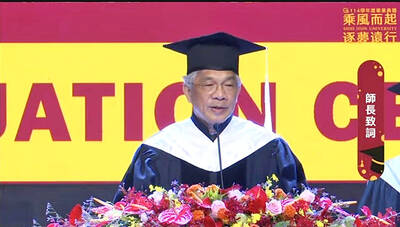
Shih Hsin University President Chen Ching-he (陳清河) yesterday issued a public apology for comments made in his commencement speech last week, stating that he has asked the school to suspend his duties and halt his wages for two months as a show of contrition. At the commencement ceremony on May 30, Chen said, “If you don’t manage your time well, or your own emotions, or your health, then I am telling every one of you — put a quick end to ‘you,’ because the world has no need for ‘you.’” The comments have sparked significant controversy online, and Chen through an open


 RSS
RSS